You walked into class. The teacher asked a question. You knew the answer — but the words just wouldn’t come. Sound familiar? Most students don’t struggle with understanding. They struggle with saying.
This guide gives you 200+ classroom sentences in English, organized by situation, with tips on when and how to use each one. Whether you’re an ESL learner or just want to sound more confident, these sentences will help you speak up — every single day.
⭐ Key Takeaways: Best Sentences to Start With Today
Use these right away — no waiting:
- “Could you please repeat that?”
- “I understand the first part, but I’m confused about step two.”
- “May I come in, sir/ma’am?”
- “Can I go to the washroom, please?”
- “I have a question about this topic.”
- “I’m not sure I got that — could you explain it differently?”
- “May I borrow a pen, please?”
- “I think the answer is X, but I’m not completely sure.”
- “Can we go over this part again?”
- “I’d like to add something to what my classmate said.”
Basic vs. Better: Upgrade Your Classroom English
Most students use very basic sentences. Here’s how to upgrade them without sounding unnatural.
| Basic Sentence | Better Version | When to Use |
| I don’t understand. | I understand the first part, but I’m lost after that. | When you’re partially confused |
| Can you repeat? | Could you please say that one more time? | Politely asking teacher to repeat |
| I don’t know. | I’m not sure right now — can I have a moment to think? | Buying time without shutting down |
| I’m late. | I’m sorry for being late — may I come in? | Entering class after it starts |
| I need help. | Could you help me with this specific part, please? | Asking for targeted help |
| I’m done. | I’ve finished — may I review my answers? | After completing a task |
| I can’t hear you. | Sorry, I couldn’t hear clearly. Could you speak a bit louder? | When sound is low |
| Tell me again. | Could you go over that example one more time? | Asking for clarification |
| I want to answer. | May I answer this question, please? | Before speaking up |
| I disagree. | I see it differently — may I share my view? | Respectful disagreement |
Introduction Classroom Sentences for Students
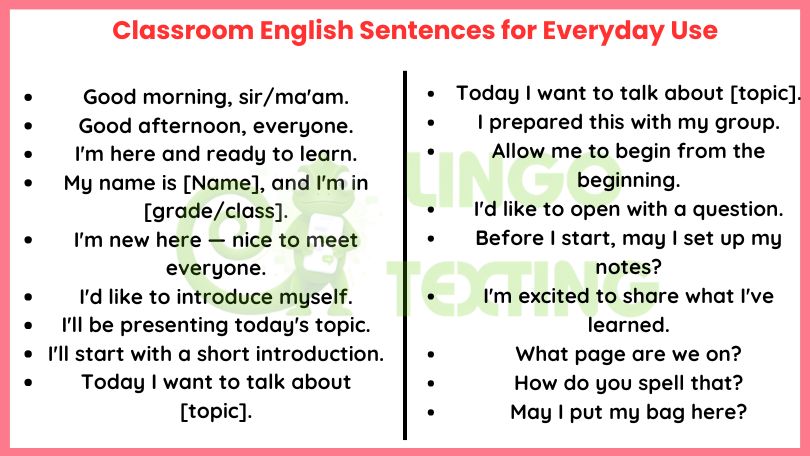
These daily use sentences in the classroom help you open conversations, introduce yourself, or launch a presentation.
- Good morning, sir/ma’am.
- Good afternoon, everyone.
- I’m here and ready to learn.
- My name is [Name], and I’m in [grade/class].
- I’m new here — nice to meet everyone.
- I’d like to introduce myself.
- I’ll be presenting today’s topic.
- I’ll start with a short introduction.
- Today I want to talk about [topic].
- I prepared this with my group.
- Allow me to begin from the beginning.
- I’d like to open with a question.
- Before I start, may I set up my notes?
- I’m excited to share what I’ve learned.
- This is my first time presenting — please bear with me.
When to use these: At the start of class, when presenting a project, or when meeting a new teacher or classmate for the first time.
Asking Questions Politely Classroom Sentences for Students
In my experience as a tutor, students who ask questions clearly get better help — faster. Here are the sentences that actually work.
Asking the Teacher
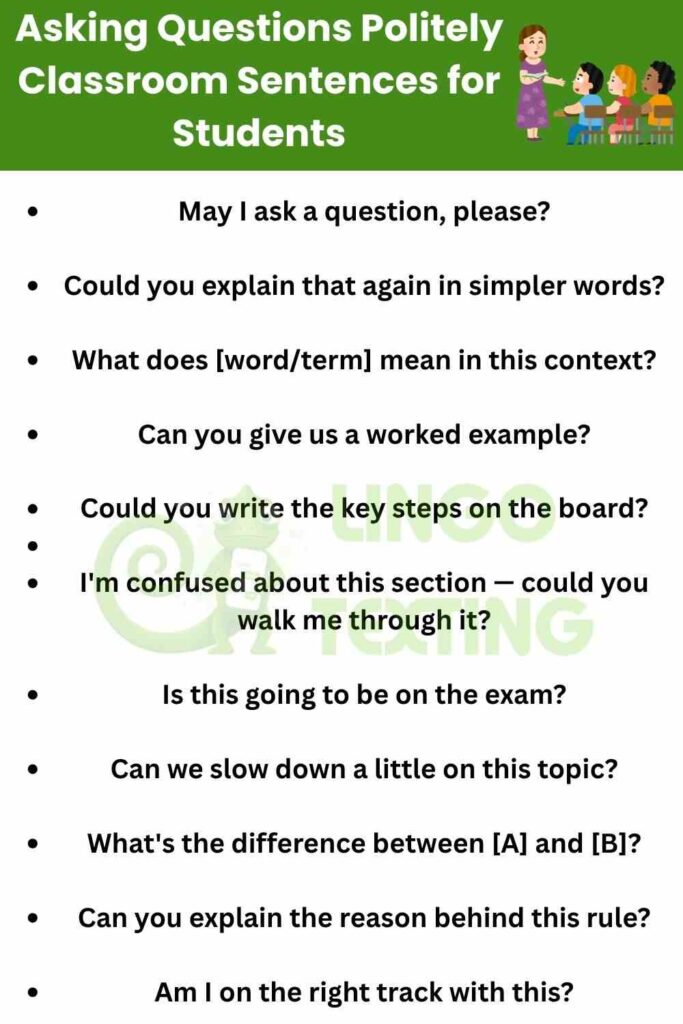
- May I ask a question, please?
- Could you explain that again in simpler words?
- What does [word/term] mean in this context?
- Can you give us a worked example?
- Could you write the key steps on the board?
- I’m confused about this section — could you walk me through it?
- Is this going to be on the exam?
- Can we slow down a little on this topic?
- What’s the difference between [A] and [B]?
- Can you explain the reason behind this rule?
- Am I on the right track with this?
- Could you check my answer, please?
- How do you spell that?
- Am I pronouncing this correctly?
- Could you give me one more example before we move on?
Asking a Classmate
- Did you understand what the teacher just explained?
- How did you get to this answer?
- Can we work through this together?
- What page are we on?
- Did the teacher give us homework?
- I think there might be a small mistake here — want to check?
- Can I look at your notes for a minute?
- What did we miss in this section?
- Can you explain this part to me?
- Should we divide this task between us?
Tone tip: Always use could and may instead of can when talking to a teacher. It sounds more respectful — and teachers notice the difference.
Daily Use Classroom Sentences for Students
These are the sentences you’ll use almost every morning before a lesson begins.
- Are we starting on time today?
- I forgot my book — may I share with a classmate?
- Is today’s class online or in person?
- I have a doubt from yesterday’s lesson I’d like to clear up.
- Should I sit in my usual seat?
- May I put my bag here?
- Can I open the window? It’s a bit warm in here.
- Are we having a test today?
- What are we studying today?
- Is there anything I should have prepared?
During the Lesson Classroom Sentences for Students
These sentences keep you involved without disrupting the class.
- Sorry, I missed the last part — could you say it again?
- Is this the right method to solve this?
- I think I have the answer — may I share it?
- Can we take a short break?
- My pen stopped working — may I get another one?
- Can I use my dictionary for this?
- Should I write this down in my notebook?
- How much time do we have for this activity?
- Should we work alone or in pairs for this?
- Do I need to submit this today?
- Can I redo this question?
- I finished early — what should I do next?
- May I help my classmate while I wait?
- I think I made a mistake — can I correct it?
- Could you check whether I understood this correctly?
End of Class — Wrapping Up Politely
- What’s our homework for today?
- When is this assignment due?
- Will you check our notebooks next class?
- Can I ask one quick question before you leave?
- What topic are we starting next time?
- May I stay back for a minute?
- I’ll work on this tonight and come prepared.
- See you next class, sir/ma’am.
- Have a good day!
- Thank you for today’s lesson.
Asking Permission Classroom Sentences for Students
Classroom etiquette matters. Here’s how to ask permission without sounding awkward.
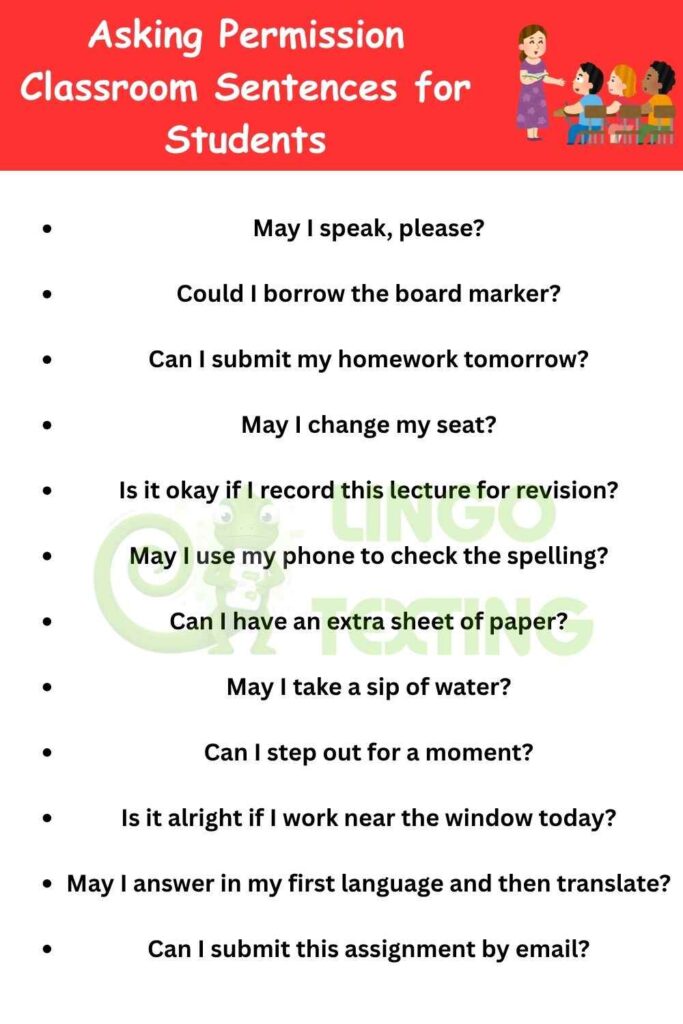
- May I speak, please?
- Could I borrow the board marker?
- Can I submit my homework tomorrow?
- May I change my seat?
- Is it okay if I record this lecture for revision?
- May I use my phone to check the spelling?
- Can I have an extra sheet of paper?
- May I take a sip of water?
- Can I step out for a moment?
- Is it alright if I work near the window today?
- May I answer in my first language and then translate?
- Can I submit this assignment by email?
- May I work with a different partner today?
- Is it okay if I draw a diagram instead of writing?
- Can I ask a question during your explanation or should I wait?
Sentences Used in Classroom by Teacher — Know These Too
Understanding what your teacher says helps you respond faster and look more engaged.
- Open your textbooks to page [number].
- Please pay attention.
- Who can answer this question?
- Work in pairs for this activity.
- You have ten minutes to finish.
- Submit your papers before leaving.
- Raise your hand if you need help.
- Please keep quiet.
- You may begin now.
- Read the passage carefully before answering.
- Let’s review yesterday’s homework.
- Any questions so far?
- Great effort — that was correct.
- Try again — you’re very close.
- I want everyone to participate today.
Why this matters: When you recognize these sentences quickly, you react correctly without confusion. That alone builds confidence in classroom communication.
Polite and Respectful Classroom Sentences for Students
Student confidence isn’t just about knowing answers — it’s about how you carry yourself.
- I appreciate your help on this, sir/ma’am.
- That was a really clear explanation — thank you.
- Excuse me, I have a small question.
- I’m sorry — I lost focus for a moment. Could you repeat that?
- Please go ahead — I was mistaken.
- You’re right, I misunderstood the question.
- I respect your point, but I see it a little differently.
- I’m sorry for interrupting.
- Could you please give me a minute to think through this?
- I’m willing to redo this task.
- I’ll work harder on this topic.
- I understand the correction — I’ll fix it.
- That’s a fair point — I hadn’t thought of it that way.
- I’m sorry for not submitting on time — it won’t happen again.
- I’d like to clarify something I said earlier.
Group Work and Sentences for Students
Many students go completely silent during group activities. These sentences fix that.
- Let me share my idea first, then hear yours.
- What do you think about this approach?
- Can we agree on this point before moving on?
- I think we should go with option B — here’s why.
- Who wants to present for our group?
- Let’s divide the work equally so no one is overloaded.
- I’ll handle the introduction — who wants the conclusion?
- That’s a strong idea — let’s include it.
- I’m not fully sure about that point — let’s verify it first.
- We’re running short on time — let’s stay focused.
- Can we combine both ideas into one argument?
- I’ll write while you speak — that way we cover more ground.
- Does everyone agree with this before we submit?
- Let me summarize what we’ve discussed so far.
- We need one more supporting point — any suggestions?
Sentences for ESL Learners — Classroom English Made Accessible
Many students I’ve worked with are learning English as a second language. These are the sentences they need most.
- I’m still learning English — please speak a little slowly.
- Could you use simpler words for this explanation?
- I know the answer but I’m struggling to say it in English right now.
- Can I write my answer instead of saying it aloud?
- Is it okay if I translate this word in my head first?
- I understand the concept, but explaining it in English is difficult for me.
- What’s the English word for [native language word]?
- Is this sentence grammatically correct?
- Can I look at a sample sentence before I try?
- I need a moment to organize my thoughts in English.
Presentation Classroom Sentences for Students in English
Presenting in front of the class is nerve-wracking. These sentences make it smoother.
- Good morning, everyone. I’ll be presenting on [topic].
- I’ve divided my presentation into three parts.
- Let me begin with some background on this topic.
- As you can see on the board / slide…
- This brings me to my next point.
- I’d like to pause here — does anyone have a question?
- Let me give you a quick real-life example.
- To put it in simple terms…
- This part was personally the most interesting for me.
- To wrap up…
- Thank you all for listening.
- I’m happy to take questions now.
- That’s everything from my side.
- I hope that was easy to follow.
- Please feel free to ask if anything was unclear.
Exam and Test Situations
- May I get an extra answer sheet?
- I didn’t hear the instructions clearly — could you repeat them?
- Can I use a ruler or calculator for this section?
- I think there’s a printing error on question [number].
- How much time is left?
- Can I write on the question paper itself?
- Should I write in pen or pencil?
- May I ask for a clarification on this question’s wording?
- I finished — should I review my answers or submit?
- May I use the washroom during the exam?
Online Class Sentences
- Can you hear me clearly?
- My microphone isn’t working — give me a second to fix it.
- I’m having a connection issue.
- Could you repeat that? I think I froze for a moment.
- Am I visible on camera?
- I’ll type my answer in the chat box.
- Can you share your screen again, please?
- I got disconnected — what did I miss?
- Could you slow down? I’m taking notes.
- Is today’s class being recorded?
Confidence-Building Classroom Sentences for Students
Most students I’ve tutored needed these more than any grammar rule.
- I can do this.
- It’s okay to make mistakes in class — that’s how I learn.
- I’ll ask when I’m confused instead of staying quiet.
- One question at a time.
- I’m here to learn, not to be perfect.
- I’m allowed to take my time before answering.
- I’ll speak up today — just once.
- Every correct answer started as a guess.
- I’ll try even if I’m not sure.
- Progress is more important than perfection.
Classroom Sentences for Primary School Students
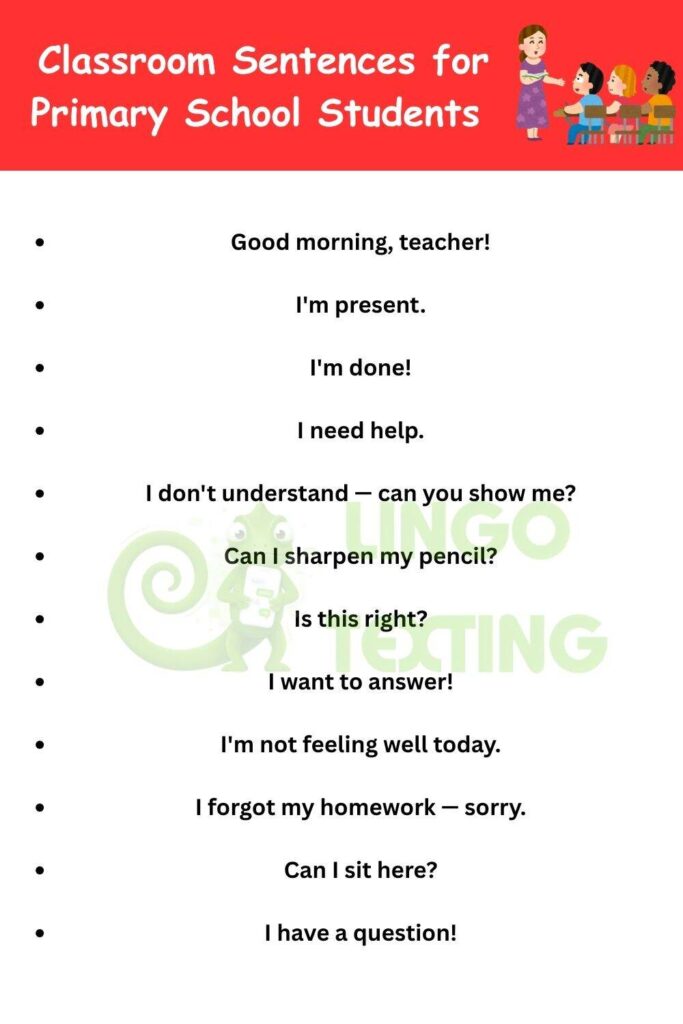
These are classroom sentences in English made for young learners. Short, direct, and easy to say.
- Good morning, teacher!
- I’m present.
- I’m done!
- I need help.
- I don’t understand — can you show me?
- Can I sharpen my pencil?
- Is this right?
- I want to answer!
- I’m not feeling well today.
- I forgot my homework — sorry.
- Can I sit here?
- I have a question!
- Can I have some water?
- I’m scared to answer — but I’ll try.
- Thank you, teacher!
Real Classroom Scenarios — What to Say and When
This is where most articles fall short. Here are real situations with exact sentences to use.
Scenario 1: You’re Confused Mid-Lesson
You followed the first half. Then you lost track.
❌ Don’t say: “I don’t understand.”
✅ Try this: “I followed up to the second step, but I got confused when you moved to the third. Could you explain that transition?”
This tells the teacher exactly where you’re lost. They can fix it in seconds.
Scenario 2: Your Classmate’s Answer Seems Wrong
❌ Don’t say: “That’s wrong.”
✅ Try this: “I got a different answer — could I share mine so we can compare?”
This keeps the classroom respectful while still participating actively.
Scenario 3: You’re Too Nervous to Speak
One student I worked with knew every answer but froze when called upon. What helped her was starting with just one tiny sentence: “I agree with that.”
That single sentence built a habit. Then came “I’d like to add one point.” Then full answers. Start small. It works every time.
Scenario 4: You Don’t Know the Answer
❌ Don’t say: “I don’t know” and look away.
✅ Try this: “I need to think through this a bit more — may I come back to it?”
This shows engagement. Teachers reward engagement far more than just correct answers.
Scenario 5: You Made a Mistake During a Presentation
❌ Don’t freeze or apologize repeatedly.
✅ Try this: “Let me correct that — what I meant to say was…”
Move on calmly. Confidence after a mistake impresses audiences more than never making one.
Pro Tips — Classroom English Done Right
Tip 1: Use “could” instead of “can” with teachers. “Could you explain this?” sounds more respectful than “Can you explain this?” Small word. Real difference.
Tip 2: Always acknowledge before interrupting. “Excuse me, sorry to interrupt — I have a quick question.” This one sentence changes how teachers perceive you.
Tip 3: Never say “I don’t understand” alone. Always name the specific part: “I don’t understand how step three connects to step four.” Now your teacher knows exactly where to help.
Tip 4: Start with agreement when nervous. “I agree with what [name] said, and I’d like to add…” — this gets you talking without the pressure of starting from scratch.
Tip 5: Learn five new sentences per week. Don’t try to memorize all 200+ at once. Five per week, practiced out loud at home, used once in real class. Over a month: 20 fully natural sentences in your speaking memory.
How to Remember These Sentences
Reading them once isn’t enough. You need to use them.
Flashcard method: Situation on one side, sentence on the other. Review every morning before school.
Mirror practice: Stand in front of a mirror. Pretend you’re in class. Say the sentence out loud — with full expression. Feels odd. Works brilliantly.
Roleplay with a friend: One plays teacher, one plays student. Switch. This is the fastest way to build comfort with classroom spoken English.
One sentence per day: Each morning, pick one sentence from this list. Use it once in class that day. Do this for 30 days and your classroom confidence will feel completely different.
Sticky note trick: Write 3 sentences on a sticky note inside your notebook cover. Glance before each class. Replace weekly with 3 new ones.
Common Mistakes Students Make — and How to Fix Them
Mistake 1: Going silent when confused. Fix: “Could you give me a moment to think?” — buys time without shutting down.
Mistake 2: Using informal language with teachers. Fix: Replace “yeah” with “yes, sir/ma’am” and “what?” with “I beg your pardon?”
Mistake 3: Starting every request with “I want…” Fix: Rotate between “May I…”, “Could I…”, “I’d like to…”, “Would it be alright if I…”
Mistake 4: Giving up mid-sentence. Fix: Have a rescue sentence ready: “Let me rephrase that…”
Mistake 5: Only speaking when forced. Fix: Set one goal — participate once per class voluntarily. That single habit changes everything over a semester.
FAQ — Classroom Sentences for Students
Q1: What are the most important classroom sentences for students in English?
The most used ones cover four situations: asking permission, asking for help, requesting repetition, and daily greetings. Master these and you’ll handle 80% of classroom moments with confidence.
Q2: What are simple classroom sentences for primary students?
Young learners need short, direct sentences: “I’m done,” “I need help,” “Is this right?” and “I have a question!” — all easy to say and understand.
Q3: How can ESL learners build confidence in classroom English?
Start with five sentences per week. Practice at home. Use each one once in real class. Confidence in classroom communication builds slowly — but it absolutely does build. Repetition and real-life use are the only shortcuts.
Q4: What sentences do teachers commonly use that students should recognize?
The most frequent ones include: “Open your textbooks to page X,” “Raise your hand,” “Work in pairs,” and “Submit your work before leaving.” Recognizing these instantly helps you respond without hesitation.
Q5: How do I sound polite without sounding overly formal?
Use “could” and “may” for requests. Add “please” naturally at the end. Say “excuse me” before interrupting. These three habits alone will shift how your teacher and classmates experience you.
Q6: What should I say when I genuinely don’t know the answer?
Try: “I’m working through this — may I share what I have so far?” or “I’d like to come back to this one after thinking it through.” Both show engagement, and engagement is what teachers actually reward.
Conclusion
Classroom confidence isn’t something you’re born with. It’s something you build — one sentence at a time. You don’t need to be the smartest student in the room to speak up well. You just need the right words at the right moment.
Start today. Pick one sentence from this list. Use it in your very next class. That’s how it begins — and it grows from there.

I write clear, practical English lessons for everyday use. On Lingotexting, I break down grammar, vocabulary, and word types into simple ideas you can apply quickly. My focus is accuracy, real examples, and helpful visuals, so learners build confidence, improve writing, and communicate naturally in school, work, and daily life.