
Learning Collective Noun Sentences is one of the easiest ways to make your English sound more natural. Instead of listing many people, animals, or things, collective nouns let you describe a whole group with a single word. They appear in conversations, books, classrooms, workplaces, and everyday writing.
This guide brings together practical examples, simple explanations, and real-life uses of collective nouns. Whether you are a student, teacher, parent, or English learner, these Collective Noun Sentences will help you build stronger vocabulary and write with greater clarity and confidence.
What Is a Collective Noun?
A collective noun names a group as a single unit.
- A flock of birds flew over the lake.
- A team of doctors saved his life.
- A herd of cattle crossed the field.
One word. Whole group. Simple.
The One Grammar Rule Worth Knowing
Collective nouns take a singular verb in most cases — especially in American English.
- ✔ The team is ready.
- ✔ The class starts at nine.
- ✔ The committee has decided.
The word “team” looks like it refers to many people, but grammatically it’s treated as one unit.
Common Collective Nouns at a Glance
| Collective Noun | Used For | Quick Example |
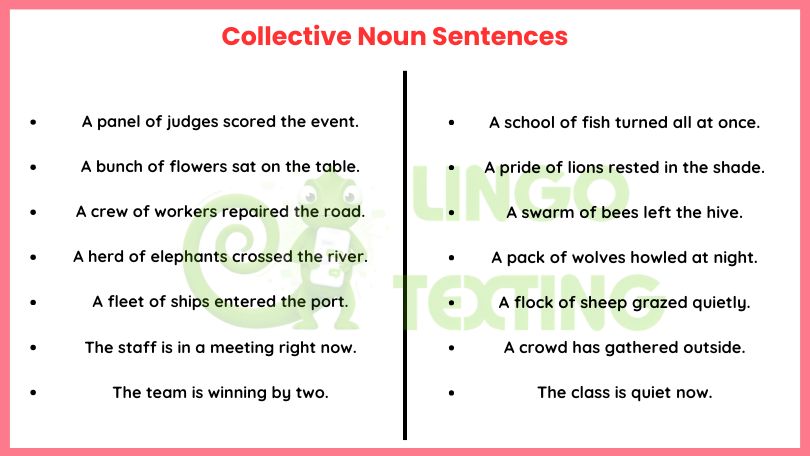
| Flock | Birds, sheep | A flock of sheep grazed quietly. |
| Pack | Wolves, dogs | A pack of wolves howled at night. |
| Swarm | Bees, insects | A swarm of bees left the hive. |
| Pride | Lions | A pride of lions rested in the shade. |
| School | Fish | A school of fish turned all at once. |
| Fleet | Ships, vehicles | A fleet of ships entered the port. |
| Herd | Cattle, elephants | A herd of elephants crossed the river. |
| Crew | Workers, sailors | A crew of workers repaired the road. |
| Bunch | Grapes, flowers | A bunch of flowers sat on the table. |
| Panel | Judges, experts | A panel of judges scored the event. |
People & Professions Collective Noun Sentences
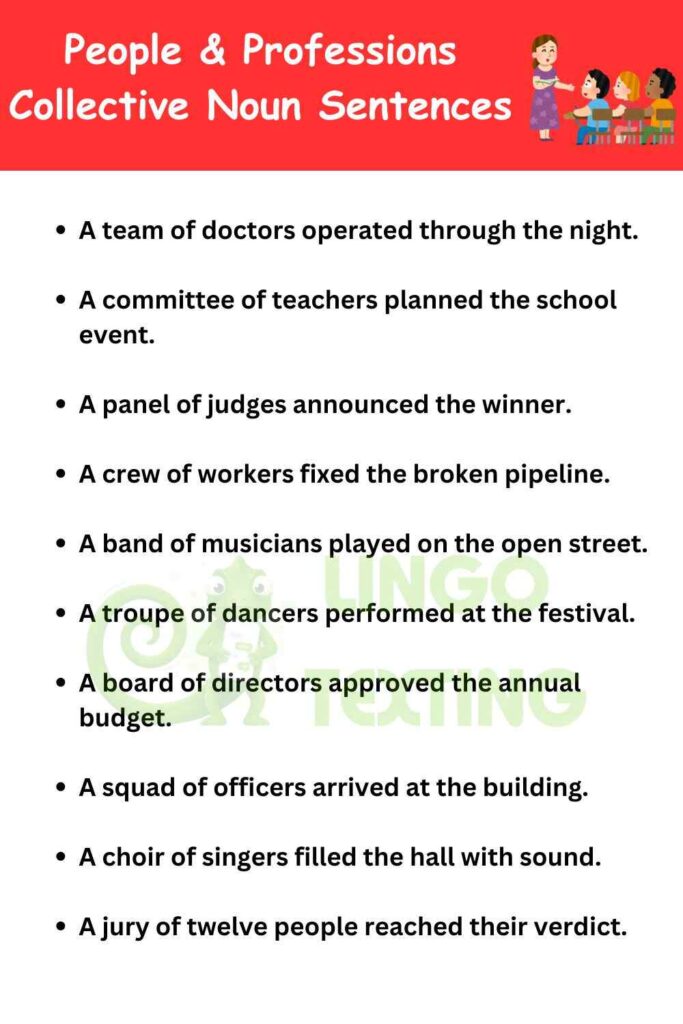
- A team of doctors operated through the night.
- A committee of teachers planned the school event.
- A panel of judges announced the winner.
- A crew of workers fixed the broken pipeline.
- A band of musicians played on the open street.
- A troupe of dancers performed at the festival.
- A board of directors approved the annual budget.
- A squad of officers arrived at the building.
- A choir of singers filled the hall with sound.
- A jury of twelve people reached their verdict.
- A mob of protesters gathered near the gate.
- A cast of actors rehearsed before the opening night.
- A delegation of officials flew into the capital.
- A congregation of worshippers sat in silence.
- A gang of robbers was arrested near the market.
- A staff of fifty handled customer calls all day.
- A faculty of professors attended the annual conference.
- A party of hikers reached the summit by noon.
- A group of engineers redesigned the faulty system.
- A team of lawyers prepared the defense case.
- A crowd of shoppers filled every aisle on the weekend.
- A troop of scouts camped near the river bend.
- A battalion of soldiers stood in formation at dawn.
- A panel of doctors reviewed the patient’s test results.
- A company of actors traveled across the country performing.
Wild Animals Collective Noun Sentences
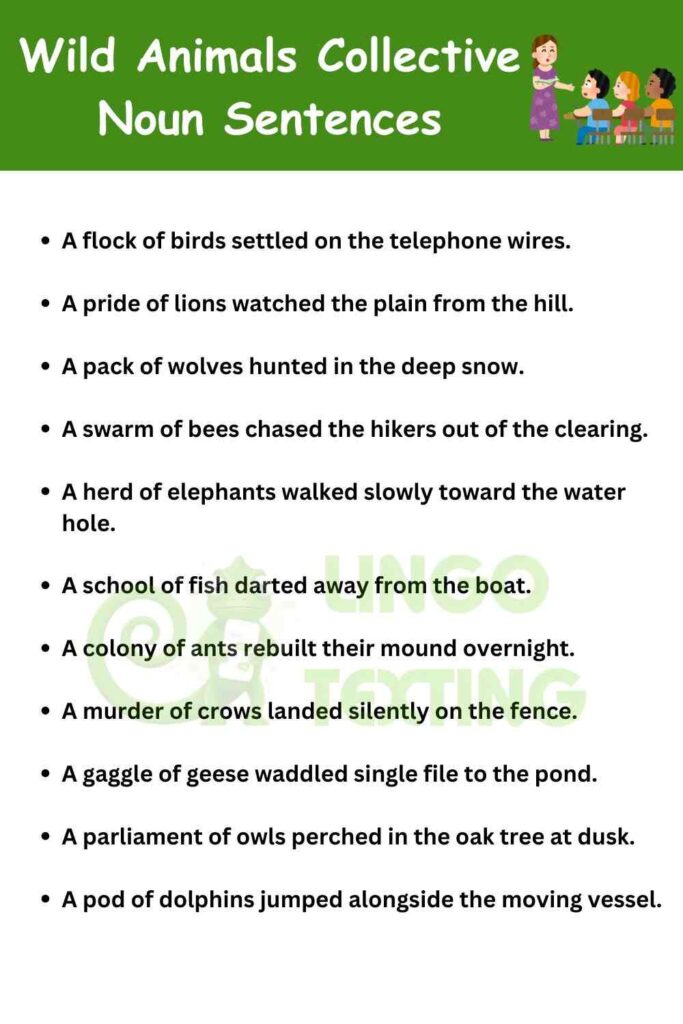
- A flock of birds settled on the telephone wires.
- A pride of lions watched the plain from the hill.
- A pack of wolves hunted in the deep snow.
- A swarm of bees chased the hikers out of the clearing.
- A herd of elephants walked slowly toward the water hole.
- A school of fish darted away from the boat.
- A colony of ants rebuilt their mound overnight.
- A murder of crows landed silently on the fence.
- A gaggle of geese waddled single file to the pond.
- A parliament of owls perched in the oak tree at dusk.
- A pod of dolphins jumped alongside the moving vessel.
- A troop of monkeys leaped from tree to tree.
- A flutter of butterflies appeared across the meadow.
- A bloat of hippos barely stirred in the afternoon heat.
- A crash of rhinos charged across the open grassland.
- A tower of giraffes moved through the tall acacia trees.
- A plague of locusts stripped the farmland in hours.
- A raft of otters floated calmly on the river surface.
- A conspiracy of lemurs watched from behind the tree trunks.
- A flamboyance of flamingos waded in the pink salt lake.
- A shrewdness of apes solved the food puzzle quickly.
- A pandemonium of parrots screamed before the rain arrived.
- A business of ferrets explored every hole in the barn.
- A prickle of porcupines moved single file down the path.
- A sleuth of bears searched the riverbank for salmon.
Farm & Domestic Animals Collective Noun Sentences
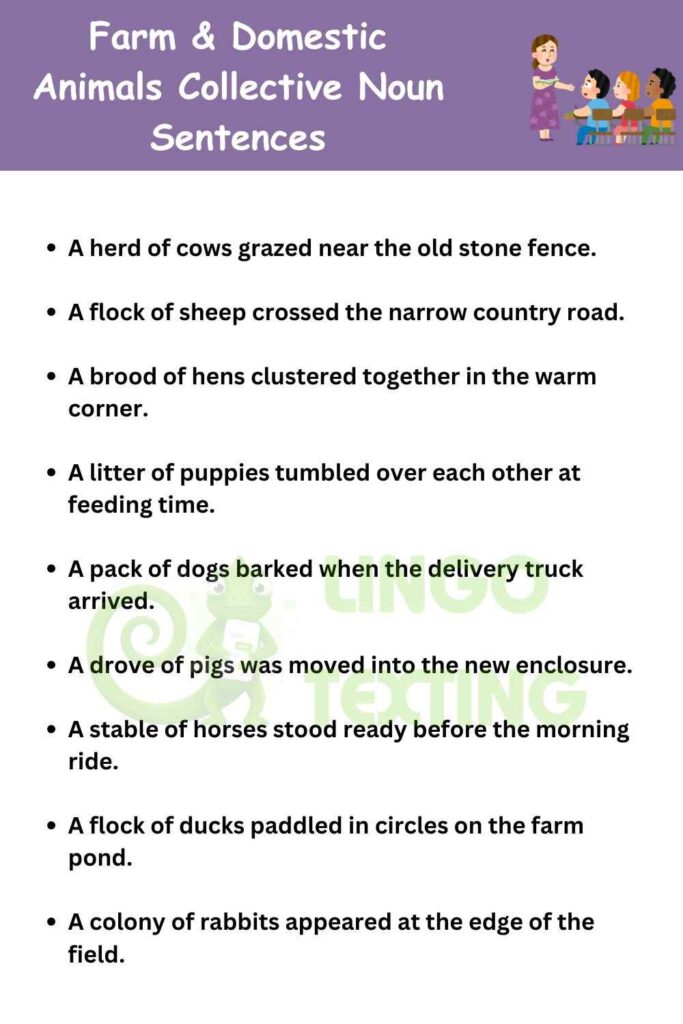
- A herd of cows grazed near the old stone fence.
- A flock of sheep crossed the narrow country road.
- A brood of hens clustered together in the warm corner.
- A litter of puppies tumbled over each other at feeding time.
- A pack of dogs barked when the delivery truck arrived.
- A drove of pigs was moved into the new enclosure.
- A stable of horses stood ready before the morning ride.
- A flock of ducks paddled in circles on the farm pond.
- A colony of rabbits appeared at the edge of the field.
- A team of oxen pulled the loaded cart up the slope.
Nature & Objects Collective Noun Sentences
- A bunch of grapes hung heavy from the vine.
- A bouquet of roses sat in the glass vase.
- A pile of books covered the corner of the desk.
- A stack of papers slid off the office shelf.
- A cluster of stars appeared as the clouds cleared.
- A range of mountains stretched toward the evening sky.
- A bundle of firewood was stacked beside the cabin door.
- A set of keys rattled in her coat pocket.
- A batch of fresh bread came out of the oven at six.
- A row of trees lined both sides of the old road.
- A chain of islands appeared on the ancient map.
- A bank of clouds moved in from the west by afternoon.
- A string of lights hung above the night market stalls.
- A collection of stamps filled the three brown albums.
- A series of paintings covered the entire gallery wall.
School & Classroom Collective Noun Sentences
- The class sat still while the teacher wrote on the board.
- A group of students stayed after school for extra help.
- A panel of teachers judged the debate competition.
- The choir rehearsed the national anthem for twenty minutes.
- A committee of parents met with the principal on Friday.
- A cluster of students crowded around the results board.
- A set of pencils was shared between the four lab partners.
- The audience rose to its feet when the curtain dropped.
- A squad of players warmed up on the school ground.
- A bundle of assignments sat unchecked on the teacher’s desk.
- A library of reference books lined the back wall.
- A batch of exam papers was sorted before the bell rang.
- A row of chairs was arranged for the morning assembly.
- A team of volunteers decorated the hall for the event.
- A group of parents watched the annual sports day quietly.
Work & Office Collective Noun Sentences
- The board reviewed last quarter’s report in the morning.
- A team of developers released the software update overnight.
- A crew of cleaners finished the offices before seven.
- A panel of interviewers called the first candidate in.
- A group of managers flew to the regional headquarters.
- A fleet of delivery vans left the warehouse at sunrise.
- The committee voted on the revised company policy.
- A chain of stores expanded into three new cities.
- A swarm of journalists gathered outside the press briefing.
- A pool of candidates applied for the open position.
Home & Family Collective Noun Sentences
- The family sat together for dinner without their phones.
- A bunch of friends arrived unannounced on her birthday.
- A pile of laundry waited in the bedroom corner.
- A set of dishes was arranged carefully on the shelf.
- A collection of photographs covered the living room wall.
- A bundle of letters arrived from overseas last Tuesday.
- A batch of cookies was cooling on the kitchen counter.
- A litter of kittens was born in the storage room.
- A team of movers carried the furniture up three flights.
- A crowd formed at the gate when the food truck parked outside.
Travel & Outdoors Collective Noun Sentences
- A fleet of buses waited at the central station.
- A caravan of camels crossed the desert before dawn.
- A convoy of jeeps moved through the mountain pass.
- A flotilla of small boats crossed the bay at daybreak.
- A band of travelers camped near the river mouth.
- A flock of pigeons burst from the old square rooftops.
- A gaggle of children chased each other around the fountain.
- A parade of floats moved slowly past the main street crowd.
- A swarm of cyclists raced through the narrow stone lanes.
- A herd of tourists followed the local guide through the ruins.
Sports Collective Noun Sentences
- A team of eleven players jogged onto the pitch together.
- The squad trained twice a day before the final match.
- A pack of runners surged forward at the starting gun.
- A crowd of fans erupted when the ball hit the net.
- A panel of referees reviewed the incident on camera.
- A lineup of athletes waited near the starting blocks.
- A fleet of swimmers took their positions along the pool edge.
- A group of coaches debated the second-half strategy.
- The bench of substitutes watched the clock tick down.
- A team of officials managed the event without any issues.
Food & Market Collective Noun Sentences
- A bunch of bananas was placed at the front of the stall.
- A basket of vegetables arrived fresh from the farm.
- A string of sausages hung on the hook above the counter.
- A tray of pastries was set out just before opening.
- A box of chocolates sat half-opened on the side table.
- A pile of mangoes ripened quickly in the afternoon sun.
- A selection of cheeses was laid out for the guests.
- A cluster of grapes was sold by the kilo at the market.
- A jar of olives was passed around at the dinner table.
- A batch of samosas was fried fresh for the afternoon crowd.
Advanced & Rare Collective Nouns
These are real English terms — many dating back centuries — and they’re popular in creative writing.
- A murder of crows sat watching from the old chimney top.
- A parliament of owls called out through the cold forest.
- A crash of rhinos scattered every animal near the watering hole.
- A flamboyance of flamingos reflected pink across the shallow lake.
- A conspiracy of lemurs crept silently through the undergrowth.
- A tower of giraffes browsed the tallest branches unhurried.
- A raft of otters held hands so the current wouldn’t separate them.
- A shrewdness of apes figured out the lock within minutes.
- A bloat of hippos surfaced slowly as the boat passed by.
- A pandemonium of parrots woke the entire village before sunrise.
- A prickle of porcupines passed quietly through the campsite.
- A sleuth of bears moved along the riverbank without a sound.
- A business of ferrets squeezed through every gap in the fence.
- A flutter of butterflies lifted from the field all at once.
- A plague of locusts moved through the valley like a dark cloud.
Abstract & Figurative Uses
Collective noun patterns also appear with ideas, feelings, and events — especially in writing and journalism.
- A wave of panic spread through the waiting room.
- A flood of memories returned when she heard that old song.
- A barrage of questions followed the official’s statement.
- A rush of emotions hit him as he stepped inside his childhood home.
- A string of bad luck followed the team through the entire season.
- A web of lies slowly unraveled during the investigation.
- A tide of complaints reached the company after the update.
- A storm of criticism fell on the decision within hours.
- A sea of debt surrounded the business from its first year.
- A cluster of problems appeared the morning before launch.
- A wealth of experience sat in that single boardroom.
- A body of evidence pointed toward the same conclusion.
- A fog of confusion settled after the contradictory reports.
- A nest of complications delayed the project by two weeks.
- A river of traffic stretched back four kilometers from the junction.
Short Conversational Collective Noun Sentences
Natural, spoken English — the kind used in real daily life.
- The class is quiet now.
- A crowd has gathered outside.
- The team is winning by two.
- The staff is in a meeting right now.
- A pack of stray dogs roams this street every evening.
- The audience is still standing.
- A bunch of kids are playing in the park.
- The crew finished the job well before lunch.
- A flock of sparrows lands on our roof every morning.
- The committee meets on the first Monday of each month.
- A cluster of shops opened along the new road.
- The squad was exhausted after three games in one week.
- A swarm of tourists arrived just before the museum closed.
- A fleet of ambulances waited outside the stadium entrance.
- The family decided to spend the break at the coast.
- A batch of results was released two days early.
- A collection of vintage cars filled the entire exhibition hall.
- The board approved the project with a single condition.
- A bunch of grapes was left on the kitchen counter overnight.
- The herd moved as one when the predator appeared.
Mixed & Memorable
- A galaxy of stars stretched across the mountain sky.
- A forest of masts appeared as the sailing fleet came into port.
- A nest of thieves was discovered in the abandoned warehouse.
- A glut of fruit sat unsold at the close of market day.
- A pool of sunlight lay across the wooden floor each morning.
- A chain of events led to the company’s unexpected success.
- A pack of reporters waited at the exit after the hearing.
- A string of victories rebuilt the team’s confidence entirely.
- A fog of rumor spread through the office before any announcement.
- A sea of faces stared up at the speaker from the auditorium floor.
- A wealth of detail was packed into the final report.
- A battalion of ants carried crumbs twice their own size.
- A stream of visitors passed through the gallery all afternoon.
- A clutch of eggs sat carefully arranged in the bird’s nest.
- A chorus of complaints rose when the price increase was announced.
Why Collective Nouns Matter in Real Writing
They do three things well:
They cut length. “A large group of people who came to watch” becomes “an audience.” One word does the work of ten.
They add character. “A murder of crows” carries an atmosphere that “several crows” never could. Word choice shapes tone.
They signal fluency. Native speakers and skilled writers reach for the right collective noun naturally. Using them correctly makes your writing feel polished rather than assembled.
One note on British vs. American English: Americans say “the team is winning,” while British English often uses “the team are winning.” Both are grammatically accepted — it’s a regional difference, not an error.
Read more:
350+ List of Nouns for Kids: A to Z Vocabulary List with Examples
300+ Basic English Sentences for Students, Kids, and Beginners
FAQs
1. What are collective noun sentences and why are they important?
Collective noun sentences use a word that represents a group as one unit, such as team, flock, or herd. They make speaking and writing shorter, clearer, and more natural. Instead of saying “many birds,” you can simply say “a flock of birds.”
2. How can students learn collective nouns more easily?
The best method is to learn them through examples and daily practice. Read short sentences, match animals or groups with their collective nouns, and use them in your own writing. Seeing words in context helps them stick in memory.
3. Do collective nouns always take singular verbs?
In American English, collective nouns usually take singular verbs when the group acts as one unit, such as “The team is ready.” In British English, plural verbs are also common, especially when focusing on individual members, such as “The team are celebrating.”
4. What are the most common collective nouns used in daily life?
Some of the most common include team, family, group, class, crowd, flock, herd, pack, committee, and staff. These appear frequently in everyday conversations, schoolwork, and news reports.
Collective nouns are small words with a lot of weight behind them. Learn the common ones first, use them in sentences today, and the unusual ones will start feeling natural soon enough.

I write clear, practical English lessons for everyday use. On Lingotexting, I break down grammar, vocabulary, and word types into simple ideas you can apply quickly. My focus is accuracy, real examples, and helpful visuals, so learners build confidence, improve writing, and communicate naturally in school, work, and daily life.