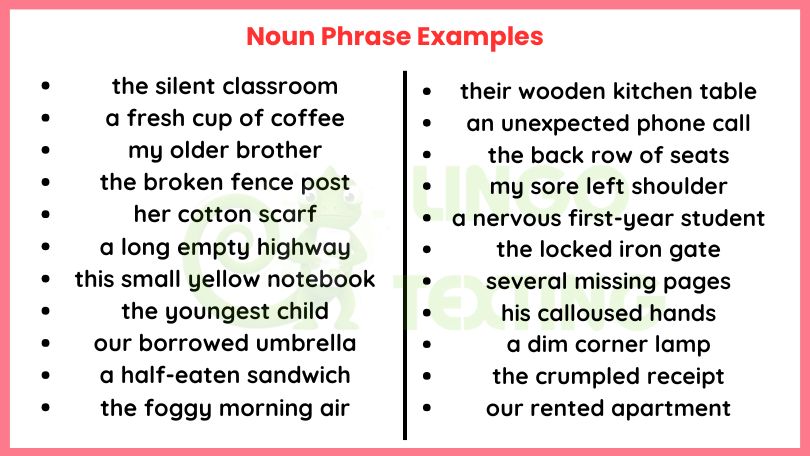
Learning grammar becomes much easier when you see real examples instead of memorizing rules. This collection of Noun Phrase Examples shows how groups of words work together to name people, places, things, ideas, and experiences in everyday sentences.
Whether you’re a student, parent, teacher, or writer, these Noun Phrase Examples will help you spot noun phrases quickly, understand how they are built, and use them naturally in speaking and writing.
What Is a Noun Phrase?
A noun phrase is a group of words built around one noun. That noun is the center — called the head noun. Everything else in the phrase describes it, introduces it, or adds detail to it. The whole group works exactly like a single noun: it can be a subject, an object, or a complement inside a sentence.
The hungry cat — noun phrase. Head noun: cat. A bowl of warm soup on the stove — noun phrase. Head noun: bowl.
Both work the way the bare word cat or bowl would — they just say far more.
How a Noun Phrase Is Built
| Position | What Goes There | Examples |
| Left of noun | Determiner | the, a, my, this, several, each |
| Left of noun | Adjective(s) | cold, broken, tall, familiar |
| Left of noun | Another noun | kitchen table, school bus |
| Center | Head noun | morning, idea, teacher, road |
| Right of noun | Prepositional phrase | on the shelf, near the window |
| Right of noun | Relative clause | who called last night, that broke |
| Right of noun | Participial phrase | sitting quietly, covered in dust |
You don’t need every part. Even the morning is a complete noun phrase. The more pieces you add, the more specific the phrase becomes.
35 Simple Noun Phrases
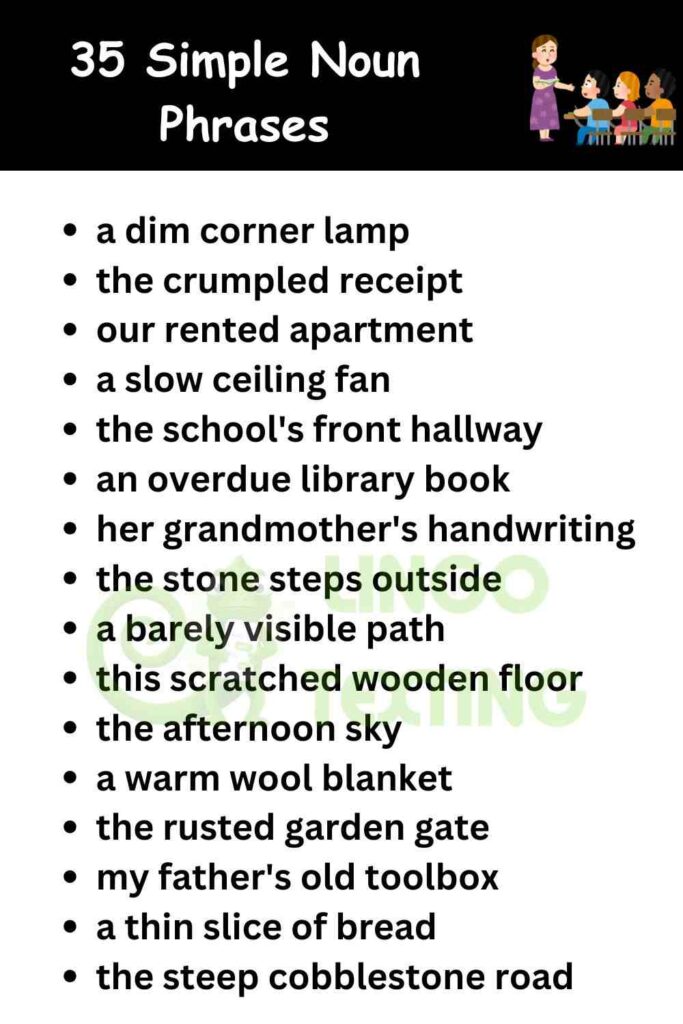
Short, beginner-friendly phrases — one or two modifiers at most.
- the silent classroom
- a fresh cup of coffee
- my older brother
- the broken fence post
- her cotton scarf
- a long empty highway
- this small yellow notebook
- the youngest child
- our borrowed umbrella
- a half-eaten sandwich
- the foggy morning air
- their wooden kitchen table
- an unexpected phone call
- the back row of seats
- my sore left shoulder
- a nervous first-year student
- the locked iron gate
- several missing pages
- his calloused hands
- a dim corner lamp
- the crumpled receipt
- our rented apartment
- a slow ceiling fan
- the school’s front hallway
- an overdue library book
- her grandmother’s handwriting
- the stone steps outside
- a barely visible path
- this scratched wooden floor
- the afternoon sky
- a warm wool blanket
- the rusted garden gate
- my father’s old toolbox
- a thin slice of bread
- the steep cobblestone road
15 Examples of Noun Phrases in Sentence
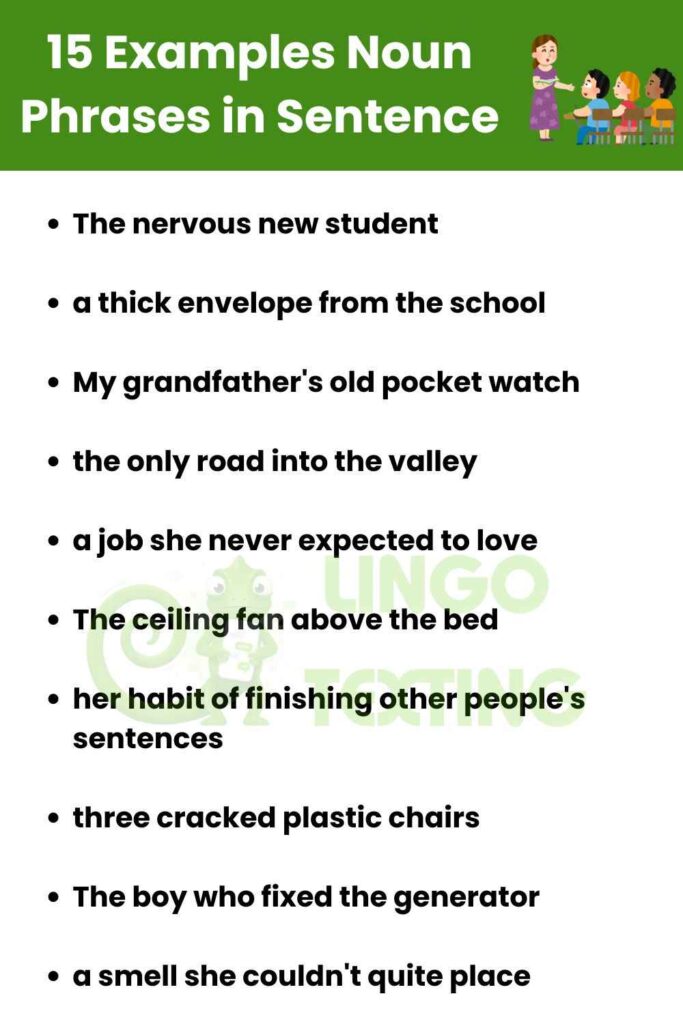
The noun phrase in each sentence is in bold.
| Noun Phrase | Full Sentence |
| The nervous new student | The nervous new student sat alone at lunch on the first day. |
| a thick envelope from the school | She found a thick envelope from the school under the doormat. |
| My grandfather’s old pocket watch | My grandfather’s old pocket watch stopped working years ago. |
| the only road into the valley | Heavy snow had blocked the only road into the valley. |
| a job she never expected to love | It turned out to be a job she never expected to love. |
| The ceiling fan above the bed | The ceiling fan above the bed clicked with every rotation. |
| her habit of finishing other people’s sentences | Everyone noticed her habit of finishing other people’s sentences. |
| three cracked plastic chairs | The waiting room held three cracked plastic chairs and nothing else. |
| The boy who fixed the generator | The boy who fixed the generator never asked for anything in return. |
| a smell she couldn’t quite place | The room had a smell she couldn’t quite place. |
| Our team’s last home game | Our team’s last home game ended in a draw nobody wanted. |
| the letter he’d been dreading | It was the letter he’d been dreading for three weeks. |
| The bakery at the corner of Fifth Street | The bakery at the corner of Fifth Street closed last month. |
| every single word she said | He remembered every single word she said that afternoon. |
| a surprisingly gentle giant of a dog | They’d been warned about him, but he turned out to be a surprisingly gentle giant of a dog. |
20 Sentence Noun Phrase Examples (With Answers)
Cover the answer, find the noun phrase, then check.
1. The tall girl with the red backpack won the spelling contest. Answer: The tall girl with the red backpack
2. Her plan to leave early fell apart completely. Answer: Her plan to leave early
3. We spotted a small wooden boat near the shore. Answer: a small wooden boat near the shore
4. The smell of fresh paint filled the hallway. Answer: The smell of fresh paint
5. My cousin’s hand-painted bicycle is parked outside. Answer: My cousin’s hand-painted bicycle
6. She offered him a second chance he didn’t deserve. Answer: a second chance he didn’t deserve
7. The children running in the garden woke the neighbors. Answer: The children running in the garden
8. Finding a quiet place to read takes real effort here. Answer: Finding a quiet place to read
9. The conference room on the fourth floor is always freezing. Answer: The conference room on the fourth floor
10. A thick blanket of fog had settled over the city by dawn. Answer: A thick blanket of fog
11. The woman who taught me to cook moved abroad last year. Answer: The woman who taught me to cook
12. Several boxes of old photographs sat untouched in the garage. Answer: Several boxes of old photographs
13. To finish the project by Friday seemed impossible. Answer: To finish the project by Friday
14. That crumbling old theater used to sell out every weekend. Answer: That crumbling old theater
15. Our neighbor, a former marathon runner, now coaches kids. Answer: Our neighbor | a former marathon runner
16. The two cats on the windowsill ignored us entirely. Answer: The two cats on the windowsill
17. A decision made in ten seconds changed everything. Answer: A decision made in ten seconds
18. His deeply held belief that people are mostly good never wavered. Answer: His deeply held belief that people are mostly good
19. She handed her daughter a brand-new book with an unbroken spine. Answer: her daughter | a brand-new book with an unbroken spine
20. That strange man on the corner watches every car that passes. Answer: That strange man on the corner
50 Noun Phrase Examples — Easy to Advanced
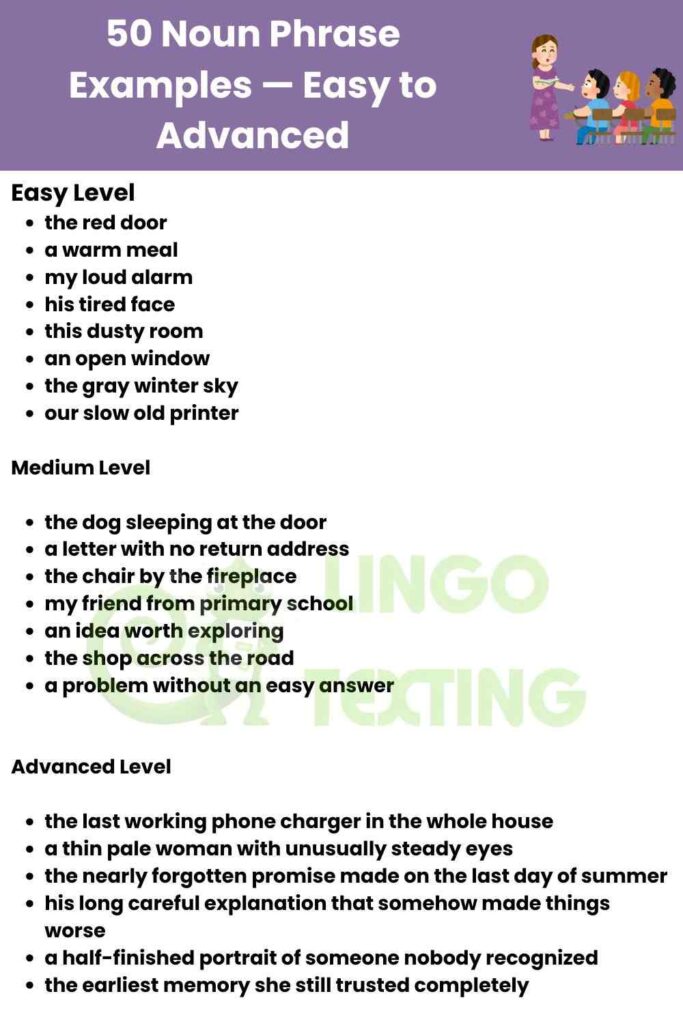
Easy Level
- the red door
- a warm meal
- my loud alarm
- his tired face
- this dusty room
- an open window
- the gray winter sky
- our slow old printer
- a crisp white shirt
- several broken pencils
- the wet umbrella
- a cold stone floor
- her sharp pencil
- the empty shelf
- this old wooden chair
Medium Level
- the dog sleeping at the door
- a letter with no return address
- the chair by the fireplace
- my friend from primary school
- an idea worth exploring
- the shop across the road
- a problem without an easy answer
- the teacher everyone remembered
- his room filled with maps
- a morning that started wrong
- the key hanging on the hook
- a village nobody visits anymore
- her voice in a crowded room
- the window facing the courtyard
- a plan that almost worked
Advanced Level
- the last working phone charger in the whole house
- a thin pale woman with unusually steady eyes
- the nearly forgotten promise made on the last day of summer
- his long careful explanation that somehow made things worse
- a half-finished portrait of someone nobody recognized
- the earliest memory she still trusted completely
- every piece of advice her father had ever given her
- a road trip with no map and no particular destination
- the one sentence she could never bring herself to say out loud
- his quietly extraordinary talent for remembering faces
- the building that replaced the old library no one wanted demolished
- to spend a full year doing only what actually matters
- her belief that one honest conversation outweighs a year of silence
- the afternoon they spent arguing about something neither cared about
- finishing what you started even when the beginning was a mistake
- a question that had been sitting in her mind for three years
- the slow patient work of rebuilding something that broke too fast
- the version of events everyone agreed on but no one believed
- a child who was both exhausting and completely unforgettable
- something small and quiet that changed everything without warning
The Seven Types of Noun Phrases
1. Simple Noun Phrases
Just a determiner and a noun. Clean and direct.
- the storm
- a chair
- my pen
- this coat
- their dog
- an answer
- some bread
- each student
The storm lasted three days. A chair scraped loudly across the floor.
2. Expanded Noun Phrases
One or more adjectives sit before the head noun.
- the cracked leather chair
- a perfectly round stone
- my surprisingly calm reaction
- this dense technical manual
- an unexpectedly warm October evening
- a long narrow hallway
- the rough unpainted wall
- her quiet determined voice
She sat in the cracked leather chair every evening. An unexpectedly warm October evening drew everyone outside.
3. Noun Phrases with Prepositional Phrases
A preposition-led group follows the noun and tells us which one or what kind.
- the clock on the kitchen wall
- a house near the railway line
- the student at the back of the room
- a letter from someone in my past
- the smell of old books in a closed room
- the road without a name
- a corner table near the window
- the light above the staircase
The clock on the kitchen wall hasn’t worked in years. The smell of old books in a closed room is something I still love.
4. Noun Phrases with Relative Clauses
A who, which, that, or where clause follows the noun and expands it.
- the man who calls every Sunday
- a place where nothing ever changes
- the rule that nobody follows
- a friend who knew when to stay quiet
- the idea that eventually saved the project
- the city where she was born
- a mistake that cost them everything
- the door that never fully closed
The man who calls every Sunday is my uncle. A friend who knew when to stay quiet was exactly what I needed.
5. Gerund Noun Phrases
An -ing verb form acts as the head of the noun phrase.
- sleeping past noon on weekdays
- making the same mistake twice
- carrying everything alone
- reading aloud to younger children
- waiting for news that doesn’t come
- leaving without saying goodbye
- finishing the race on tired legs
- asking the wrong question at the right time
Carrying everything alone eventually wears a person down. Waiting for news that doesn’t come is its own kind of exhaustion.
6. Infinitive Noun Phrases
The phrase opens with to + verb and acts as a noun.
- to admit you were wrong
- to walk away from a bad situation
- to finish what you started
- to ask for help without shame
- to remember every face but forget every name
- to leave before anyone noticed
- to say the thing nobody wanted to hear
- to trust a stranger with something real
To admit you were wrong takes more courage than most people expect. To ask for help without shame is something children do naturally.
7. Appositive Noun Phrases
One noun phrase sits directly beside another noun and renames or describes it.
- my boss, a man of very few words
- the capital, a city of impossible contrasts
- her older sister, the only doctor in the family
- this novel, a quiet masterpiece most people missed
- our coach, the most patient person any of us had ever met
- the river, a muddy slow-moving thing in summer
- his father, a carpenter who never wasted a word
- the old building, a relic from a different era entirely
My boss, a man of very few words, approved the plan with one nod. This novel, a quiet masterpiece most people missed, deserves to be read.
Noun vs. Noun Phrase — Side by Side
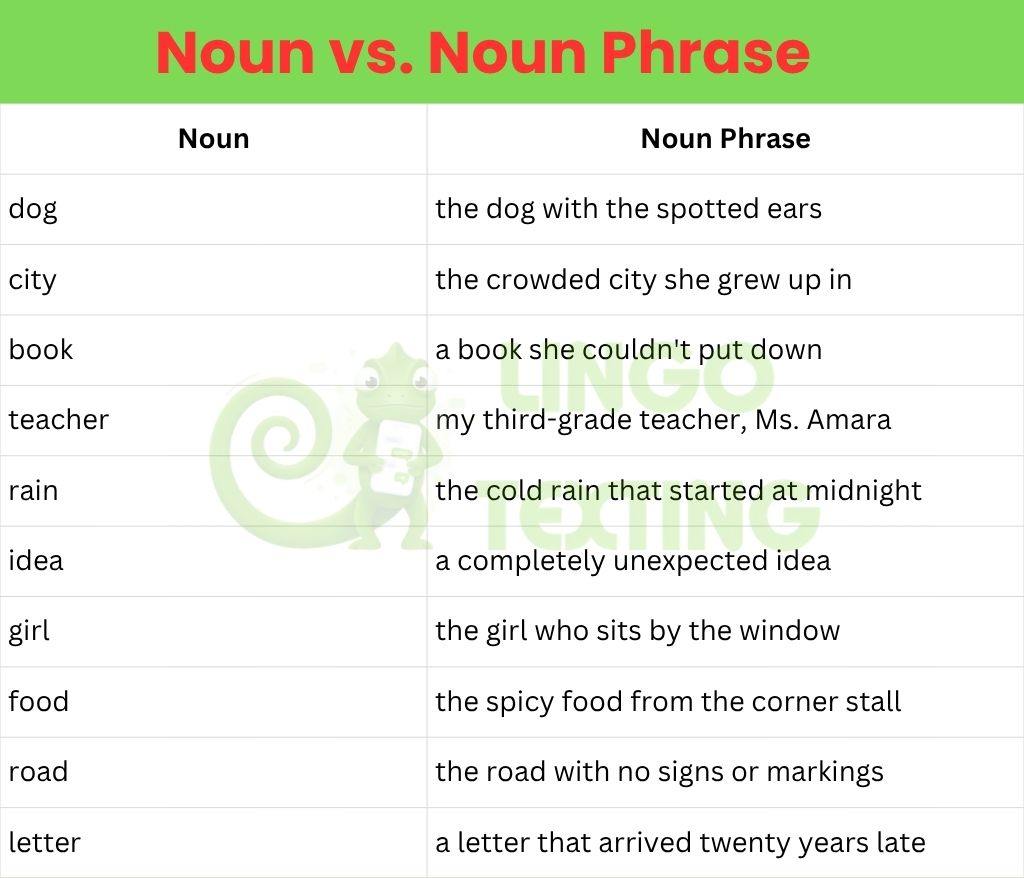
| Noun | Noun Phrase |
| dog | the dog with the spotted ears |
| city | the crowded city she grew up in |
| book | a book she couldn’t put down |
| teacher | my third-grade teacher, Ms. Amara |
| rain | the cold rain that started at midnight |
| idea | a completely unexpected idea |
| girl | the girl who sits by the window |
| food | the spicy food from the corner stall |
| road | the road with no signs or markings |
| letter | a letter that arrived twenty years late |
The noun does the job. The noun phrase does the job and tells a story.
Where Students Go Wrong
Mistake 1 — Stopping the phrase too early
When a prepositional phrase directly modifies the noun, it belongs inside the noun phrase.
- Incomplete: “the box”
- Full noun phrase: “the box under the floorboards”
The phrase under the floorboards tells us which box. It is part of the noun phrase.
Mistake 2 — Underlining only the adjective
Dark is an adjective. The dark corner of the room is a noun phrase. The adjective alone is never the full answer.
Mistake 3 — Mixing up noun phrases and noun clauses
A noun phrase has no subject-and-verb inside it: the reason for her silence — no internal verb. Noun phrase.
A noun clause has its own subject and verb: why she stayed silent — subject (she) + verb (stayed). Noun clause.
Both act like nouns. They’re built differently.
Mistake 4 — Thinking every noun phrase needs an adjective
The car. A teacher. My city. All valid noun phrases. An adjective is optional, never required.
8 Exercises with Full Answers
Exercise 1: The small café near the old post office sells the best cardamom tea in the city.
Answer: The small café near the old post office | the best cardamom tea in the city
Exercise 2: Admitting she was wrong turned out to be easier than expected.
Answer: Admitting she was wrong
Exercise 3: My uncle, a retired electrician, rewired the entire house in a single weekend.
Answer: My uncle | a retired electrician | the entire house
Exercise 4: That unusually quiet child in the back row had read every book on the shelf.
Answer: That unusually quiet child in the back row | every book on the shelf
Exercise 5: To understand a second language is to gain a second way of seeing the world.
Answer: To understand a second language | a second way of seeing the world
Exercise 6: The feeling she got standing at the top of the hill every morning was impossible to describe.
Answer: The feeling she got standing at the top of the hill every morning
Exercise 7: She handed her daughter, the best reader in the class, a brand-new book with an unbroken spine.
Answer: her daughter | the best reader in the class | a brand-new book with an unbroken spine
Exercise 8: Several students from the advanced class stayed behind to finish their group project on climate change.
Answer: Several students from the advanced class | their group project on climate change
Read more –
Nouns That Start with A: 500+ Words with Meanings and Real Examples
350+ Nouns That Start with E: Complete Word List with Examples
FAQs
1. What is the easiest way to identify a noun phrase?
Start by finding the main noun in a sentence. Then look for any words connected to it that describe, limit, or add information about it. Together, those words form the noun phrase. For example, in the small blue car, the main noun is car, and the entire group is the noun phrase.
2. Why do students often struggle with noun phrases?
Many students stop at the noun and miss the words that belong with it. They may underline only dog instead of the friendly dog near the gate. Learning to see the complete phrase helps improve grammar, reading, and writing skills.
3. How do noun phrases improve writing?
Noun phrases add detail and make writing more interesting. Instead of writing a man entered the room, you can write a tall man in a worn black coat entered the room. The extra detail helps readers picture the scene more clearly.
4. Can noun phrases be only one word?
Yes. A single noun such as teacher or a pronoun such as she can function as a noun phrase. Longer noun phrases simply add more information around the main noun.
5. Are noun phrases important for school exams?
Yes. Noun phrases are a common topic in grammar tests because they help students understand sentence structure. Being able to identify and build noun phrases can improve performance in reading, writing, and language assessments.
Closing Thought
Noun phrases carry the weight of description in every sentence you read and write. The subject is a noun phrase. The object is a noun phrase. Most of the texture and detail in good writing lives inside them.
Start small — pick noun phrases out of sentences you read today. Then try expanding simple ones when you write. A dog becomes the nervous three-legged dog that lived at the end of our lane. That shift, practiced over time, is what separates flat writing from writing people actually want to read.

I write clear, practical English lessons for everyday use. On Lingotexting, I break down grammar, vocabulary, and word types into simple ideas you can apply quickly. My focus is accuracy, real examples, and helpful visuals, so learners build confidence, improve writing, and communicate naturally in school, work, and daily life.