
Learning Daily Routine Words in English helps you talk about your everyday life with confidence. Whether you are describing your morning, explaining your school schedule, discussing work habits, or writing about your day, these words make communication easier and more natural.
This guide brings together useful vocabulary used in real daily situations. Instead of memorizing random words, you will learn practical expressions that people use every day at home, school, work, and during their free time. The goal is simple: help you speak, write, and understand everyday English more comfortably.
Morning Routine Words
These are the first actions of the day — from the moment the alarm rings to leaving the house.
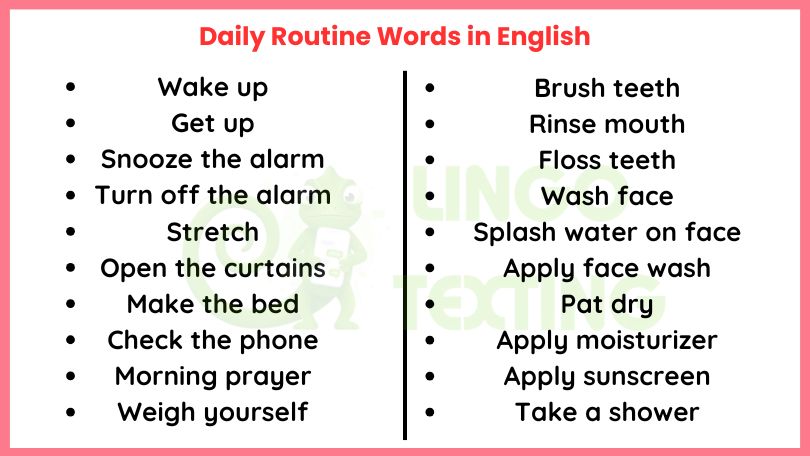
1. Wake up Meaning: To stop sleeping and become conscious. Example: I wake up at 6:15 every morning without fail. Real-Life Use: Said when describing what time your day begins. Picture Idea: Person opening their eyes slowly, sunlight through a bedroom window.
2. Get up Meaning: To physically rise from the bed and stand. Example: She gets up as soon as her alarm rings — no snoozing. Real-Life Use: Wake up and get up are two steps. You wake up first, then get up.
3. Snooze the alarm Meaning: To press a button that delays the alarm by a few minutes. Example: He snoozed the alarm three times and was late for work. Common Mistake: Saying “I pressed the sleep button” — the correct word is “snooze.”
4. Turn off the alarm Meaning: To completely stop the alarm from ringing. Example: She turned off the alarm and immediately sat up in bed.
5. Stretch Meaning: To extend the arms, legs, and back to loosen the body after sleep. Example: He stretches for five minutes before getting dressed. Picture Idea: Person standing, arms raised, back arched slightly.
6. Open the curtains Meaning: To pull back window coverings to let daylight into the room. Example: She opens the curtains first thing to let the morning light in.
7. Make the bed Meaning: To straighten the sheets, blanket, and pillows neatly after sleeping. Example: Making the bed takes two minutes but makes the whole room look tidy. Picture Idea: Hands smoothing a white duvet over a bed.
8. Check the phone Meaning: To look at messages, notifications, or news on a smartphone. Example: Most people check their phone within five minutes of waking up.
9. Morning prayer Meaning: A quiet religious practice done first thing in the morning. Example: My grandmother never skips her morning prayer — it sets her day right.
10. Weigh yourself Meaning: To step on a scale to measure body weight. Example: She weighs herself every morning as part of her health tracking habit.
Personal Care and Getting Ready Daily Routine Words
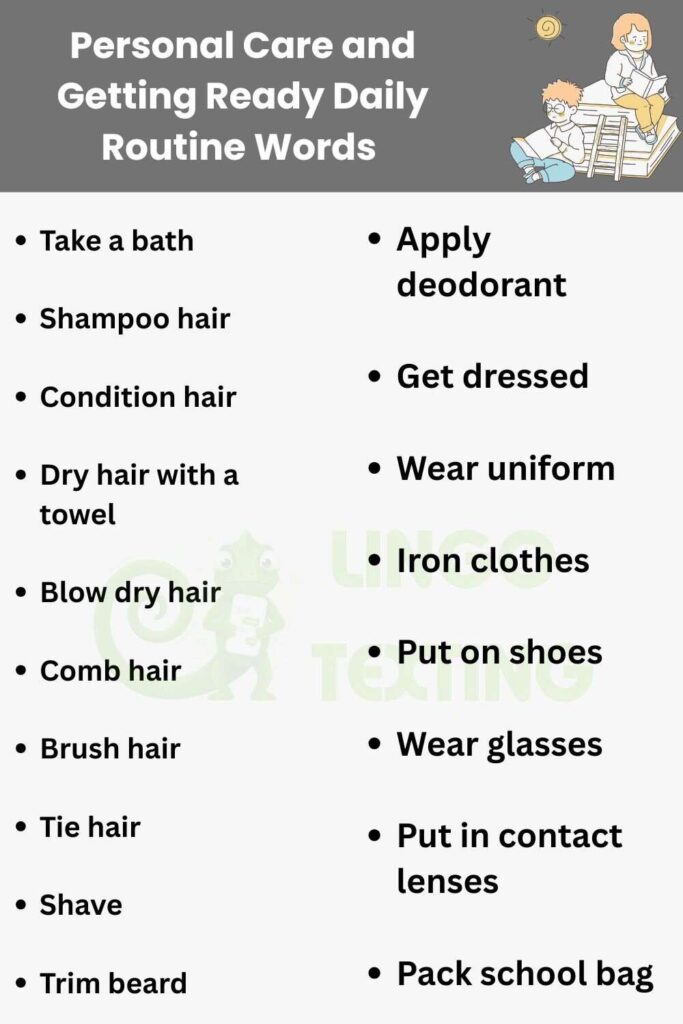
These are the bathroom and grooming words that appear in every daily routine.
11. Brush teeth
Meaning: To clean teeth with a toothbrush and toothpaste.
Example: Brush your teeth for two full minutes — not 30 seconds.
Common Mistake: “Do teeth” or “clean teeth with brush” — always say “brush teeth.” Picture Idea: Child brushing teeth at a bathroom sink.
12. Rinse mouth Meaning: To swish water inside the mouth after brushing to wash out toothpaste. Example: Rinse your mouth with cold water after brushing.
13. Floss teeth Meaning: To pull a thin thread between the teeth to remove food and plaque. Example: Dentists recommend flossing once a day, ideally at night.
14. Wash face Meaning: To clean the face with water and a cleanser. Example: She washes her face every morning to remove oil from overnight sleep. Picture Idea: Person splashing water on their face over a sink.
15. Splash water on face Meaning: To quickly throw water at the face, usually to feel more awake. Example: He splashed cold water on his face to shake off the sleepiness.
16. Apply face wash Meaning: To rub a cleansing gel or foam onto the face and rinse it off. Example: She applies face wash in circular motions before rinsing.
17. Pat dry Meaning: To gently press a towel against the skin rather than rubbing. Example: After washing your face, pat dry — rubbing irritates skin.
18. Apply moisturizer
Meaning: To rub a hydrating lotion onto the face or body.
Example: She applies moisturizer right after washing her face every morning.
19. Apply sunscreen
Meaning: To spread a protective cream on the skin before going outside.
Example: Apply sunscreen every morning — even on cloudy days.
20. Take a shower Meaning: To stand under running water to clean the body. Example: I take a quick shower before school to feel fresh and awake. Common Mistake: “I do shower” — always say “take a shower” or “have a shower.”
21. Take a bath Meaning: To sit in a tub filled with warm water for bathing. Example: She takes a relaxing bath on Sunday evenings.
22. Shampoo hair Meaning: To wash the scalp and hair with a cleansing product called shampoo. Example: He shampoos his hair every other day to keep it healthy.
23. Condition hair Meaning: To apply a softening product to the hair after shampooing. Example: She always conditions her hair for two minutes before rinsing.
24. Dry hair with a towel Meaning: To press and squeeze a towel against the hair to absorb water. Example: She dries her hair with a towel before using the blow dryer.
25. Blow dry hair Meaning: To use a hair dryer to dry and style the hair with hot air. Example: She blow dries her hair every morning before school.
26. Comb hair Meaning: To pass a comb through the hair to remove tangles. Example: He combs his hair neatly after every shower.
27. Brush hair Meaning: To smooth and style hair using a hair brush. Example: She brushes her long hair before tying it each morning.
28. Tie hair Meaning: To gather hair and secure it with a band or clip. Example: She ties her hair in a ponytail every morning before school.
29. Shave Meaning: To remove facial or body hair using a razor. Example: He shaves every morning before leaving for the office.
30. Trim beard Meaning: To cut a beard shorter and neater with scissors or a trimmer. Example: He trims his beard every few days to keep it looking clean.
31. Apply deodorant Meaning: To put a product under the arms to prevent body odor. Example: Apply deodorant after showering — it’s a basic daily habit.
32. Get dressed Meaning: To put clothing on the body. Example: She gets dressed in under ten minutes on school days.
33. Wear uniform Meaning: To put on a specific set of clothing required by school or workplace. Example: He wears his school uniform every day without complaining.
34. Iron clothes Meaning: To press a hot iron over fabric to remove wrinkles. Example: She irons her shirt the night before so mornings are calmer.
35. Put on shoes Meaning: To wear footwear before leaving the house. Example: He puts on his shoes last before stepping out the door.
36. Wear glasses Meaning: To place eyeglasses on the face to see clearly. Example: She wears glasses the moment she gets out of bed.
37. Put in contact lenses Meaning: To place small corrective lenses directly onto the eyes. Example: He puts in contact lenses instead of wearing glasses for work.
38. Pack school bag Meaning: To place books, notebooks, and supplies inside a school bag. Example: He packs his school bag the night before to avoid morning chaos. Picture Idea: Student placing textbooks into a backpack.
Breakfast and Morning Meal Daily Routine Words
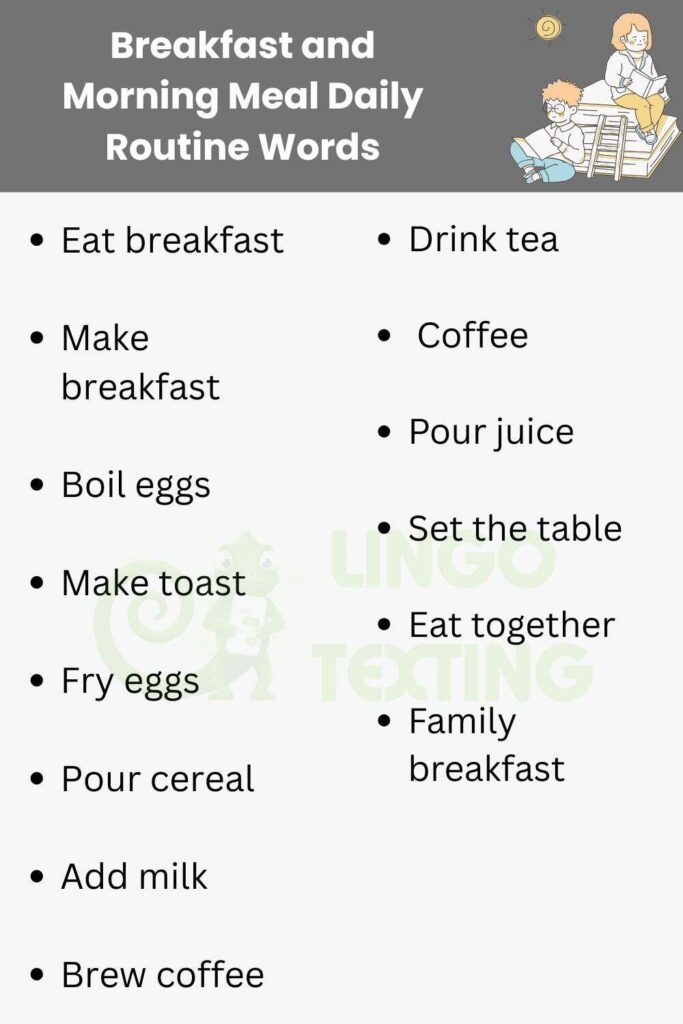
39. Eat breakfast Meaning: To have the first meal of the day. Example: Never skip breakfast — your brain needs energy to focus. Common Mistake: “Do breakfast” or “take breakfast” — say “eat breakfast” or “have breakfast.”
40. Make breakfast Meaning: To prepare the morning meal at home. Example: On weekends, Dad makes breakfast for the whole family.
41. Boil eggs Meaning: To cook eggs in hot water inside their shells. Example: Boiled eggs with toast is a fast and filling breakfast.
42. Make toast Meaning: To heat bread in a toaster until it turns golden and crispy. Example: She makes toast and spreads butter on it every morning.
43. Fry eggs Meaning: To cook eggs in a pan using oil or butter. Example: He fries two eggs every morning with a pinch of salt.
44. Pour cereal Meaning: To tip cereal from the box into a bowl. Example: She pours cereal and adds cold milk every weekday morning.
45. Add milk Meaning: To pour milk onto cereal or into a hot drink. Example: She adds milk to her tea and stirs it before drinking.
46. Brew coffee Meaning: To prepare coffee by passing hot water through coffee grounds. Example: He brews a fresh pot of coffee every morning at 7 a.m.
47. Drink tea / coffee Meaning: To consume a hot beverage. Example: She drinks one cup of green tea every morning before anything else.
48. Pour juice Meaning: To fill a glass with fruit juice. Example: He pours a glass of orange juice with breakfast every day.
49. Set the table Meaning: To arrange plates, cups, and cutlery on the table before eating. Example: The children set the table while their mother brings the food.
50. Eat together / family breakfast Meaning: To share a meal with family at the table. Example: They eat breakfast together every Sunday morning as a family tradition.
Daily School Routine Vocabulary
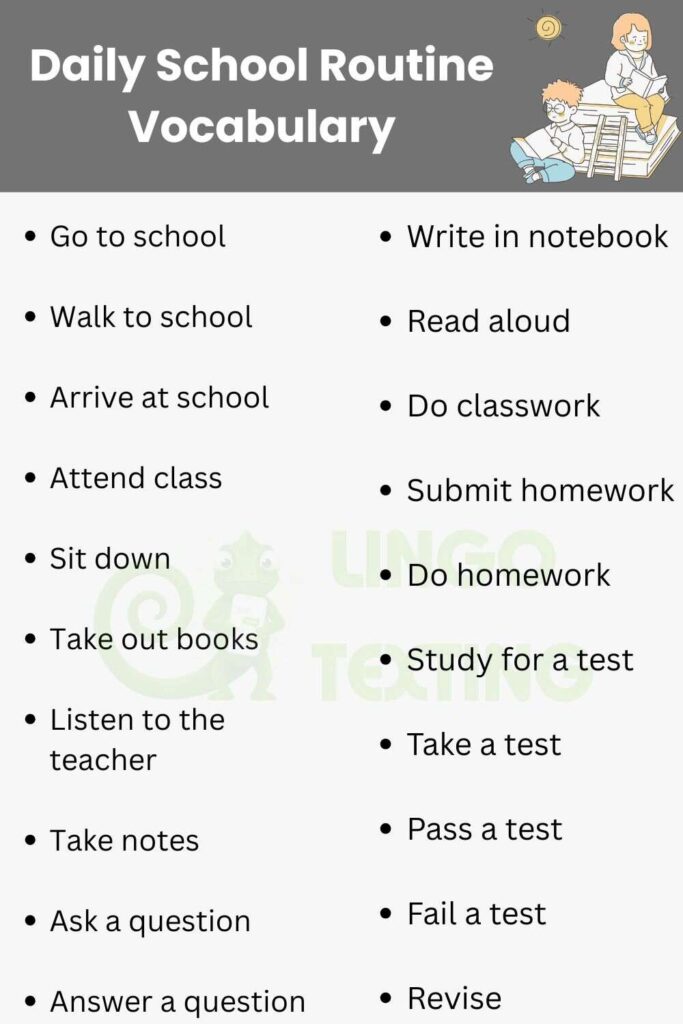
These words describe what students do before, during, and after class.
51. Go to school Meaning: To travel from home to school. Example: She goes to school by bus every weekday morning.
52. Walk to school Meaning: To travel to school on foot. Example: He walks to school with his neighbor — it takes about 15 minutes.
53. Arrive at school Meaning: To reach the school premises at a specific time. Example: She tries to arrive at school ten minutes before the first bell.
54. Attend class Meaning: To be physically present in a lesson. Example: He attends every class because missing notes creates problems later.
55. Sit down Meaning: To lower yourself into a chair. Example: Students sit down immediately when the teacher enters the room.
56. Take out books Meaning: To remove textbooks and notebooks from a school bag. Example: Take out your English books — we’re starting a new chapter today.
57. Listen to the teacher Meaning: To pay close attention to what the teacher is explaining. Example: Students who listen to the teacher usually need less time to study at home.
58. Take notes Meaning: To write down key information during a lesson. Example: She takes detailed notes in every subject and reviews them that evening.
59. Ask a question Meaning: To request an explanation from the teacher or a classmate. Example: Raise your hand and ask a question if something is unclear.
60. Answer a question Meaning: To respond when the teacher or a classmate asks something. Example: He answered the question correctly and the class applauded.
61. Write in notebook Meaning: To record information by hand in a paper notebook. Example: The teacher told students to write the new vocabulary in their notebooks.
62. Read aloud Meaning: To speak the words of a written text out loud for others to hear. Example: The teacher asked two students to read the passage aloud.
63. Do classwork Meaning: To complete exercises or tasks assigned during lesson time. Example: Finish your classwork before the end of the period — no taking it home.
64. Submit homework Meaning: To hand in a completed assignment to the teacher. Example: Homework must be submitted before 8:30 — no late submissions.
65. Do homework Meaning: To complete school assignments at home after class. Example: She does homework right after school so her evenings stay free.
66. Study for a test Meaning: To review material in preparation for an upcoming exam. Example: Starting to study three days before a test is much better than the night before.
67. Take a test Meaning: To sit a formal written or oral assessment. Example: The class takes a vocabulary test every Friday.
68. Pass a test Meaning: To achieve a score that meets or exceeds the required standard. Example: She passed the maths test with a score of 87%.
69. Fail a test Meaning: To score below the passing mark on an examination. Example: He failed the science test because he had not revised at all.
70. Revise Meaning: To go over previously taught material to strengthen understanding. Example: Spend 30 minutes each evening revising what was covered in class that day.
71. Break / recess Meaning: A short free period during the school day for eating or playing. Example: Students eat their snacks and run around during the morning break.
72. Eat lunch at school Meaning: To have the midday meal in the school canteen or dining hall. Example: Most students eat lunch at school rather than going home and coming back.
73. Go home from school Meaning: To travel back to your house after the school day ends. Example: She walks home from school with her two best friends every day.
Work and Office Daily Routine Words
74. Commute to work Meaning: To travel regularly between home and workplace. Example: She commutes to work by train — it takes 40 minutes each way.
75. Clock in / punch in Meaning: To officially register your arrival time at work. Example: All employees must clock in before 9 a.m.
76. Check emails Meaning: To read messages received in your email inbox. Example: She checks her work emails first thing every morning.
77. Reply to emails Meaning: To respond to messages in your inbox. Example: He replies to all client emails within two hours.
78. Attend a meeting Meaning: To be present at a scheduled discussion with colleagues or clients. Example: She attends three meetings on Monday mornings — it is a heavy day.
79. Give a presentation Meaning: To speak in front of an audience to share information or a proposal. Example: He gave a presentation on the company’s quarterly results.
80. Meet a deadline Meaning: To complete and submit work before the required time limit. Example: The whole team worked late to meet the Friday deadline.
81. Take a lunch break Meaning: To pause work around midday to eat and rest. Example: She always takes her lunch break away from her desk — a healthy habit.
82. File documents Meaning: To organize papers or computer files into a proper storage system. Example: She spends 15 minutes filing documents at the end of each working day.
83. Make a phone call Meaning: To contact someone using a telephone. Example: He made several phone calls before noon to follow up with clients.
84. Work overtime Meaning: To continue working beyond the normal hours of employment. Example: The team worked overtime to finish the project before the weekend.
85. Clock out / punch out Meaning: To mark the official end of your workday in the attendance system. Example: She clocked out at 6:30 p.m. after finishing her last task.
Household Chores Vocabulary
These are the cleaning and maintenance words that come up in home life every day.
86. Sweep the floor
Meaning: To use a broom to push dust and dirt into a pile.
Example: She sweeps the kitchen floor every morning after breakfast. Picture Idea: Person holding a broom, small pile of dust at their feet.
87. Mop the floor
Meaning: To clean a hard floor using a wet mop and a cleaning solution.
Example: After sweeping, she mops the tiles to remove any stains.
88. Vacuum the carpet Meaning: To use a vacuum cleaner to remove dust and debris from a carpet. Example: He vacuums the living room carpet every Saturday morning.
89. Dust the furniture Meaning: To wipe surfaces like shelves and tables with a dry or damp cloth. Example: She dusts the furniture every week so nothing builds up.
90. Wipe the countertops Meaning: To clean kitchen or bathroom flat surfaces with a damp cloth. Example: She wipes the kitchen countertops immediately after cooking.
91. Clean the bathroom Meaning: To scrub and disinfect the toilet, sink, floor, and shower or bathtub. Example: The bathroom is cleaned every Saturday as part of the weekly routine.
92. Scrub the toilet Meaning: To use a toilet brush and cleaner to remove stains from inside the bowl. Example: She scrubs the toilet twice a week to keep it hygienic.
93. Clean the sink Meaning: To remove soap marks and grime from the bathroom or kitchen sink. Example: He wipes the sink every night before going to bed.
94. Clean the windows Meaning: To wash glass windowpanes to remove dust, fingerprints, and smudges. Example: She cleans the windows every two weeks using a spray and cloth.
95. Do the laundry Meaning: To wash, dry, and fold dirty clothes. Example: She does the laundry on Monday and Thursday evenings.
96. Load the washing machine Meaning: To place dirty clothes into the washing machine before starting a wash cycle. Example: He loads the washing machine every Sunday evening.
97. Hang clothes to dry Meaning: To place washed clothes on a line or rack so they air dry. Example: She hangs the clothes outside on sunny days so they dry faster.
98. Fold clothes Meaning: To neatly crease and arrange clean dry clothes for storage. Example: He folds the laundry while watching TV in the evening.
99. Put clothes away Meaning: To place folded or ironed clothes inside the wardrobe or drawers. Example: Folding is only half the job — the clothes still need to be put away.
100. Change the bed sheets Meaning: To remove used bedding and replace it with fresh clean sheets. Example: She changes the bed sheets every Sunday without exception.
101. Take out the rubbish Meaning: To carry the full bin bag outside to the collection point. Example: He takes out the rubbish every night before going to bed.
102. Empty the bin Meaning: To remove the full rubbish bag from inside the bin. Example: She empties the kitchen bin every two days.
103. Feed the pets Meaning: To give food and fresh water to household animals. Example: He feeds the cat first thing every morning — she will not let him forget.
104. Water the plants Meaning: To pour water onto indoor or outdoor plants to keep them alive. Example: She waters the balcony plants every morning before school.
105. Tidy up the room
Meaning: To place things back in their proper positions and restore order.
Example: She tidies up the living room every evening before the family watches TV.
106. Organize the cupboard Meaning: To arrange items inside a cupboard in a neat and logical order. Example: He organized the kitchen cupboard on Saturday and found forgotten items.
107. Wash the dishes Meaning: To clean plates, pots, and cutlery with soap and water after meals. Example: She washes the dishes every evening while listening to the radio.
108. Dry the dishes Meaning: To use a cloth to wipe water off freshly washed dishes. Example: He dries the dishes and stacks them neatly in the cupboard.
109. Fix something at home Meaning: To repair a broken or damaged item in the house. Example: Dad fixes small things around the house every weekend.
110. Cook dinner Meaning: To prepare the evening meal using heat. Example: She cooks dinner from scratch every night — the family looks forward to it.
Exercise and Fitness Daily Routine Words in English
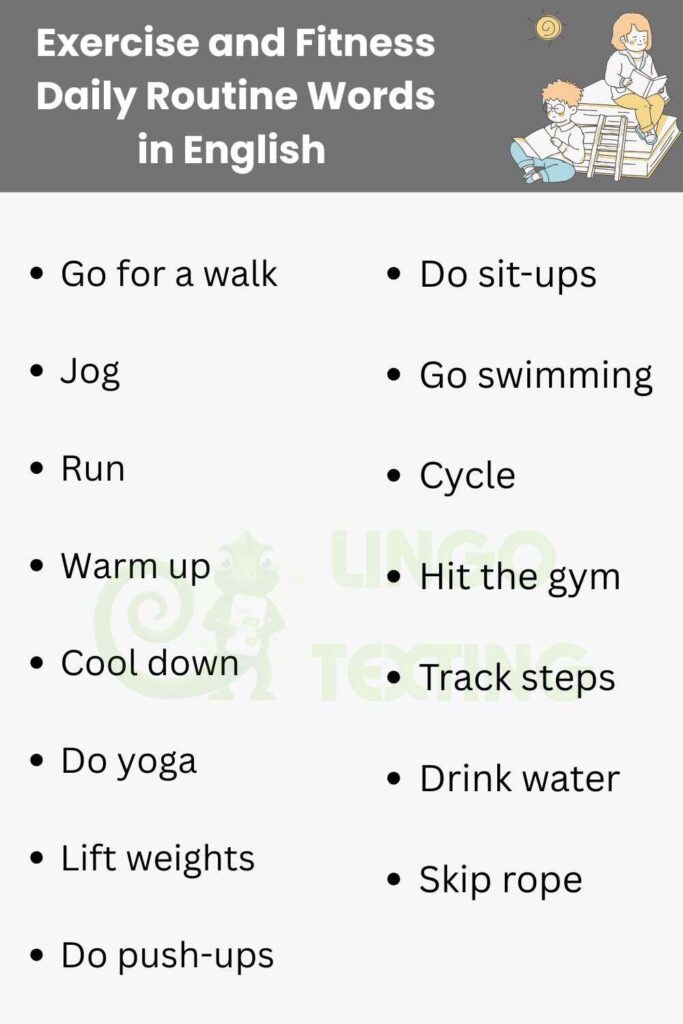
111. Go for a walk Meaning: To take a walk outside for fresh air, health, or leisure. Example: She goes for a 30-minute walk in the park every morning.
112. Jog Meaning: To run at a slow, steady pace for exercise. Example: He jogs around the block every morning before breakfast.
113. Run Meaning: To move on foot at a faster pace than jogging. Example: She runs 5 kilometers three times a week.
114. Warm up Meaning: To do light exercise before a workout to prepare the body. Example: Always warm up for at least five minutes before running.
115. Cool down Meaning: To do gentle stretching or walking after a workout to relax the muscles. Example: Cooling down after exercise helps prevent sore muscles the next day.
116. Do yoga Meaning: To practice a series of physical poses combined with controlled breathing. Example: She does yoga every morning before making breakfast.
117. Lift weights Meaning: To use dumbbells or a barbell as resistance to build muscle. Example: He lifts weights at the gym four mornings a week.
118. Do push-ups Meaning: To lower and raise the body using the arms while facing the floor. Example: He does 20 push-ups every morning as part of his fitness routine.
119. Do sit-ups Meaning: To strengthen the stomach muscles by lifting the upper body from a lying position. Example: She does 30 sit-ups every night before going to sleep.
120. Go swimming Meaning: To exercise by moving through water at a pool or open water. Example: He swims laps every Saturday morning.
121. Cycle Meaning: To ride a bicycle for exercise or transport. Example: She cycles to school instead of taking the bus when the weather is good.
122. Hit the gym Meaning: To visit a fitness center and exercise there. Example: He hits the gym every evening after finishing work.
123. Track steps Meaning: To count the number of steps walked in a day using a device or phone app. Example: She tracks her steps daily and aims for 8,000 each day.
124. Drink water Meaning: To consume enough water throughout the day to stay hydrated. Example: He drinks two glasses of water first thing every morning.
125. Skip rope Meaning: To jump over a rope that swings beneath the feet repeatedly for exercise. Example: She skips rope for ten minutes as a warm-up before her main workout.
Afternoon and Leisure Daily Routine Words in English
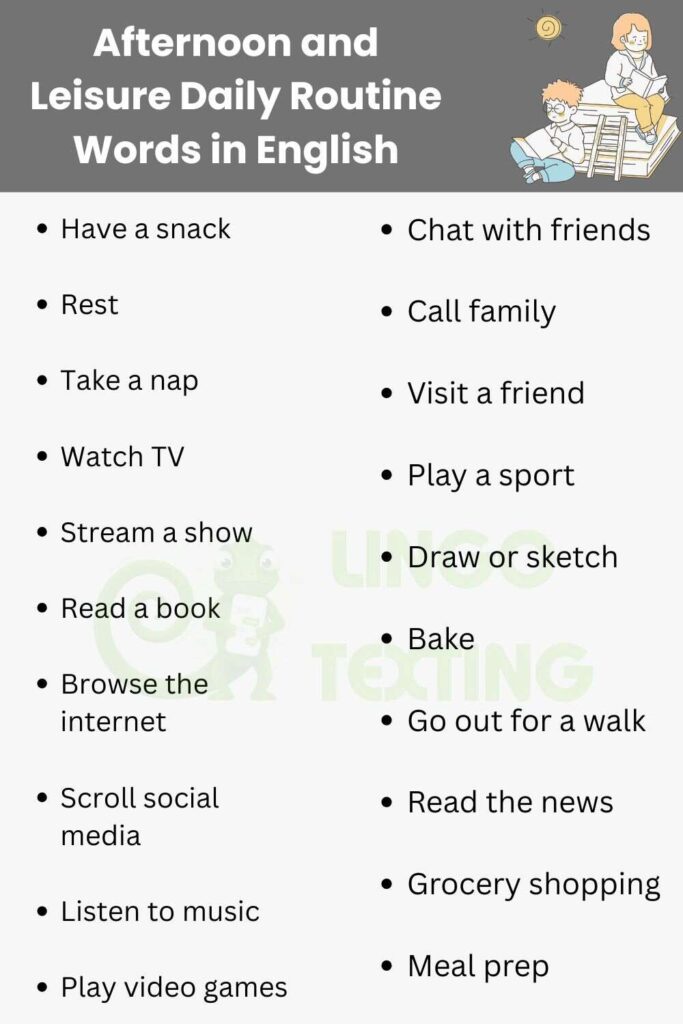
126. Have a snack Meaning: To eat a small amount of food between main meals. Example: She has a snack after school — usually fruit or a handful of nuts.
127. Rest Meaning: To stop activity and allow the body and mind to recover. Example: She sets aside 30 minutes in the afternoon to simply rest quietly.
128. Take a nap Meaning: To sleep for a short time during the day. Example: A 20-minute nap after lunch can restore energy for the rest of the day.
129. Watch TV Meaning: To view television programs for entertainment or information. Example: The family watches TV together for an hour after dinner.
130. Stream a show Meaning: To watch online video content through a streaming service. Example: She streams one episode of a series before going to sleep.
131. Read a book Meaning: To read the pages of a physical or digital book. Example: He reads one chapter every afternoon — a habit that keeps him calm.
132. Browse the internet Meaning: To look at various websites casually and without a fixed purpose. Example: She browses cooking websites on Sunday afternoons for new recipes.
133. Scroll social media Meaning: To swipe through posts and videos on a social media platform. Example: He limits himself to 20 minutes of scrolling social media each evening.
134. Listen to music Meaning: To play and enjoy songs through a device or speaker. Example: She listens to music while doing homework — it helps her concentrate.
135. Play video games Meaning: To play interactive electronic games on a console or computer. Example: He plays video games with friends online on Friday evenings.
136. Chat with friends Meaning: To have casual conversations in person or through messages. Example: She chats with friends on the phone during her afternoon break.
137. Call family Meaning: To contact family members by telephone for a conversation. Example: He calls his mother every Sunday afternoon without fail.
138. Visit a friend Meaning: To go to a friend’s house to spend time together in person. Example: She visits her best friend every other Saturday.
139. Play a sport Meaning: To participate in an organized physical activity or game. Example: He plays cricket with the neighbors in the park on weekends.
140. Draw or sketch Meaning: To create images using a pencil, pen, or other drawing tool. Example: She spends 20 minutes sketching in her notebook every afternoon.
141. Bake Meaning: To cook food — usually bread, cakes, or pastries — in an oven. Example: On weekends, she bakes cakes and shares them with neighbors.
142. Go out for a walk Meaning: To leave the house for a relaxed stroll outdoors. Example: The family goes out for a walk after dinner most evenings.
143. Read the news Meaning: To check current events through a newspaper, app, or website. Example: She reads the news on her phone during her lunch break.
144. Grocery shopping Meaning: To buy food and household supplies from a supermarket. Example: She does grocery shopping every Saturday morning.
145. Meal prep Meaning: To prepare and portion meals in advance for several days ahead. Example: He spends two hours every Sunday doing meal prep for the week.
Evening Meal and Kitchen Daily Routine Words in English
146. Eat dinner Meaning: To have the main meal of the evening. Example: The whole family eats dinner together at 8 p.m. every night.
147. Serve food Meaning: To place food onto plates or in dishes for eating. Example: She serves food before everyone sits down at the table.
148. Clear the table Meaning: To remove plates, glasses, and leftovers from the table after eating. Example: After dinner, the children clear the table while the parents wash up.
149. Pack leftovers Meaning: To put remaining food into containers for later use. Example: She packs leftovers right after dinner and places them in the fridge.
150. Follow a recipe Meaning: To use written cooking instructions to prepare a dish step by step. Example: He followed a recipe online and made chicken curry for the first time.
151. Boil water Meaning: To heat water until it bubbles and turns to steam. Example: She boils water for tea while setting out the cups.
152. Chop vegetables Meaning: To cut vegetables into smaller pieces using a knife and board. Example: He chops vegetables every evening while his wife cooks the main dish.
153. Stir the pot Meaning: To move food in a pot in circles to prevent it from sticking or burning. Example: She stirs the soup every few minutes so it does not stick to the bottom.
154. Season the food Meaning: To add salt, pepper, or spices to improve the taste of a dish. Example: Taste first, then season — otherwise food ends up too salty.
155. Drain the pasta Meaning: To pour pasta and water through a colander to separate the two. Example: Drain the pasta when it is just firm — not too soft.
Night Routine Vocabulary
156. Watch the news Meaning: To see news broadcasts on television in the evening. Example: He watches the news for 15 minutes after dinner every night.
157. Prepare for the next day Meaning: To get things ready in the evening so mornings run smoothly. Example: She lays out her clothes, packs her bag, and checks her schedule every night.
158. Have a bath / take a shower Meaning: To wash the body in the evening before sleeping. Example: He takes a warm shower every night to help him relax before bed.
159. Brush and floss teeth Meaning: To clean teeth and remove food from between them before sleeping. Example: She brushes and flosses every night — her dentist has noticed.
160. Apply night cream Meaning: To put a moisturizing product on the face before sleeping. Example: Her night routine ends with applying a light cream to her skin.
161. Set the alarm Meaning: To program a device to ring at a chosen time the next morning. Example: He sets his alarm for 6:30 every night before putting down his phone.
162. Charge the phone Meaning: To connect a phone to a power source to refill its battery overnight. Example: She charges her phone by the bed so it is ready in the morning.
163. Read before bed Meaning: To read a book or magazine as a relaxing wind-down before sleeping. Example: Reading before bed is far better for sleep quality than scrolling a phone.
164. Turn off the lights Meaning: To switch off all lights in the house before sleeping. Example: He checks every room and turns off the lights before going to bed.
165. Go to sleep Meaning: To enter the state of sleep. Example: She usually goes to sleep by 10 p.m. on school nights.
166. Fall asleep Meaning: To transition naturally into sleep after lying down. Example: He falls asleep within minutes of putting his head on the pillow.
Additional Daily Routine Words in English
These words round out the full picture — transport, personal habits, social actions, health, and home management.
Transport and Travel Daily Routine Words
167. Catch the bus — To board a bus by arriving at the stop on time. Example: She catches the 7:45 bus every weekday morning.
168. Miss the bus — To arrive at the stop too late and fail to board. Example: He missed the bus and had to walk to school.
169. Drive to work — To travel to the workplace in a personal vehicle. Example: She drives to work when the weather is bad.
170. Ride the train — To travel by rail transport. Example: He rides the train to the city every morning.
171. Park the car — To leave a vehicle in a designated space. Example: She parks the car in the same spot every day at work.
172. Fill up the tank — To add fuel to a vehicle at a petrol station. Example: He fills up the tank every Saturday to avoid running out during the week.
173. Unlock the door — To use a key or code to open a locked door. Example: She unlocks the front door and kicks off her shoes the moment she gets home.
174. Lock up — To secure a building by locking all doors before leaving or sleeping. Example: He locks up the house every night at 10 p.m.
Health and Self-Care Habits
175. Take medicine — To consume prescribed or over-the-counter medication. Example: She takes her vitamins every morning with breakfast.
176. Take vitamins — To swallow nutritional supplement tablets daily. Example: He takes a vitamin D tablet every morning with water.
177. Do breathing exercises — To practice controlled, deliberate breathing for relaxation or health. Example: She does three minutes of breathing exercises before getting out of bed.
178. Drink lemon water — To consume water mixed with fresh lemon juice, often in the morning. Example: She drinks warm lemon water first thing — a habit she has kept for two years.
179. Log meals — To record what you eat in an app or notebook for health tracking. Example: He logs every meal to monitor his daily calorie and nutrition intake.
180. Weigh food — To measure portions using a kitchen scale. Example: She weighs her food when cooking to stay on track with her nutrition goals.
Social and Communication Habits
181. Send a message — To type and deliver a text or chat message to someone. Example: She sends a good morning message to her sister every day.
182. Reply to messages — To respond to texts, chat messages, or app notifications. Example: He replies to messages after lunch so they don’t distract him in the morning.
183. Check notifications — To look at alerts from apps or messages on a device. Example: She checks notifications once an hour rather than every few minutes.
184. Make a video call — To speak face-to-face with someone over an internet video connection. Example: She makes a video call to her parents every Sunday evening.
185. Write in a journal — To record personal thoughts, events, or feelings in a notebook. Example: He writes three sentences in his journal every night before sleeping.
186. Read a newspaper — To read printed or digital news coverage. Example: His grandfather reads the newspaper every morning with breakfast — old habit.
Kitchen and Food Preparation Daily Routine Words
187. Peel vegetables — To remove the outer skin of a vegetable using a peeler or knife. Example: She peels the potatoes while the water comes to a boil.
188. Grate cheese — To shred cheese into fine pieces using a grater. Example: He grates fresh cheese over the pasta just before serving.
189. Slice bread — To cut a loaf into individual pieces. Example: She slices bread fresh every morning for the family’s breakfast.
190. Spread butter — To press softened butter across toast or bread using a knife. Example: He spreads butter on his toast every morning with a generous hand.
191. Warm up leftovers — To heat previously cooked food before eating. Example: She warms up last night’s soup for a quick and easy lunch.
192. Wash fruits and vegetables — To rinse produce under water before eating or cooking. Example: Wash fruits and vegetables before cutting them — always.
193. Defrost food — To bring frozen food to room temperature or thaw it in water. Example: She defrosts the chicken in the fridge overnight so it is ready to cook the next day.
194. Put food away — To place leftover or unused food back in the fridge or cupboard. Example: He always puts food away immediately after eating — no plates left out.
Cleaning and Organization Daily Routine Words
195. Disinfect surfaces — To apply a cleaning product that kills bacteria on a surface. Example: She disinfects the kitchen counters every evening after cooking.
196. Change towels — To replace used bathroom or kitchen towels with clean ones. Example: She changes the bathroom towels every three days.
197. Declutter — To remove unnecessary items from a space to keep it organized. Example: She spends 10 minutes decluttering one drawer every weekend.
198. Sort recycling — To separate recyclable materials like glass, paper, and plastic. Example: He sorts the recycling into different bins before taking them outside.
199. Refill soap dispensers — To top up hand wash or dish soap containers when they run low. Example: She refills the soap dispenser in the bathroom every few days.
200. Wipe the stove — To clean the cooking surface after use. Example: He wipes the stove every evening after cooking — grease does not build up.
Garden and Outdoor Daily Routine Words
201. Mow the lawn — To cut grass with a lawnmower to keep it at a neat height. Example: He mows the lawn every Saturday morning during spring and summer.
202. Rake leaves — To gather fallen leaves into a pile using a garden rake. Example: She rakes the leaves every autumn weekend — it is a family job.
203. Weed the garden — To pull out unwanted plants growing between flowers or vegetables. Example: He weeds the garden on Sunday mornings before it gets too hot.
204. Sweep the path — To use a broom on outdoor tiles, steps, or pathways. Example: She sweeps the front path every morning before leaving the house.
205. Feed the birds — To scatter seed or food outside for birds to eat. Example: His grandfather feeds the birds every morning from the back porch.
Personal Management and Study
206. Set goals — To decide on specific targets or objectives for the day, week, or longer. Example: She sets three small goals each morning and reviews them at night.
207. Make a to-do list — To write down tasks that need to be completed. Example: He makes a to-do list every morning so he does not forget anything.
208. Check the calendar — To look at a planner or digital calendar for scheduled events. Example: She checks her calendar every morning over breakfast.
209. Plan the day — To decide what tasks will be done and in what order. Example: He spends five minutes planning his day before opening his laptop.
210. Review notes — To re-read written notes from class or a meeting. Example: She reviews her notes from each class before moving to the next subject.
211. Highlight important points — To mark key information in a text with a coloured pen. Example: He highlights important points while reading so revision is faster later.
212. Memorize vocabulary — To actively commit new words to memory through repetition. Example: She memorizes ten new English words every morning with her coffee.
213. Practice writing — To write sentences or short paragraphs as a regular exercise. Example: He practices writing in English for 15 minutes every evening.
214. Read ahead — To study material before the teacher covers it in class. Example: She reads ahead in her science textbook on Sunday evenings.
215. Print documents — To produce physical copies of digital files using a printer. Example: He prints the worksheet before class so he does not need to use his phone.
Personal Finance and Admin
216. Pay bills — To settle utility, rent, or service charges by the due date. Example: She pays all household bills on the first of every month.
217. Check bank balance — To look at the current amount of money in an account. Example: He checks his bank balance every Sunday morning.
218. Set a budget — To decide how much money to spend in each category for a period. Example: She sets a weekly budget for groceries and sticks to it.
219. Write a shopping list — To list items needed before going to the shops. Example: He writes a shopping list every Saturday morning before heading out.
220. Count change — To total the coins received from a purchase. Example: She counts her change every time she shops — an old careful habit.
Children’s and Family Daily Routine Words s
221. Drop kids at school — To drive or walk children to their school and leave them there. Example: She drops the kids at school every morning before going to work.
222. Pick up kids from school — To collect children from school at the end of the day. Example: He picks up the kids from school every afternoon at 3 p.m.
223. Help with homework — To sit with a child and assist them in completing their school tasks. Example: She helps with homework every evening from 5 to 6 p.m.
224. Read a bedtime story — To read a book aloud to a young child before they sleep. Example: He reads a bedtime story to his daughter every night — she insists on it.
225. Bathe the children — To wash young children in a tub or shower. Example: She bathes the children every evening at 7 p.m. before the bedtime routine begins.
226. Prepare school lunch box — To pack food and snacks in a container for a child to take to school. Example: He prepares the lunch box every night so mornings are easier.
Evening Wind-Down Daily Routine Words
227. Dim the lights — To reduce the brightness of lights to create a calmer atmosphere. Example: She dims the lights after 9 p.m. to signal to her body that it is time to rest.
228. Put phone on silent — To turn off sound notifications on a smartphone. Example: He puts his phone on silent at 10 p.m. every night.
229. Turn off the TV — To switch the television off at the end of the evening. Example: She turns off the TV at 10 p.m. and reads for 20 minutes before sleeping.
230. Close the windows — To shut windows before sleeping for security and temperature. Example: He closes all windows every night before locking up.
231. Check door locks — To verify that all entry doors are locked before sleeping. Example: She checks door locks every night — it is the last thing she does.
232. Lay out clothes for tomorrow — To choose and place tomorrow’s outfit ready the night before. Example: She lays out her clothes every night so mornings are quicker and calmer.
Miscellaneous Daily Action Words
233. Open the door — To swing or slide a door open. Example: He opens the front door for guests every evening.
234. Close the curtains — To draw window coverings shut to block light or increase privacy. Example: She closes the curtains every evening when it gets dark.
235. Refill the water bottle — To fill a reusable bottle with fresh water. Example: He refills his water bottle every morning before leaving the house.
236. Hang up the coat — To place a coat on a hook or hanger after coming indoors. Example: She hangs up her coat the moment she gets home — keeps things tidy.
237. Take off shoes — To remove footwear when entering the house. Example: He takes off his shoes at the door every day without being reminded.
238. Unpack the bag — To remove items from a school or work bag after returning home. Example: She unpacks her bag immediately after school and puts everything away.
239. Sort post / sort mail — To go through letters and packages received during the day. Example: He sorts the post every evening — bills in one pile, everything else in another.
240. Switch off appliances — To turn off devices like the iron, oven, or kettle when not in use. Example: She always switches off appliances before leaving the house.
241. Empty the dishwasher — To remove clean, dry dishes from the dishwasher and put them away. Example: He empties the dishwasher every morning before breakfast.
242. Load the dishwasher — To place dirty dishes inside the dishwasher before running a cycle. Example: She loads the dishwasher every night after dinner.
243. Air the room — To open windows for a short time to let fresh air circulate. Example: She airs the bedroom every morning for ten minutes before making the bed.
244. Replace batteries — To swap old, dead batteries for new ones in a device. Example: He keeps a supply of batteries and replaces them whenever devices stop working.
245. Restock the fridge — To fill the refrigerator with fresh groceries after shopping. Example: She restocks the fridge every Saturday afternoon after grocery shopping.
246. Wipe down the microwave — To clean the inside and outside of the microwave. Example: She wipes down the microwave once a week — food splatter builds up quickly.
247. Charge headphones — To plug wireless headphones or earbuds into a charging cable. Example: He charges his headphones every night so they are ready for the commute.
248. Prepare work clothes — To select and iron clothes for the working week. Example: She prepares her work clothes every Sunday evening for the week ahead.
249. Refill the kettle — To fill the kettle with fresh water before boiling. Example: He refills the kettle every morning to make tea without waiting.
250. Pack gym bag — To place workout clothes and equipment into a bag for the gym. Example: She packs her gym bag the night before so nothing is forgotten in the morning.
251. Log off the computer — To sign out of a computer system at the end of a session. Example: He logs off the computer every evening — a good security habit.
252. Back up files — To save copies of digital files to a second location. Example: She backs up her work files every Friday before closing the laptop.
253. Close apps — To shut down programs running on a phone or computer. Example: He closes all apps before putting his phone on charge at night.
254. Set a reminder — To create a notification on a device for a future task or appointment. Example: She sets a reminder for every important task so nothing slips through.
255. Tighten a tap — To turn a dripping tap firmly closed to stop water waste. Example: He tightens the bathroom tap every few days — it has a small leak.
Common Mistakes and Speaking Tips
Common Mistakes Table
| Incorrect | Correct |
| Do breakfast | Eat breakfast / Have breakfast |
| Take shower | Take a shower / Have a shower |
| I do exercise at gym | I go to the gym / I work out |
| I sleep 10 pm | I go to sleep at 10 p.m. |
| I wake at 7 | I wake up at 7 |
| Do the teeth | Brush teeth |
| Take rest | Have a rest / rest |
| Do the dishes | Wash the dishes |
Speaking Tips
Daily routine vocabulary works naturally in the present simple tense because it describes habits that repeat.
Use these time phrases to make sentences sound natural:
- every morning / every evening
- at night / during the day
- after school / before bed
- on weekdays / on weekends
- once a week / twice a day
- first thing / last thing
Did You Know?
People who follow a consistent daily routine tend to feel less mentally drained during busy periods. When small decisions — what to eat, when to exercise, when to sleep — are already part of a fixed pattern, the brain has more energy for bigger thinking.
Practice Exercises of Daily Routine Words
Fill in the Blanks Choose: (brush, wake up, set, sweep, do)
- I _______ at 6:30 every morning.
- She _______ the kitchen floor after every meal.
- He _______ his teeth before going to school.
- Don’t forget to _______ the alarm before sleeping.
- I _______ my homework right after school.
Answers: 1. wake up — 2. sweeps — 3. brushes — 4. set — 5. do
Match the Word
| Word | Correct Meaning |
| Commute | Travel to work regularly |
| Snooze | Delay the alarm |
| Floss | Clean between teeth |
| Declutter | Remove unnecessary items |
| Meal prep | Prepare meals in advance |
Sentence Building Write your own sentence using each word below:
- Commute
- Fold clothes
- Browse the internet
- Take a nap
- Set the alarm
Conversation Examples of Daily Routine Words in English
Conversation 1 — Two students
Rania: What time do you wake up for school? Tariq: I wake up at 6:15. I shower, get dressed, eat breakfast, and pack my bag — all before 7. Rania: How? I wake up at 6 and still end up rushing. Tariq: I prepare everything the night before. Clothes, bag, lunch box — all ready. Mornings are much calmer now.
Conversation 2 — At home in the evening
Mother: Did you finish your homework? Son: Almost — just one question left. Mother: When you’re done, water the plants and take out the rubbish. Son: Should I set the table for dinner too? Mother: Yes please. Dinner’s in 20 minutes.
Conversation 3 — About fitness habits
Ali: Do you exercise regularly? Sara: I go for a walk every morning and do yoga twice a week. Nothing intense. Ali: I hit the gym three times a week, but I struggle to wake up early enough. Sara: I switched to evening workouts. Less pressure in the morning.
My Daily Routine Paragraph
My day starts at 6:30 a.m. when the alarm goes off. I turn it off — no snoozing — and stretch for a few minutes before getting up. After brushing my teeth and washing my face, I take a quick shower and get dressed.
Breakfast is usually toast with eggs, and I eat with my family before packing my school bag. At school, I attend all my classes, take notes, and try to stay focused even during the long afternoon lessons. Break time is for snacks and chatting with friends.
When I get home, I change clothes, eat lunch, and then do my homework while the material is still fresh. After that, I go for a short walk or help with a small chore at home. Dinner is a family meal at 8 p.m. After eating, I clear the table, brush my teeth, charge my phone, set my alarm, and read for 20 minutes before turning off the light. I am usually asleep by 10 p.m.
Ten Lines on My Daily Routine
- I wake up at 6:30 every morning and get up without pressing snooze.
- I brush my teeth and wash my face before anything else.
- After a shower, I get dressed and eat a healthy breakfast with my family.
- I pack my school bag and leave the house by 7:15 a.m.
- At school, I attend every class and take notes to study later.
- During the break, I eat a snack and rest for a short while.
- I complete my homework every evening before relaxing.
- I help my parents with household chores — setting the table, taking out the rubbish.
- Our family eats dinner together every night at 8 p.m.
- I set my alarm, charge my phone, and go to sleep by 10 p.m.
Short Essay on Daily Routine
The Shape of a Good Day
A day without a routine feels scattered. A day with one feels manageable — even when it is busy.
Every part of the day has its own rhythm. Mornings belong to preparation: washing, dressing, eating, and getting to wherever the day demands. These tasks are small but important. Missing breakfast or rushing through them tends to create a low-level stress that lasts until noon.
The middle of the day is for work — school, office, or both. The students who do well are usually not the ones who study longer. They are the ones who sit in class, write things down, ask questions, and then review the notes that evening. The effort happens in small, regular doses, not in one long overnight panic before an exam.
Evening is when the day processes itself. Cooking, eating together, doing a small chore, and then winding down. Reading before bed instead of scrolling a screen is a small swap that genuinely changes how well sleep comes.
The vocabulary in this guide describes all of that. These are not just English words — they are the language of a life being lived and managed. Knowing them in English means you can talk about your own days clearly, write about them naturally, and understand when others do the same.
You may like:
300+ Basic English Sentences for Students, Kids, and Beginners
150+ Noun Phrase Examples: Easy Examples for Students
FAQs
1. What is the best way to learn daily routine vocabulary quickly?
The easiest method is to connect new words to actions you already do every day. When you wake up, get dressed, eat breakfast, or do homework, say the English words aloud. Using vocabulary in real situations helps you remember it much faster than studying long lists.
2. How can I use daily routine words in spoken English?
Start by talking about your own day in simple sentences. For example: “I wake up at 6:30,” “I take a shower,” or “I do my homework after school.” Speaking about familiar activities builds confidence and helps you use the vocabulary naturally in conversations.
3. Which daily routine words are most important for beginners?
Beginners should focus on common actions such as wake up, get up, brush teeth, take a shower, eat breakfast, go to school, study, work, exercise, eat dinner, and go to sleep. These words appear frequently in everyday conversations and writing.
4. Why do English learners make mistakes with routine expressions?
Many routine expressions are fixed word combinations. For example, English speakers say “do homework,” “make the bed,” and “take a shower.” Translating directly from another language often creates mistakes. Learning these phrases as complete expressions makes your English sound more natural.

I write clear, practical English lessons for everyday use. On Lingotexting, I break down grammar, vocabulary, and word types into simple ideas you can apply quickly. My focus is accuracy, real examples, and helpful visuals, so learners build confidence, improve writing, and communicate naturally in school, work, and daily life.