
Speaking English at school becomes easier when you know what to say in everyday situations. These Daily Use English Sentences in School help students communicate naturally with teachers, classmates, and school staff. Instead of memorizing grammar rules, you can learn practical phrases that fit real classroom moments.
From asking questions and requesting permission to joining group discussions and talking during lunch breaks, these sentences build confidence through daily practice. Use them regularly, and speaking English at school will start to feel comfortable and natural.
Most Common Daily Use English Sentences in School
These are the sentences every student needs on day one.
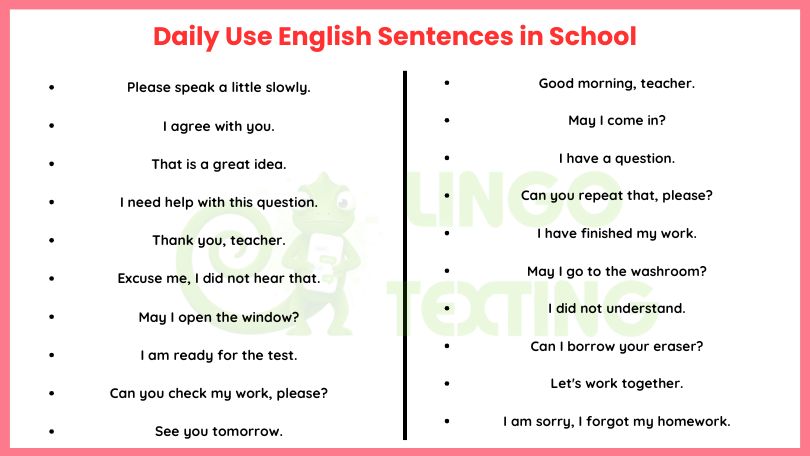
| Sentence | When to Use |
| Good morning, teacher. | Greeting |
| May I come in? | Arriving late |
| I have a question. | Before asking |
| Can you repeat that, please? | Did not hear |
| I have finished my work. | Telling the teacher |
| May I go to the washroom? | Asking permission |
| I did not understand. | Being honest |
| Can I borrow your eraser? | Asking a classmate |
| Let’s work together. | Group work |
| I am sorry, I forgot my homework. | Explaining a mistake |
| Please speak a little slowly. | Need slower explanation |
| I agree with you. | During discussion |
| That is a great idea. | Responding to a classmate |
| I need help with this question. | Asking for help |
| Thank you, teacher. | Showing respect |
| Excuse me, I did not hear that. | Politely asking again |
| May I open the window? | Classroom permission |
| I am ready for the test. | Before an exam |
| Can you check my work, please? | Wanting feedback |
| See you tomorrow. | Leaving school |
Daily Use English Sentences in School Before Class
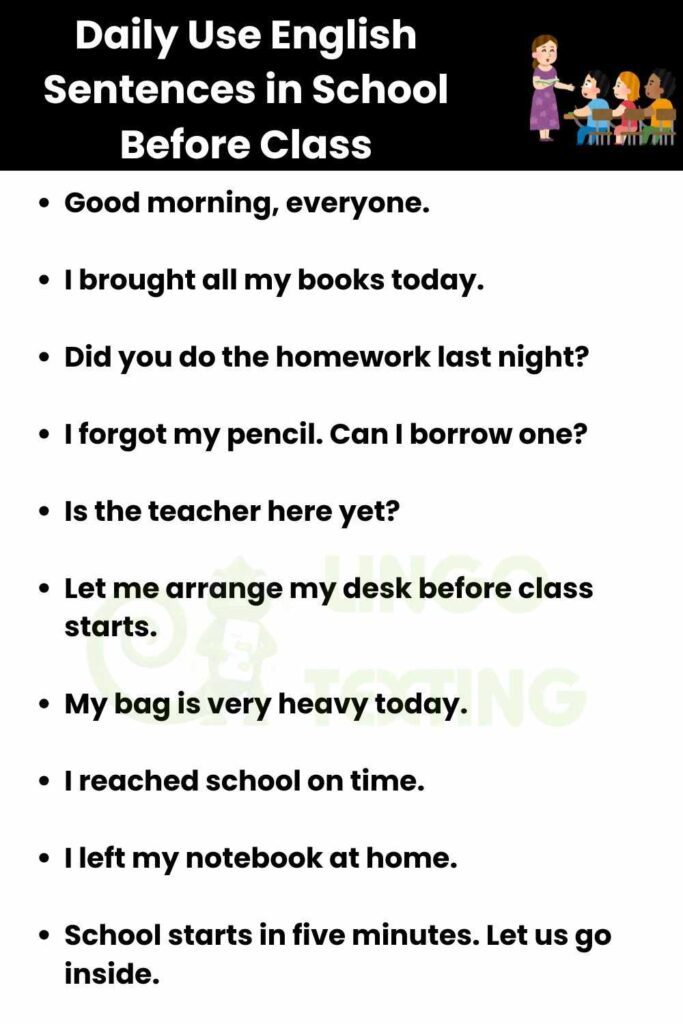
Use these from the school gate to your seat.
- Good morning, everyone.
- I brought all my books today.
- Did you do the homework last night?
- I forgot my pencil. Can I borrow one?
- Is the teacher here yet?
- Let me arrange my desk before class starts.
- My bag is very heavy today.
- I reached school on time.
- I left my notebook at home.
- School starts in five minutes. Let us go inside.
Daily Use English Sentences in School During Class — Asking and Responding
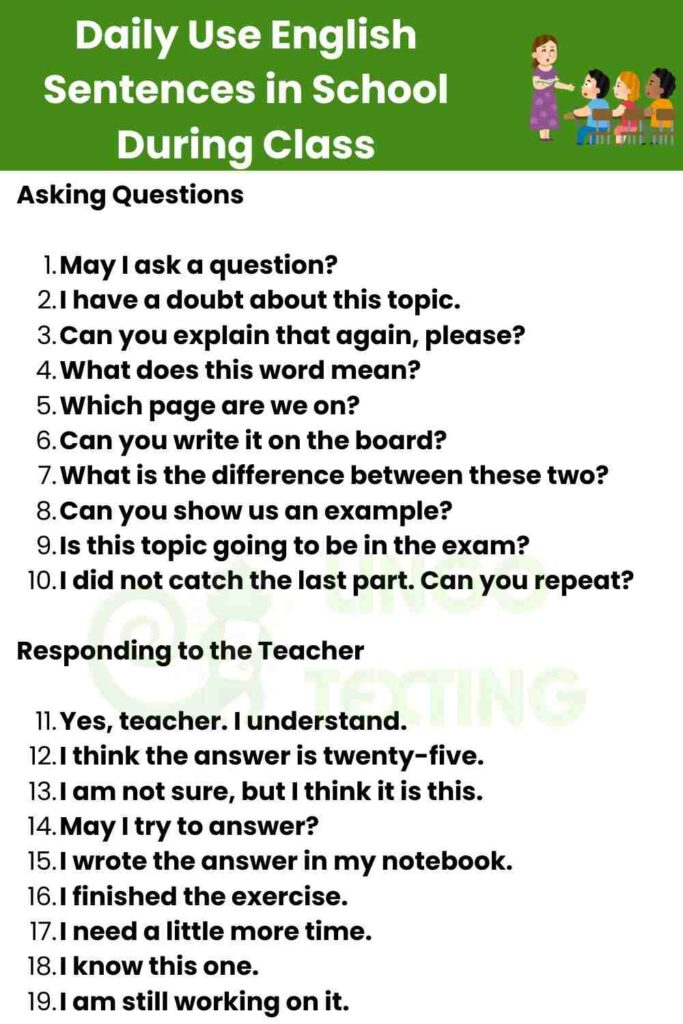
Asking Questions
- May I ask a question?
- I have a doubt about this topic.
- Can you explain that again, please?
- What does this word mean?
- Which page are we on?
- Can you write it on the board?
- What is the difference between these two?
- Can you show us an example?
- Is this topic going to be in the exam?
- I did not catch the last part. Can you repeat?
Responding to the Teacher
- Yes, teacher. I understand.
- I think the answer is twenty-five.
- I am not sure, but I think it is this.
- May I try to answer?
- I wrote the answer in my notebook.
- I finished the exercise.
- I need a little more time.
- I know this one.
- I am still working on it.
When You Did Not Understand
- I did not follow that explanation.
- Could you please go a little slower?
- I am confused about this step.
- Can you explain it in a different way?
- This part is not clear to me yet.
Daily Use English Sentences in School Asking Permission
| Request | What to Say |
| Washroom | May I go to the washroom, please? |
| Open window | May I open the window? |
| Sharpen pencil | Can I sharpen my pencil? |
| Leave early | May I be excused a little early? |
| Switch on fan | May I switch on the fan? |
| Speak in class | May I say something? |
| Change seat | Can I move to another seat? |
| Go to nurse | May I go to the medical room? |
| Enter late | May I come in? I am sorry I am late. |
| Write on board | May I write on the board? |
| Drink water | May I have some water? |
| Read aloud | Can I read this paragraph? |
| Step outside | May I step out for a moment? |
| Submit late | Can I give this to you after lunch? |
| Show something | Can I show you something, teacher? |
Daily Use English Sentences in School Talking to Your Teacher
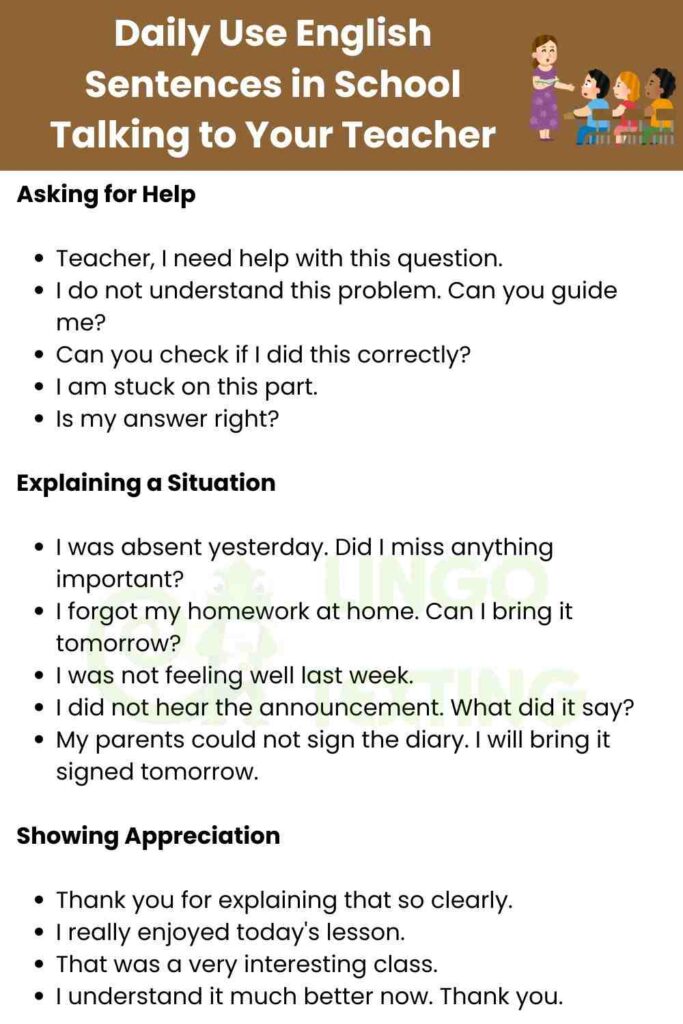
Asking for Help
- Teacher, I need help with this question.
- I do not understand this problem. Can you guide me?
- Can you check if I did this correctly?
- I am stuck on this part.
- Is my answer right?
Explaining a Situation
- I was absent yesterday. Did I miss anything important?
- I forgot my homework at home. Can I bring it tomorrow?
- I was not feeling well last week.
- I did not hear the announcement. What did it say?
- My parents could not sign the diary. I will bring it signed tomorrow.
Showing Appreciation
- Thank you for explaining that so clearly.
- I really enjoyed today’s lesson.
- That was a very interesting class.
- I understand it much better now. Thank you.
Talking to Classmates
Starting a Conversation
- Can I sit here?
- Are you done with the worksheet?
- Did you understand what the teacher said?
- What question are you on?
- Let us compare our answers.
Asking for Something
- Can I borrow your ruler?
- Do you have an extra pen?
- Can I see your notes from yesterday?
- Do you have the textbook? I forgot mine.
- May I use your sharpener for a second?
Being Helpful and Kind
- Good job on your presentation.
- You answered that really well.
- Do not worry. I will help you.
- We can study together after school.
- You did great in the test.
Disagreeing Politely
- I think it might be different.
- I am not sure that is right. Let us check.
- Can we ask the teacher to confirm?
- I see it a little differently.
Read also: 150+ Things That Start With I — Words, Objects, and Ideas for Every Learner
Group Discussion Daily Use English Sentences in School
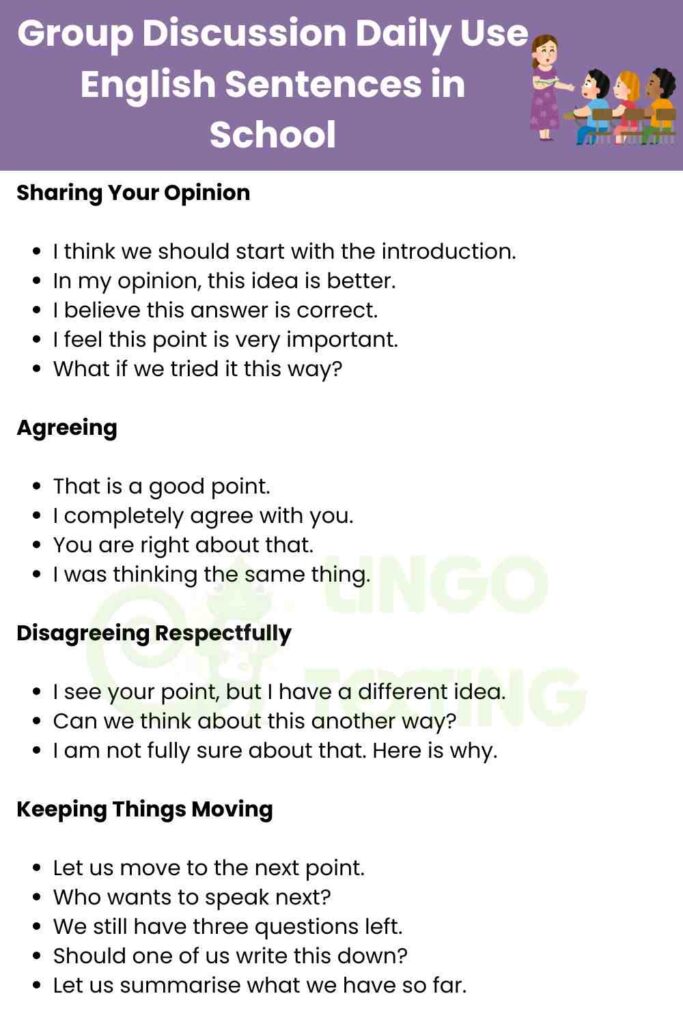
Sharing Your Opinion
- I think we should start with the introduction.
- In my opinion, this idea is better.
- I believe this answer is correct.
- I feel this point is very important.
- What if we tried it this way?
Agreeing
- That is a good point.
- I completely agree with you.
- You are right about that.
- I was thinking the same thing.
Disagreeing Respectfully
- I see your point, but I have a different idea.
- Can we think about this another way?
- I am not fully sure about that. Here is why.
Keeping Things Moving
- Let us move to the next point.
- Who wants to speak next?
- We still have three questions left.
- Should one of us write this down?
- Let us summarise what we have so far.
Library Daily Use English Sentences in School
- Excuse me, where is the science section?
- I need a book on the water cycle for my project.
- Can I renew this book for one more week?
- Is this seat taken?
- Please keep your voice low. People are studying here.
- I need to return this book today.
- Can you help me find this title?
- I want to take notes from this book.
- I finished reading this chapter.
- This book is very useful for my assignment.
Playground and Lunch Break
- Do you want to play with us?
- What are you having for lunch?
- Can I join your team?
- We won the match today!
- Let us sit under the tree.
- I have an extra sandwich. Do you want some?
- Be careful — the ground is wet.
- Wait for me. I am coming.
- The bell rang. Let us go back to class.
School Event English Sentences in School
- I am very excited about the Annual Day.
- Which role did you get in the play?
- I have been practising my dance for two weeks.
- Let us set up our science project display together.
- Our team is ready for the relay race.
- I am nervous about speaking on stage.
- You will do great. Just speak slowly and clearly.
- Our class won the best decorated classroom award.
- When does the prize distribution start?
- Have you finished your painting for the art exhibition?
English Sentences in School with Concrete Nouns
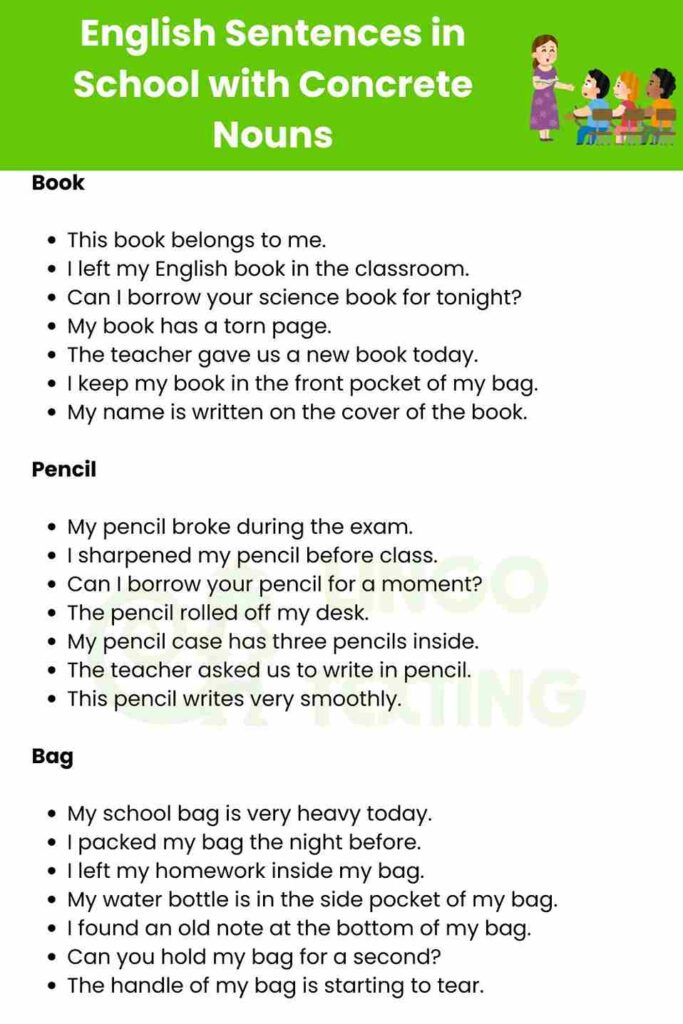
Book
- This book belongs to me.
- I left my English book in the classroom.
- Can I borrow your science book for tonight?
- My book has a torn page.
- The teacher gave us a new book today.
- I keep my book in the front pocket of my bag.
- My name is written on the cover of the book.
Pencil
- My pencil broke during the exam.
- I sharpened my pencil before class.
- Can I borrow your pencil for a moment?
- The pencil rolled off my desk.
- My pencil case has three pencils inside.
- The teacher asked us to write in pencil.
- This pencil writes very smoothly.
Desk
- My desk is clean and organised.
- I keep my stationery inside my desk.
- The desk near the window is my favourite spot.
- Someone left a book on my desk.
- The teacher walked past every desk to check our work.
- Please clear your desk before the test begins.
- My desk is made of wood.
Bag
- My school bag is very heavy today.
- I packed my bag the night before.
- I left my homework inside my bag.
- My water bottle is in the side pocket of my bag.
- I found an old note at the bottom of my bag.
- Can you hold my bag for a second?
- The handle of my bag is starting to tear.
Chair
- The chair near the window wobbles.
- Please push the chair in before you leave.
- I left my jacket on the chair.
- Someone moved my chair to another row.
- Please do not tilt back on the chair.
- There is an empty chair at the front of the class.
- My chair makes a noise when I sit on it.
Eraser
- My eraser is almost finished.
- Can I use your eraser? I made a mistake.
- The eraser left a mark on my page.
- I dropped my eraser under the desk.
- I keep a spare eraser in my pencil box.
- This eraser does not work well on ink.
Real-Life Dialogues
Dialogue 1: Arriving Late
Student: Good morning, teacher. May I come in? I am sorry I am late.
Teacher: Why are you late today?
Student: The school bus was delayed because of traffic. It will not happen again.
Teacher: Alright. Take your seat. Which page are we on?
Student: Thank you, teacher.
Dialogue 2: Asking for Clarification
Student: Excuse me, teacher. May I ask something?
Teacher: Yes, go ahead.
Student: I did not understand the second step of this math problem. Can you explain it again?
Teacher: Of course. Which part is confusing?
Student: The part where we multiply the fractions. I am getting a different answer.
Teacher: Come closer and watch. I will show you on the board.
Student: Thank you. Now it is clear.
Dialogue 3: Group Work
Student A: Let us divide the work. I will write the introduction.
Student B: Good idea. I will do the main points.
Student A: Who will make the diagram?
Student C: I will do it. I am good at drawing.
Student B: Let us finish in twenty minutes. The teacher will check at the end of class.
Student A: Agreed. Let us start now.
Dialogue 4: In the Library
Student: Excuse me. I am looking for books about the solar system. Can you help me?
Librarian: Yes. The science section is in the third row. Follow me.
Student: Thank you. Do I need to sign somewhere to borrow a book?
Librarian: Yes. Write your name and class on this sheet.
Student: How many books can I take at one time?
Librarian: Two books. Return them in one week.
Student: Understood. Thank you.
Common Mistakes and Corrections
Mistake 1
Wrong: Can I goes outside?
Correct: Can I go outside?
Why: After “can,” always use the base form of the verb.
Mistake 2
Wrong: I am not understanding.
Correct: I do not understand.
Why: “Understand” does not use -ing form. It is a stative verb.
Mistake 3
Wrong: Please repeat again.
Correct: Please repeat that. / Could you say that again?
Why: “Repeat” already means to say again. “Again” is extra and wrong here.
Mistake 4
Wrong: I want to tell you a doubt.
Correct: I have a question I would like to ask.
Why: We “ask” a question, not “tell” a doubt.
Mistake 5
Wrong: My pencil is finish.
Correct: My pencil is finished. / My pencil is too short to use.
Why: You need the adjective form “finished,” not the verb “finish.”
Mistake 6
Wrong: I am not knowing the answer.
Correct: I do not know the answer.
Why: “Know” is a stative verb. It does not take the -ing form.
Tips to Remember English Sentences in School
Say five sentences out loud every morning. Your mouth gets used to the sounds faster than your brain memorises them.
Use at least one new sentence in class each day. Real use in the real moment beats writing in a notebook twenty times.
Practise with a friend. One of you plays the teacher, the other the student. Use the dialogues from Section 12 as a starting point.
Notice what good speakers around you say. Your classmates who speak English well are already using many of these sentences. Start listening.
Do not wait until you are perfect. Speak with small mistakes now. Fix them as you go. Silence teaches you nothing.
Read more:
150+ Compound Sentence Examples: Guide for Real English Learners
250+ Sentence for Class 4: Easy English Sentences With Examples & Practice
English Sentences Vocabulary Table
| Word | Simple Meaning | Example |
| Permission | Approval to do something | May I have permission to leave early? |
| Assignment | A task given by the teacher | I submitted my assignment on time. |
| Clarify | Make something clearer | Can you clarify that point? |
| Absent | Not present in school | I was absent on Monday. |
| Presentation | Showing or explaining something | My presentation is tomorrow. |
| Submission | Handing in your work | The submission date is Friday. |
| Stationery | Writing tools and supplies | I keep my stationery in a pencil box. |
| Announce | Tell everyone something | The teacher announced the test date. |
| Renew | Extend the time for a borrowed book | I want to renew this library book. |
| Summarise | Say the main points briefly | Let us summarise what we discussed. |
FAQs about Daily Use English Sentences in School
1. What is the best way to remember English sentences for school?
The easiest way is to use them in real situations. Choose five sentences each week and say them during class, group work, or break time. Regular use helps the sentences become natural without memorizing long lists.
2. How can shy students improve their English speaking confidence at school?
Begin with short sentences instead of trying to speak for a long time. Ask one question, greet your teacher, or speak during a small group activity. Confidence grows through small daily conversations, not by waiting until your English feels perfect.
3. Should students focus more on grammar or speaking practice?
Both matter, but speaking practice should come first for everyday communication. Students learn faster when they use simple sentences in real conversations and improve grammar gradually through feedback and practice.
Conclusion
You now have 150+ real school sentences — sorted by situation, explained clearly, and shown in real conversations. These are not just sentences to read. They are sentences to say.
Start with Section 1 today. Pick any five. Say them out loud right now. Use one tomorrow morning when you walk into school.
Confidence in speaking English does not come from studying harder. It comes from speaking — one sentence at a time, every single day.
Good morning, teacher. That is where it begins.

I write clear, practical English lessons for everyday use. On Lingotexting, I break down grammar, vocabulary, and word types into simple ideas you can apply quickly. My focus is accuracy, real examples, and helpful visuals, so learners build confidence, improve writing, and communicate naturally in school, work, and daily life.