Concrete nouns are some of the first words we learn because they name real things we can experience with our senses. From the phone in your hand to the rain outside your window, these words help us describe the world clearly and accurately.
In this guide, you’ll find practical Examples of Concrete Nouns, simple explanations, and everyday examples that make the concept easy to understand for kids, students, parents, and teachers alike.
What Are Concrete Nouns?
A concrete noun names a person, place, animal, or thing that exists physically and can be experienced through at least one of the five senses — sight, touch, hearing, smell, or taste.
Quick Answer (40–60 words): A concrete noun is a word that names something real and physical. You can see it, touch it, hear it, smell it, or taste it. Examples include apple, dog, chair, river, teacher, and music. If at least one of your five senses can detect it, the noun is concrete.
The opposite is an abstract noun. Love, freedom, and justice are abstract — you cannot see or touch them. A book, a mountain, a cup of tea — those are physical, real, and concrete.
Characteristics of Concrete Nouns
- Names something that exists in the physical world
- Can be detected by at least one of the five senses
- Includes people, animals, places, objects, food, and nature
- Can often be counted or measured
- Feels immediate and real — not an idea or emotion
Key point: Something does not need to be visible to be concrete. Thunder is concrete because you hear it. Perfume is concrete because you smell it. The test is always the senses — not sight alone.
Examples of Concrete Nouns by Category
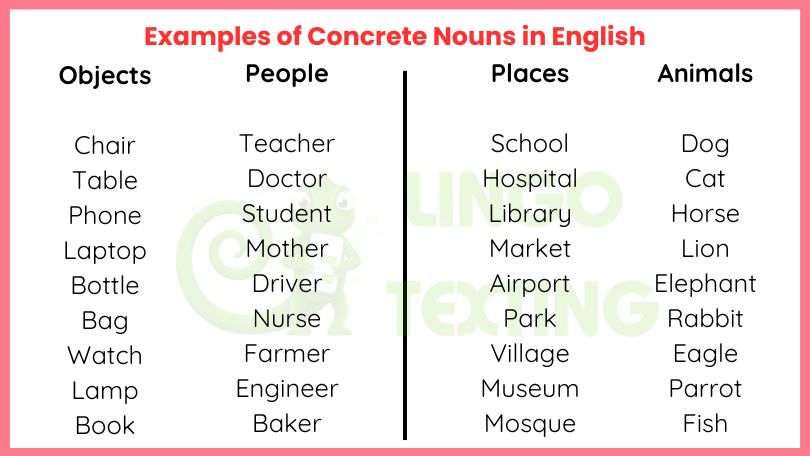
| Objects | People | Places | Animals | Food | Nature |
| Chair | Teacher | School | Dog | Apple | River |
| Table | Doctor | Hospital | Cat | Bread | Mountain |
| Phone | Student | Library | Horse | Rice | Ocean |
| Laptop | Mother | Market | Lion | Mango | Tree |
| Bottle | Driver | Airport | Elephant | Pizza | Flower |
| Bag | Nurse | Park | Rabbit | Orange | Cloud |
| Watch | Farmer | Village | Eagle | Chocolate | Stone |
| Lamp | Engineer | Museum | Parrot | Egg | Soil |
| Book | Baker | Mosque | Fish | Butter | Rain |
| Pen | Soldier | Stadium | Deer | Cake | Leaf |
Examples of Concrete Nouns by Category
Objects
Everything with a physical shape and weight around you right now — your desk, your chair, your cup — is a concrete noun.
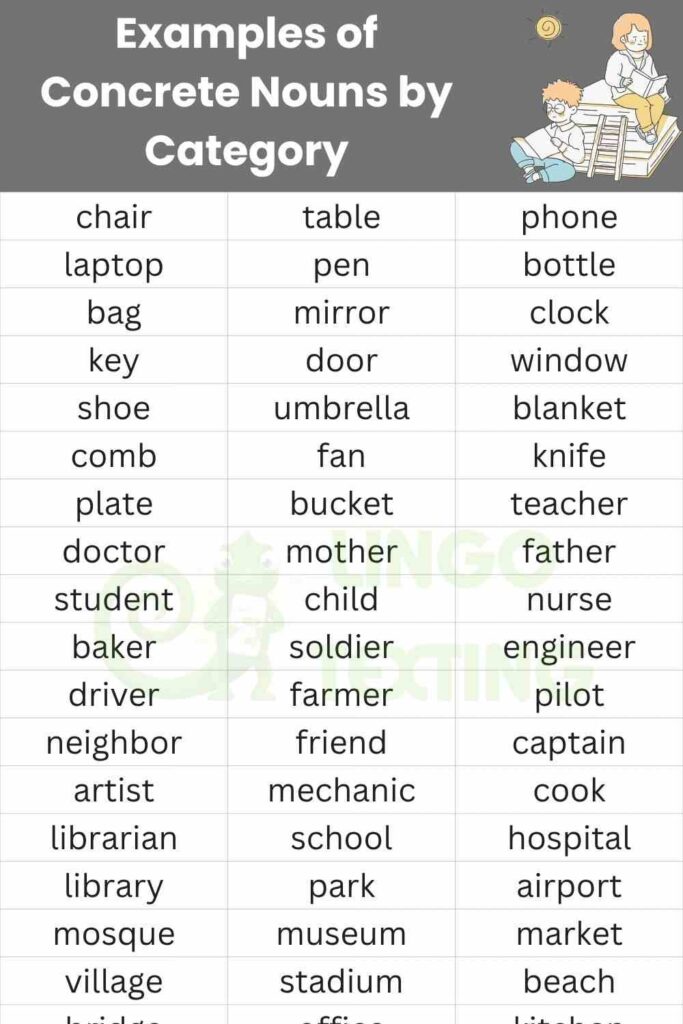
chair, table, phone, laptop, pen, bottle, bag, mirror, clock, key, door, window, shoe, umbrella, blanket, comb, fan, knife, plate, bucket
People
Any word naming a real human being is a concrete noun. People breathe, move, and exist physically.
teacher, doctor, mother, father, student, child, nurse, baker, soldier, engineer, driver, farmer, pilot, neighbor, friend, captain, artist, mechanic, cook, librarian
Places
Any location you can visit, walk through, or stand inside is a concrete noun.
school, hospital, library, park, airport, mosque, museum, market, village, stadium, beach, bridge, office, kitchen, garden, factory, classroom, cave, temple, warehouse
Animals
Every creature in the animal kingdom is a concrete noun — visible, audible, and physical.
dog, cat, lion, horse, elephant, rabbit, eagle, parrot, fish, tiger, deer, wolf, frog, cow, penguin, snake, camel, bear, crow, donkey
Food
Food engages taste, smell, sight, and touch all at once — one of the most sensory categories.
apple, bread, rice, mango, pizza, orange, chocolate, egg, butter, cake, milk, banana, soup, cheese, lemon, onion, tomato, carrot, honey, salt
Nature
The natural world is filled with concrete nouns that exist completely independently of human creation.
river, mountain, ocean, tree, flower, cloud, stone, soil, rain, leaf, snow, sand, sun, rainbow, wind, valley, lake, waterfall, forest, pebble
Examples of Concrete Nouns and the Five Senses
You Can See
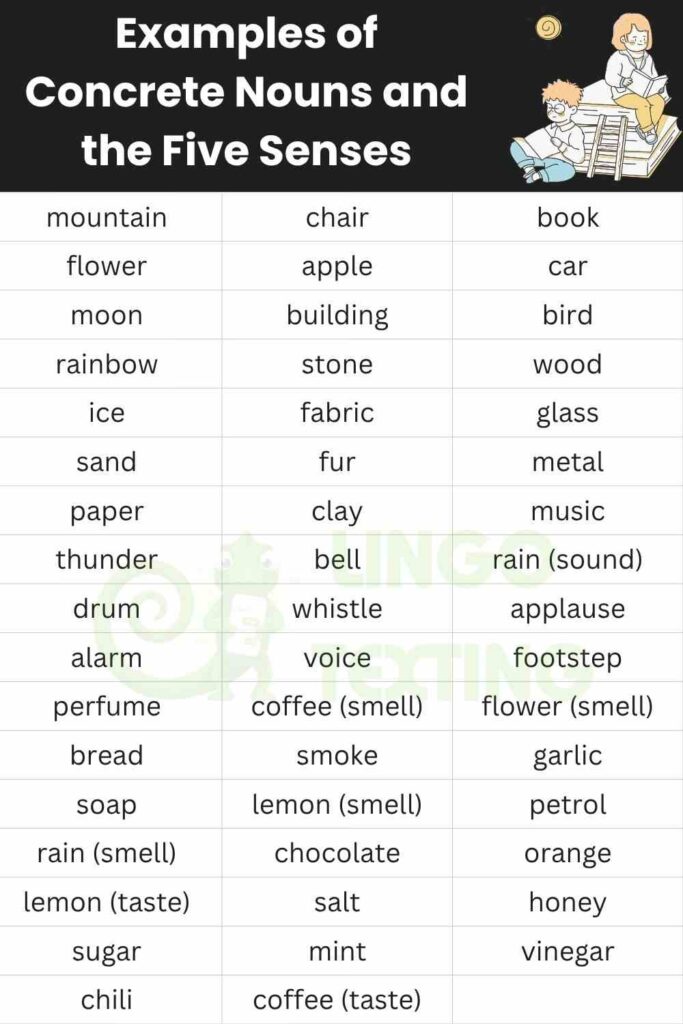
mountain, chair, book, flower, apple, car, moon, building, bird, rainbow
These have a visible physical form you can look at directly.
You Can Touch
stone, wood, ice, fabric, glass, sand, fur, metal, paper, clay
These have texture, temperature, or weight your hands can feel.
You Can Hear
music, thunder, bell, rain, drum, whistle, applause, alarm, voice, footstep
Sound is a physical wave. Hearing it makes it just as concrete as seeing it.
You Can Smell
perfume, coffee, flower, bread, smoke, garlic, soap, lemon, petrol, rain
Your nose detects real particles in the air — that is a physical experience.
You Can Taste
chocolate, orange, lemon, salt, honey, sugar, mint, vinegar, chili, coffee
Every flavor comes from something physically real inside your mouth.
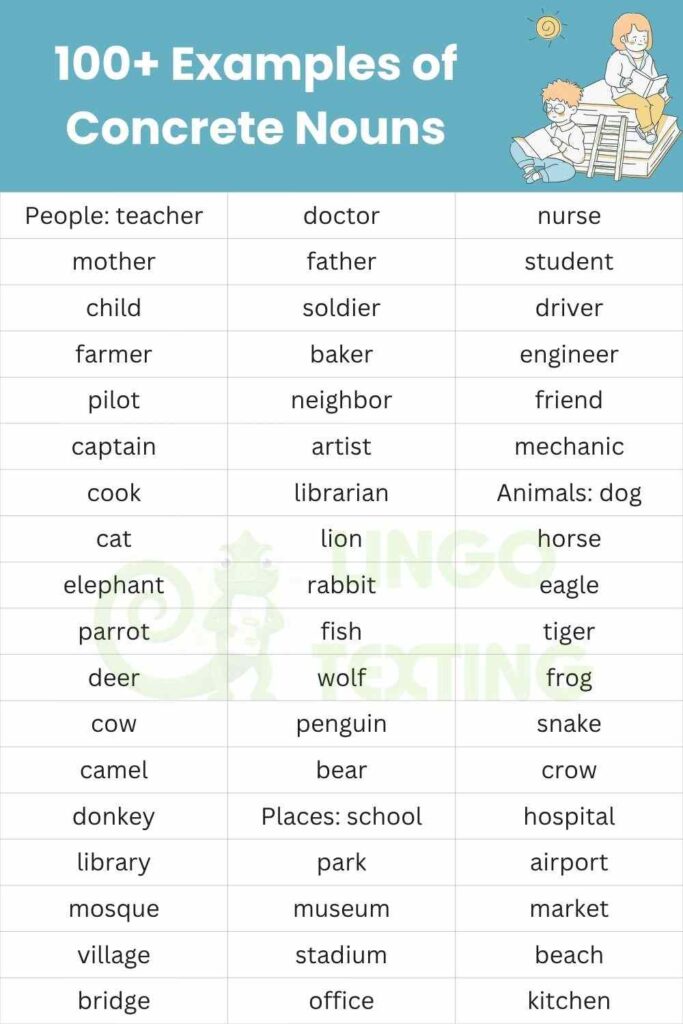
Complete List: 100+ Examples of Concrete Nouns
People
teacher, doctor, nurse, mother, father, student, child, soldier, driver, farmer, baker, engineer, pilot, neighbor, friend, captain, artist, mechanic, cook, librarian
Animals
dog, cat, lion, horse, elephant, rabbit, eagle, parrot, fish, tiger, deer, wolf, frog, cow, penguin, snake, camel, bear, crow, donkey
Places
school, hospital, library, park, airport, mosque, museum, market, village, stadium, beach, bridge, office, kitchen, garden, factory, classroom, cave, temple, warehouse
Objects
chair, table, phone, laptop, pen, bottle, bag, mirror, clock, key, door, window, shoe, umbrella, blanket, comb, fan, knife, plate, bucket
Food
apple, bread, rice, mango, pizza, orange, chocolate, egg, butter, cake, milk, banana, soup, cheese, lemon
Nature
river, mountain, ocean, tree, flower, cloud, stone, soil, rain, leaf, snow, sand, sun, valley, lake
A to Z Examples of Concrete Nouns List
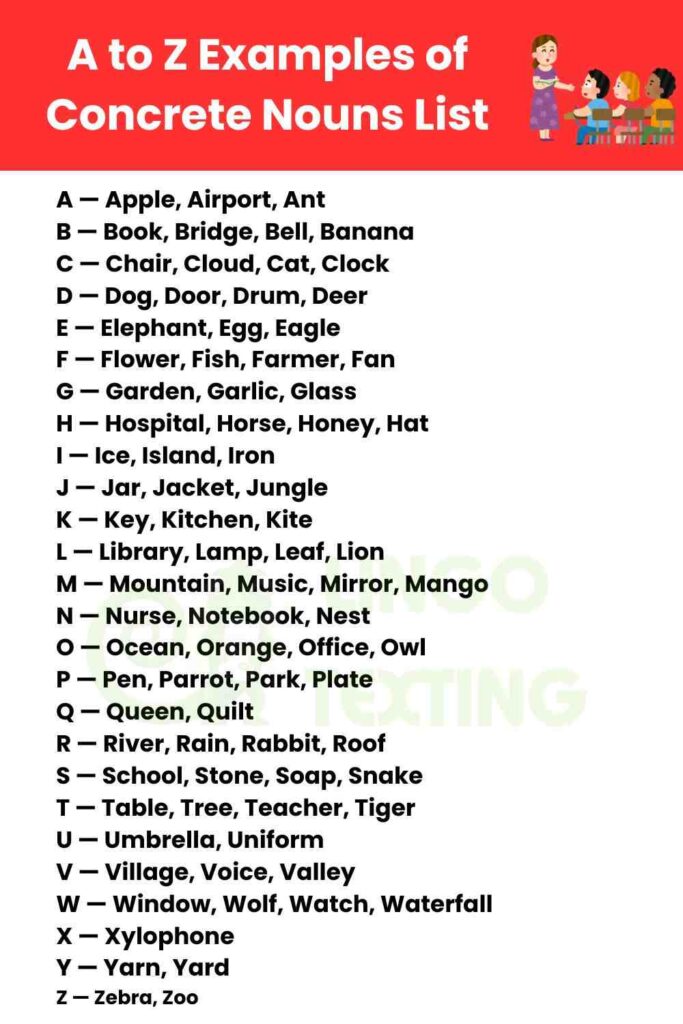
A — Apple, Airport, Ant
B — Book, Bridge, Bell, Banana
C — Chair, Cloud, Cat, Clock
D — Dog, Door, Drum, Deer
E — Elephant, Egg, Eagle
F — Flower, Fish, Farmer, Fan
G — Garden, Garlic, Glass
H — Hospital, Horse, Honey, Hat
I — Ice, Island, Iron
J — Jar, Jacket, Jungle
K — Key, Kitchen, Kite
L — Library, Lamp, Leaf, Lion
M — Mountain, Music, Mirror, Mango
N — Nurse, Notebook, Nest
O — Ocean, Orange, Office, Owl
P — Pen, Parrot, Park, Plate
Q — Queen, Quilt
R — River, Rain, Rabbit, Roof
S — School, Stone, Soap, Snake
T — Table, Tree, Teacher, Tiger
U — Umbrella, Uniform
V — Village, Voice, Valley
W — Window, Wolf, Watch, Waterfall
X — Xylophone
Y — Yarn, Yard
Z — Zebra, Zoo
Examples of Concrete Nouns in Sentences (30 Examples)
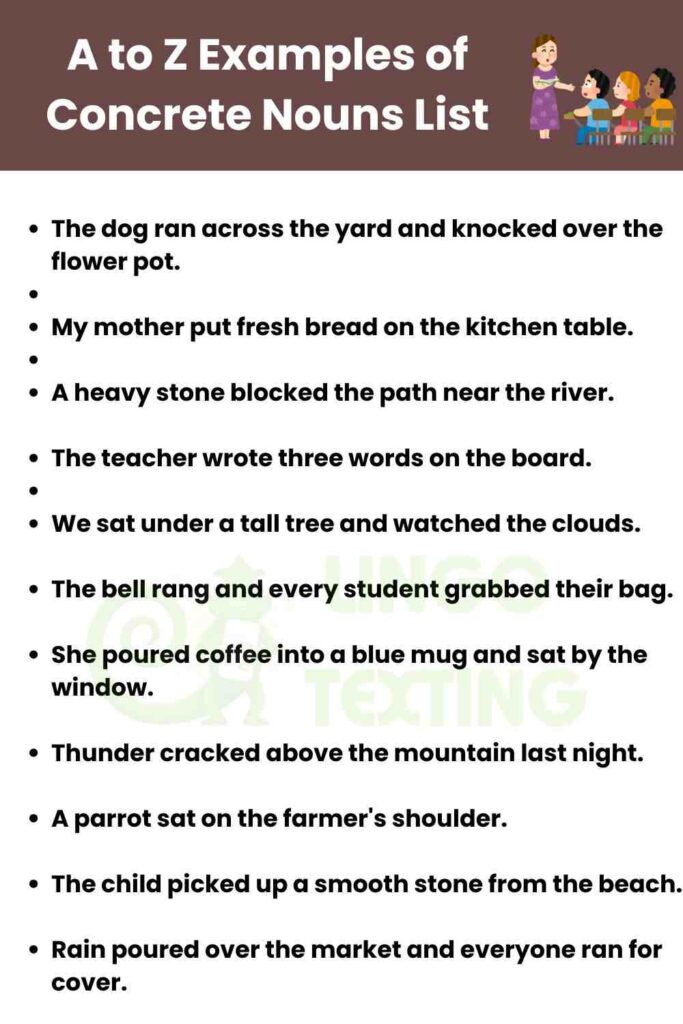
- The dog ran across the yard and knocked over the flower pot.
- My mother put fresh bread on the kitchen table.
- A heavy stone blocked the path near the river.
- The teacher wrote three words on the board.
- We sat under a tall tree and watched the clouds.
- The bell rang and every student grabbed their bag.
- She poured coffee into a blue mug and sat by the window.
- Thunder cracked above the mountain last night.
- A parrot sat on the farmer’s shoulder.
- The child picked up a smooth stone from the beach.
- Rain poured over the market and everyone ran for cover.
- He found his keys under the chair near the door.
- The nurse carried a lamp through the hospital corridor.
- My father planted a lemon tree in our garden last spring.
- The old library has books nobody has opened in fifty years.
- A wolf appeared at the edge of the forest before sunset.
- She squeezed fresh orange juice into a glass.
- The soldier stood at the bridge for three hours.
- He cut the mango with a knife and placed it on a plate.
- The cat knocked the glass off the table.
- Snow covered the roof and the entire garden.
- The drummer played so loudly the windows shook.
- She bought a jacket, a bag, and two pairs of shoes.
- The child dropped their pencil and it rolled under the chair.
- A warm smell of garlic came drifting from the kitchen.
- The pilot spoke into the microphone before takeoff.
- He pressed his face against the glass and looked into the museum.
- The horse ran past the gate and into the open field.
- My neighbor’s radio plays old music every evening.
- A crow landed on the roof and stayed there all morning.
Everyday Concrete Nouns Around You
At Home: bed, sofa, television, blanket, lamp, pillow, refrigerator, spoon, plate, mirror
At School: notebook, pencil, ruler, desk, chalk, board, bag, clock, teacher, eraser
At the Office: computer, desk, printer, phone, file, calendar, pen, lamp, stapler, chair
At the Park: bench, tree, fountain, grass, bird, path, bicycle, kite, flower, dog
At the Market: basket, fruit, bottle, scale, bag, jar, cloth, stall, vegetable, money
On the Street: car, bus, building, sign, lamp post, puddle, fence, gate, bicycle, road
Examples of Concrete Nouns for Kids
Simple words every child already knows: cat, ball, toy, cookie, bike, book, doll, apple, crayon, fish, shoe, cup, kite, drum, clock
Examples of Concrete Nouns for Students
Classroom-related and easy to remember: notebook, pencil, ruler, textbook, desk, board, chalk, bag, library, computer, eraser, clock, teacher, printer, chair
How to Identify a Concrete Noun
Run any noun through this five-question sense test:
- Can you see it?
- Can you touch it?
- Can you hear it?
- Can you smell it?
- Can you taste it?
One “yes” is enough. The noun is concrete.
If the word names a feeling, idea, or concept — like hope, justice, or loyalty — it fails every question. That makes it abstract.
Common Mistakes about Concrete Nouns
Mistake 1 — Assuming every noun is concrete. “Memory,” “anger,” and “freedom” are nouns too. But none of them are physical. Not every noun names something you can touch.
Mistake 2 — Forgetting sound and smell count. Students often think only visible or touchable things are concrete. Thunder, music, smoke, and coffee are just as concrete as a rock — because your body physically detects them through your senses.
Mistake 3 — Getting confused by tricky words like “pain.” You feel pain, but pain itself is not an object you can point to. It is a sensation, not a physical thing. Most grammarians classify it as abstract.
Mistake 4 — Thinking a sentence can only have one type. “The child’s happiness filled the room.” Child and room are concrete. Happiness is abstract. One sentence holds both — and that is completely normal.
Practice Exercises of Concrete Nouns
Find the concrete noun(s) in each sentence:
1. The bird landed on the roof.
→ bird, roof
2. She put the book on the table.
→ book, table
3. The farmer picked mangoes from the tree.
→ farmer, mangoes, tree
4. His courage was greater than his fear.
→ No concrete nouns — both are abstract
5. The dog barked at the stranger near the gate.
→ dog, stranger, gate
6. A cold glass of milk sat on the kitchen counter.
→ glass, milk, kitchen, counter
7. They played music near the river at sunset.
→ music, river
8. The nurse brought a lamp into the room.
→ nurse, lamp, room
9. His dream was to climb the mountain.
→ mountain (dream is abstract)
10. We ate cake and oranges after the game.
→ cake, oranges
Mini Quiz about Examples of Concrete Nouns
Q1. Which is a concrete noun?
A. Honesty B. Chair C. Love D. Peace
✅ B — Chair. You can see it, sit on it, touch it.
Q2. Thunder is a concrete noun because:
A. It is an emotion B. You can hear it physically C. It is an idea D. It is invisible
✅ B. Thunder is real sound produced by a physical atmospheric event.
Q3. Which sentence contains concrete nouns?
A. She felt deep sadness after the news.
B. The cat knocked the glass off the shelf.
C. His loyalty impressed everyone.
D. Freedom matters more than comfort.
✅ B — cat, glass, shelf are all concrete.
Q4. Is “music” a concrete noun?
A. No, you cannot touch it B. Yes, you can hear it C. No, it is an art form D. It depends
✅ B. Music is physical sound your ears detect — fully concrete.
Read more:
350+ Nouns That Start with E: Complete Word List with Examples
200+ Collective Noun Sentences: Examples, Meaning & Real-Life Usage
Frequently Asked Questions
Is “teacher” a concrete noun?
Yes. A teacher is a real human being — visible, physical, and present in the world. Any noun referring to an actual person qualifies as concrete without question.
Can something invisible still be a concrete noun?
Yes. If any sense detects it, it counts. Thunder is invisible but heard. Smoke is detected by smell. The rule is not limited to sight — any sensory experience qualifies.
What is the simplest way to tell concrete from abstract?
Ask: can my body experience this directly? A river, a friend, a piece of bread — yes. An idea, a feeling, a belief — no. That single question handles almost every case correctly.
Is “rain” a concrete noun?
Absolutely. You see it falling, hear it hit the ground, feel it on your skin, and even smell the air when it starts. Rain passes every sensory test there is.
Conclusion
Concrete nouns name the physical world — every person, place, animal, object, food item, and natural thing your senses can reach. They make writing vivid, sentences clear, and communication grounded in reality.
Look up from this page right now. The chair, the wall, the window, the cup nearby — every single one is a concrete noun. They were always there. Now you know exactly what to call them.

I write clear, practical English lessons for everyday use. On Lingotexting, I break down grammar, vocabulary, and word types into simple ideas you can apply quickly. My focus is accuracy, real examples, and helpful visuals, so learners build confidence, improve writing, and communicate naturally in school, work, and daily life.