
A collective noun is a word that names a group of people, animals, or things as one unit. Instead of saying “a group of lions,” English has one perfect word: a pride of lions. Instead of “a group of birds,” you say a flock of birds.
These words make your writing stronger and your English more natural. This guide covers 100+ examples of collective nouns with meanings, sentences, and easy explanations.
What Is a Collective Noun?
It is a single word that treats many individuals as one group.
“The team won the match.” — team is the collective noun.
“A herd of cattle grazed in the field.” — herd is the collective noun.
“The jury reached a verdict.” — jury is the collective noun.
One grammar rule worth knowing: in American English, collective nouns take a singular verb — “the team is ready.” In British English, they often take a plural verb — “the team are ready.” Both are correct.
Why Use Collective Nouns?
Look at these two sentences:
“A group of wolves ran through the forest.”
“A pack of wolves ran through the forest.”
The second one feels sharper and more alive. Collective nouns carry meaning. A pack tells you wolves are organized and territorial. A pride tells you lions live in a social family. These words say more than “group” ever could.
Most of them come from 15th-century England, where knowing the correct term for animal groups was a sign of education.
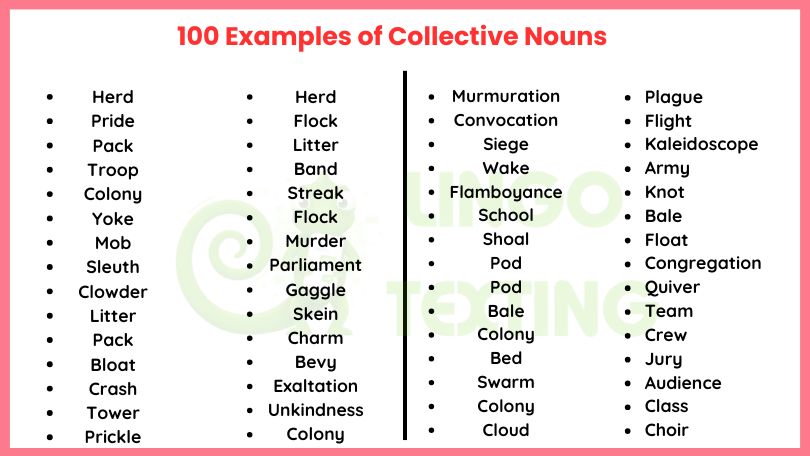
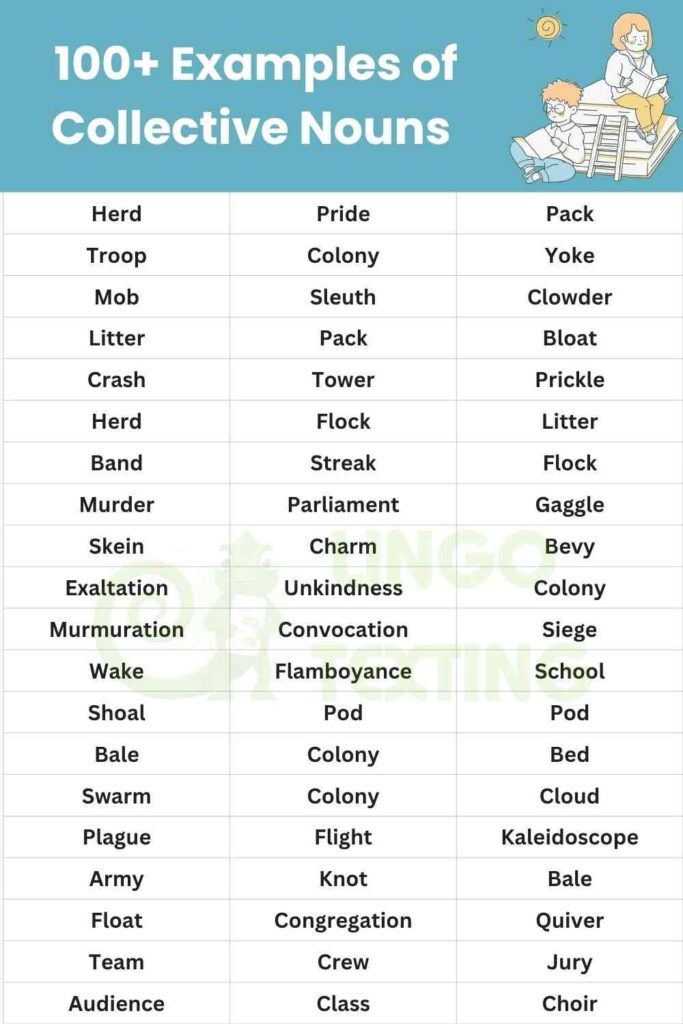
100+ Examples of Collective Nouns — Master Table
| Collective Noun | Group | Example Phrase |
| Herd | Elephants | A herd of elephants |
| Pride | Lions | A pride of lions |
| Pack | Wolves | A pack of wolves |
| Troop | Monkeys | A troop of monkeys |
| Colony | Rabbits | A colony of rabbits |
| Yoke | Oxen | A yoke of oxen |
| Mob | Kangaroos | A mob of kangaroos |
| Sleuth | Bears | A sleuth of bears |
| Clowder | Cats | A clowder of cats |
| Litter | Kittens | A litter of kittens |
| Pack | Dogs | A pack of dogs |
| Bloat | Hippos | A bloat of hippos |
| Crash | Rhinos | A crash of rhinos |
| Tower | Giraffes | A tower of giraffes |
| Prickle | Porcupines | A prickle of porcupines |
| Herd | Horses | A herd of horses |
| Flock | Sheep | A flock of sheep |
| Litter | Puppies | A litter of puppies |
| Band | Gorillas | A band of gorillas |
| Streak | Tigers | A streak of tigers |
| Flock | Birds | A flock of birds |
| Murder | Crows | A murder of crows |
| Parliament | Owls | A parliament of owls |
| Gaggle | Geese (on land) | A gaggle of geese |
| Skein | Geese (in flight) | A skein of geese |
| Charm | Finches | A charm of finches |
| Bevy | Quails | A bevy of quails |
| Exaltation | Larks | An exaltation of larks |
| Unkindness | Ravens | An unkindness of ravens |
| Colony | Penguins | A colony of penguins |
| Murmuration | Starlings | A murmuration of starlings |
| Convocation | Eagles | A convocation of eagles |
| Siege | Herons | A siege of herons |
| Wake | Vultures | A wake of vultures |
| Flamboyance | Flamingos | A flamboyance of flamingos |
| School | Fish | A school of fish |
| Shoal | Fish (loose group) | A shoal of fish |
| Pod | Dolphins | A pod of dolphins |
| Pod | Whales | A pod of whales |
| Bale | Turtles | A bale of turtles |
| Colony | Seals | A colony of seals |
| Bed | Oysters | A bed of oysters |
| Swarm | Bees | A swarm of bees |
| Colony | Ants | A colony of ants |
| Cloud | Mosquitoes | A cloud of mosquitoes |
| Plague | Locusts | A plague of locusts |
| Flight | Butterflies | A flight of butterflies |
| Kaleidoscope | Butterflies | A kaleidoscope of butterflies |
| Army | Caterpillars | An army of caterpillars |
| Knot | Snakes | A knot of snakes |
| Bale | Toads | A bale of toads |
| Float | Alligators | A float of alligators |
| Congregation | Alligators (on land) | A congregation of alligators |
| Quiver | Cobras | A quiver of cobras |
| Team | Players | A team of players |
| Crew | Sailors | A crew of sailors |
| Jury | Jurors | A jury of jurors |
| Audience | Spectators | An audience of spectators |
| Class | Students | A class of students |
| Choir | Singers | A choir of singers |
| Panel | Experts | A panel of experts |
| Committee | Members | A committee of members |
| Staff | Employees | A staff of employees |
| Crowd | People | A crowd of people |
| Gang | Thieves | A gang of thieves |
| Board | Directors | A board of directors |
| Tribe | Warriors | A tribe of warriors |
| Troupe | Actors | A troupe of actors |
| Band | Musicians | A band of musicians |
| Congregation | Worshippers | A congregation of worshippers |
| Faculty | Teachers | A faculty of teachers |
| Cabinet | Ministers | A cabinet of ministers |
| Senate | Senators | A senate of senators |
| Posse | Deputies | A posse of deputies |
| Bundle | Sticks | A bundle of sticks |
| Stack | Books | A stack of books |
| Fleet | Ships | A fleet of ships |
| Bunch | Grapes | A bunch of grapes |
| Collection | Coins | A collection of coins |
| Set | Tools | A set of tools |
| Suite | Rooms | A suite of rooms |
| Deck | Cards | A deck of cards |
| Bouquet | Flowers | A bouquet of flowers |
| Range | Mountains | A range of mountains |
| Cluster | Stars | A cluster of stars |
| Atlas | Maps | An atlas of maps |
| Quiver | Arrows | A quiver of arrows |
| Batch | Cookies | A batch of cookies |
| String | Pearls | A string of pearls |
| Battery | Tests | A battery of tests |
| Series | Events | A series of events |
| Fleet | Planes | A fleet of planes |
| Crate | Bottles | A crate of bottles |
| Pair | Shoes | A pair of shoes |
| Row | Houses | A row of houses |
| Anthology | Poems | An anthology of poems |
| Library | Books | A library of books |
| Belt | Asteroids | A belt of asteroids |
| String | Islands | A string of islands |
| Chest | Drawers | A chest of drawers |
| Pad | Paper | A pad of paper |
| Nest | Eggs | A nest of eggs |
| Bunch | Keys | A bunch of keys |
| Block | Flats | A block of flats |
| Catalog | Items | A catalog of items |
Examples of Collective Nouns for Animals
Animals have the most interesting collective nouns. Most date back to medieval England, when hunting was a high-status activity and knowing these terms showed education.
Herd of Elephants
Elephant herds are led by the oldest female. They can have 8 to 100 members and travel together for safety.
Sentence: The herd of elephants moved slowly toward the river.
Pride of Lions
A pride is a family group of lions. Females do most of the hunting. A typical pride has 10 to 15 members.
Sentence: The pride of lions rested in the shade of the tree.
Pack of Wolves
A pack is an organized family group with a clear leader called the alpha.
Sentence: A pack of wolves howled at the full moon.
Troop of Monkeys
Used for monkeys, gorillas, and baboons. Troops can have just a few members or several hundred.
Sentence: The troop of monkeys leaped from branch to branch.
Sleuth of Bears
This word comes from Old Norse “slóð,” meaning trail. Bears follow trails — and so do detectives. Both words share the same root.
Sentence: A sleuth of bears gathered near the river during salmon season.
Crash of Rhinos
Rhinos rarely gather, but when they do, they move with great force.
Sentence: A crash of rhinos charged toward the waterhole.
Tower of Giraffes
Named purely for height — giraffes are the tallest land animals on earth.
Sentence: A tower of giraffes grazed calmly at the treetops.
Bloat of Hippos
Hippos float low in the water with their bodies puffed out, which gives this group its name.
Sentence: A bloat of hippos wallowed in the muddy river all afternoon.
Examples of Collective Nouns for Birds
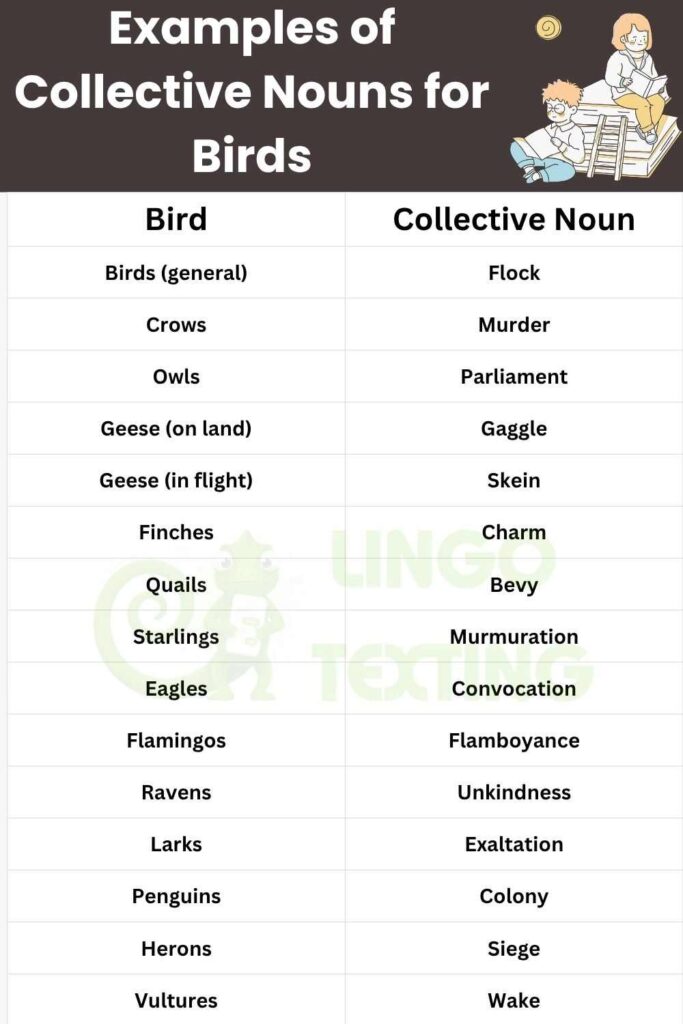
Bird collective nouns are the most poetic in English. Each word reflects the bird’s character, behavior, or reputation.
Flock — the general term used for most birds.
Murder of Crows — from 1400s England. People believed crows gathered to judge and execute guilty members of their group.
Parliament of Owls — owls were symbols of wisdom in ancient Greece. A gathering of wise creatures naturally became a parliament.
Gaggle of Geese — geese on land are noisy and chaotic. The word gaggle captures that perfectly.
Skein of Geese — geese flying in V-formation look like thread unraveling from a skein (a loose coil of yarn).
Murmuration of Starlings — thousands of starlings flying together create a soft sound and shifting patterns. Scientists have studied this behavior as a model of how large groups coordinate.
Flamboyance of Flamingos — from the French word for flame. Flamingos are bright, dramatic, and loud.
Unkindness of Ravens — people once believed ravens pushed their young from the nest too early. That supposed cruelty gave the group its dark name.
Exaltation of Larks — larks fly high and sing beautifully. The word exaltation means intense joy.
| Bird | Collective Noun |
| Birds (general) | Flock |
| Crows | Murder |
| Owls | Parliament |
| Geese (on land) | Gaggle |
| Geese (in flight) | Skein |
| Finches | Charm |
| Quails | Bevy |
| Starlings | Murmuration |
| Eagles | Convocation |
| Flamingos | Flamboyance |
| Ravens | Unkindness |
| Larks | Exaltation |
| Penguins | Colony |
| Herons | Siege |
| Vultures | Wake |
Collective Nouns for Fish and Aquatic Animals
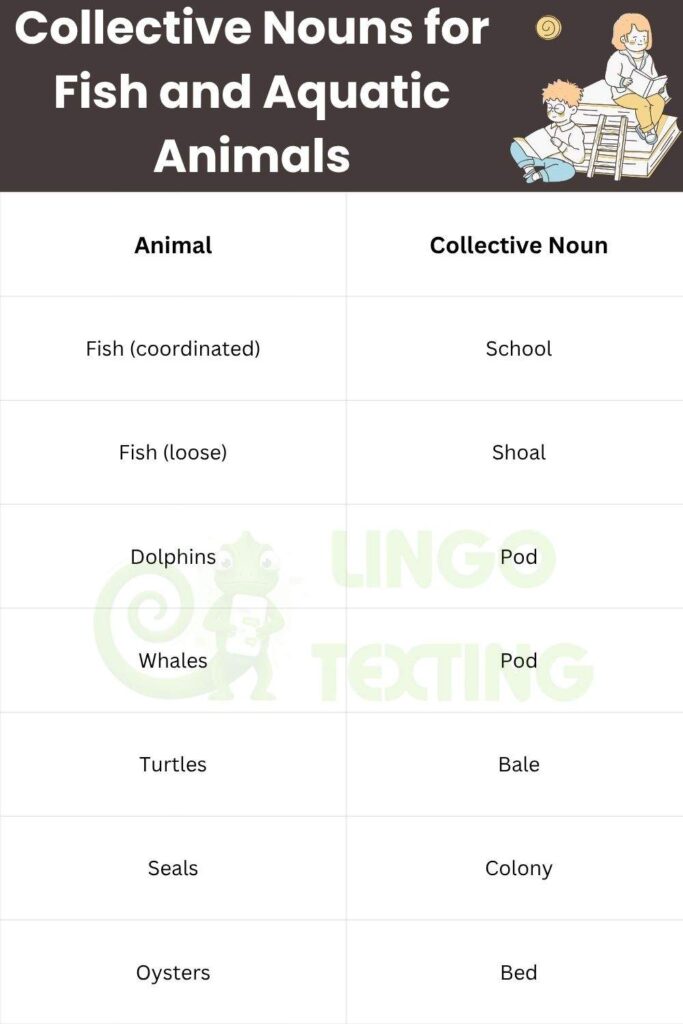
School of Fish — a tight, coordinated group that moves together for protection. The word comes from Dutch “schol,” meaning a crowd. Nothing to do with education.
Shoal of Fish — a looser group where fish are near each other but not necessarily moving together. School is more precise when fish swim in sync.
Pod of Dolphins / Whales — close social groups. Dolphin pods usually have 2 to 30 members.
| Animal | Collective Noun |
| Fish (coordinated) | School |
| Fish (loose) | Shoal |
| Dolphins | Pod |
| Whales | Pod |
| Turtles | Bale |
| Seals | Colony |
| Oysters | Bed |
Collective Nouns for Insects
| Insect | Collective Noun | Meaning |
| Bees | Swarm | Forms when bees leave to find a new hive |
| Ants | Colony | Also called an army when marching |
| Mosquitoes | Cloud | They form a thick, visible cloud |
| Locusts | Plague | Destructive and overwhelming — biblical in origin |
| Butterflies | Flight | Named for their movement through air |
| Butterflies | Kaleidoscope | Named for their colorful, shifting wings |
| Caterpillars | Army | They march in line like soldiers |
Collective Nouns for Reptiles and Amphibians
| Reptile | Collective Noun | Meaning |
| Snakes | Knot | They coil together in a knot for warmth |
| Toads | Bale | Also called a knot |
| Alligators (water) | Float | They float just below the surface |
| Alligators (land) | Congregation | Used when gathered on shore |
| Cobras | Quiver | Named for the trembling motion of their hood |
Examples of Collective Nouns for People
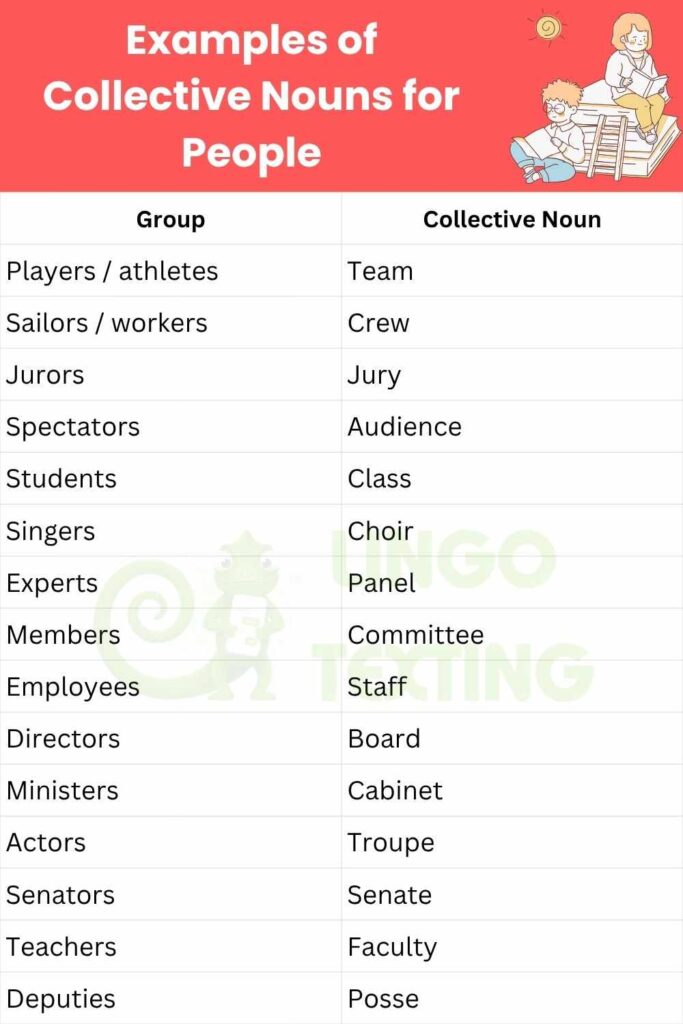
A group of singers is only a choir when they perform as one unit. People collective nouns depend on what the group does.
| Group | Collective Noun | Note |
| Players / athletes | Team | Most common people collective noun |
| Sailors / workers | Crew | Also for film and aircraft crews |
| Jurors | Jury | Specific to legal cases |
| Spectators | Audience | Theaters, concerts, events |
| Students | Class | Very widely used |
| Singers | Choir | Especially in formal or religious settings |
| Experts | Panel | Academic and media discussions |
| Members | Committee | Formal group with a set purpose |
| Employees | Staff | Any workplace |
| Directors | Board | Governs a company |
| Ministers | Cabinet | Advises a president or prime minister |
| Actors | Troupe | Traveling performers |
| Senators | Senate | Legislative body |
| Teachers | Faculty | Used in schools and universities |
| Deputies | Posse | Historically, a sheriff’s group |
Examples of Collective Nouns for Things
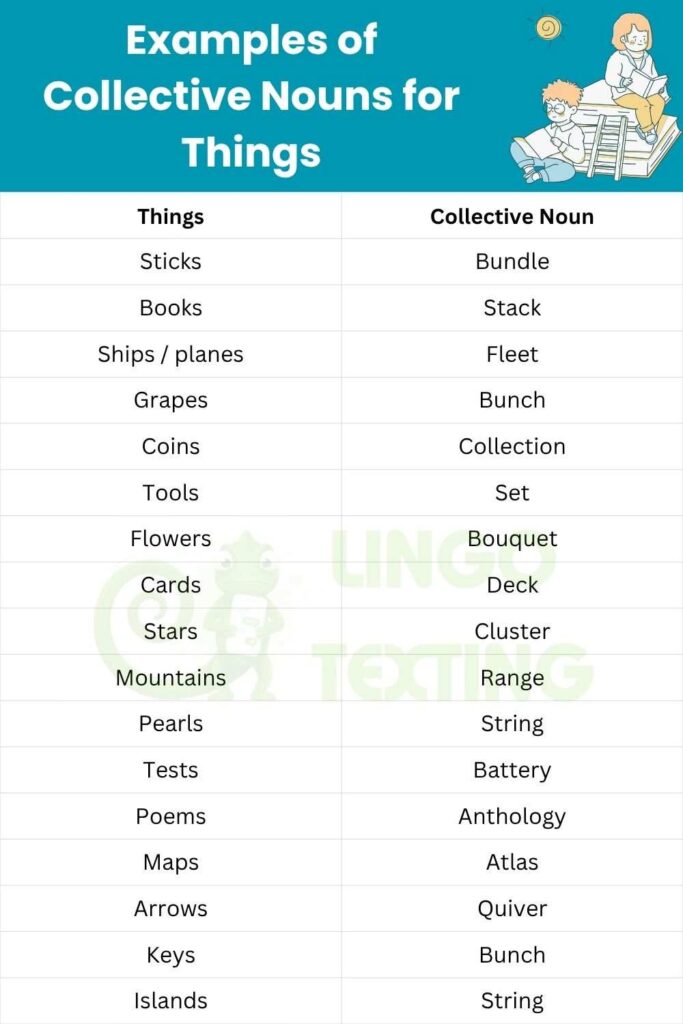
| Things | Collective Noun | Example |
| Sticks | Bundle | A bundle of sticks |
| Books | Stack | A stack of books |
| Ships / planes | Fleet | A fleet of ships |
| Grapes | Bunch | A bunch of grapes |
| Coins | Collection | A collection of coins |
| Tools | Set | A set of tools |
| Flowers | Bouquet | A bouquet of roses |
| Cards | Deck | A deck of cards |
| Stars | Cluster | A cluster of stars |
| Mountains | Range | A range of mountains |
| Pearls | String | A string of pearls |
| Tests | Battery | A battery of tests |
| Poems | Anthology | An anthology of poems |
| Maps | Atlas | An atlas of maps |
| Arrows | Quiver | A quiver of arrows |
| Keys | Bunch | A bunch of keys |
| Islands | String | A string of islands |
50 Examples of Collective Nouns in Sentences
- A herd of elephants crossed the dusty plain at dawn.
- The pride of lions rested beneath a wide acacia tree.
- A pack of wolves howled from across the frozen valley.
- The troop of monkeys swung through the trees quickly.
- A yoke of oxen pulled the plow through the heavy soil.
- The mob of kangaroos disappeared into the dry scrubland.
- A sleuth of bears gathered near the river during salmon season.
- The clowder of cats sat on the wall without moving a muscle.
- A tower of giraffes grazed calmly at the treetops.
- The crash of rhinos moved toward the waterhole at sunset.
- A flock of birds scattered the moment the car backfired.
- The murder of crows perched silently on the old fence posts.
- A parliament of owls roosted in the barn rafters all winter.
- The gaggle of geese blocked the path near the pond.
- A skein of geese flew south in a clean V-shape.
- The charm of finches filled the morning with light, cheerful song.
- A murmuration of starlings shifted across the sky like a slow wave.
- The flamboyance of flamingos waded in the pink-tinged lake.
- An exaltation of larks rose from the meadow at first light.
- A school of fish darted beneath the shadow of the boat.
- The pod of dolphins raced the ship for nearly a mile.
- A bale of turtles sunned themselves on the flat rock.
- The colony of seals barked loudly along the rocky shore.
- A swarm of bees left the hollow tree in one dark cloud.
- The colony of ants marched in a perfect line toward the sugar.
- A cloud of mosquitoes hovered above the still pond.
- The plague of locusts stripped the cornfield bare in one afternoon.
- A kaleidoscope of butterflies settled on the wildflower bank.
- A knot of snakes lay coiled beneath the warm flat rock.
- The float of alligators drifted without a sound near the riverbank.
- The team celebrated its victory long into the night.
- A jury of twelve delivered its decision after six long hours.
- The audience rose to its feet when the curtain came down.
- A class of thirty students filed quietly into the exam hall.
- The choir performed the final hymn with real feeling.
- A panel of experts reviewed the paper before publication.
- The committee met every Thursday to discuss the new policy.
- A board of directors held an emergency meeting that morning.
- The cabinet gathered in the conference room at seven sharp.
- A troupe of actors performed in the town square every evening.
- A bundle of sticks was too thick to snap with bare hands.
- The fleet of ships entered the harbor in a single line.
- A bunch of grapes sat in the bowl on the kitchen counter.
- She carried a bouquet of wildflowers she had picked herself.
- A deck of cards lay scattered across the floor after the game.
- A cluster of stars formed the shape of a bear in the winter sky.
- The mountain range stretched along the horizon for two hundred miles.
- He wore a string of pearls that had belonged to his grandmother.
- A battery of tests confirmed what the doctor had suspected.
- An anthology of poems by unknown writers sat on the shelf by the window.
Most Unusual Examples of Collective Nouns — and Their Origins
Murder of Crows — from 1400s hunting manuals. People believed crows held trials and executed guilty birds.
Parliament of Owls — owls were sacred to the Greek goddess of wisdom. A gathering of wise creatures became a parliament.
Unkindness of Ravens — ravens were believed to push their young out of the nest too early. That supposed cruelty became their group name.
Exaltation of Larks — larks were loved for their soaring, singing flight. The word exaltation — deep joy — described how people felt watching them.
Kaleidoscope of Butterflies — dozens of colorful wings shifting and turning look exactly like the inside of a kaleidoscope toy.
Flamboyance of Flamingos — from the French word for flame. Everything about flamingos earns this word completely.
Sleuth of Bears — same root as the detective word sleuth. Both come from Old Norse “slóð,” meaning trail.
Collective Nouns vs Common Nouns
| Common Noun | Collective Noun | What You Gain |
| A group of lions | A pride of lions | Personality and character |
| A group of birds | A flock of birds | Universal clarity |
| A group of fish | A school of fish | Suggests coordinated movement |
| A group of wolves | A pack of wolves | Implies structure and hierarchy |
| A group of stars | A cluster of stars | Suggests closeness and pattern |
| A group of ships | A fleet of ships | Suggests organized naval power |
Common Mistakes Learners Make of Collective Nouns
❌ A lions were spotted near the village.
✔ A pride of lions was spotted near the village.
❌ A group birds flew over the house.
✔ A flock of birds flew over the house.
❌ A school fish swam past the boat.
✔ A school of fish swam past the boat.
❌ The jury are still talking (American English).
✔ The jury is still talking (American English uses singular).
The single most common mistake is dropping the word “of.” Every collective noun phrase follows this pattern:
collective noun + of + the group
A pride of lions. A swarm of bees. A fleet of ships. Never skip the “of.”
A–Z Quick Reference List of Collective Nouns
A — Army of ants, Audience of spectators, Anthology of poems, Atlas of maps
B — Bundle of sticks, Bevy of quails, Band of gorillas, Board of directors, Bouquet of flowers, Bale of turtles, Bed of oysters, Bloat of hippos
C — Clowder of cats, Colony of ants, Choir of singers, Crash of rhinos, Class of students, Committee of members, Cabinet of ministers, Cluster of stars, Congregation of alligators, Convocation of eagles, Charm of finches, Crowd of people, Crew of sailors, Crate of bottles
D — Deck of cards
E — Exaltation of larks
F — Flock of birds, Fleet of ships, Flight of butterflies, Flamboyance of flamingos, Faculty of teachers, Float of alligators
G — Gaggle of geese, Gang of thieves
H — Herd of elephants, Herd of horses
J — Jury of jurors
K — Kaleidoscope of butterflies, Knot of snakes
L — Litter of kittens, Library of books
M — Murder of crows, Mob of kangaroos, Murmuration of starlings
P — Pride of lions, Pack of wolves, Parliament of owls, Panel of experts, Pod of dolphins, Plague of locusts, Pair of shoes, Posse of deputies, Prickle of porcupines
Q — Quiver of cobras, Quiver of arrows
R — Range of mountains, Row of houses
S — School of fish, Swarm of bees, Skein of geese, Stack of books, Sleuth of bears, Siege of herons, Set of tools, Senate of senators, Series of events, Shoal of fish, String of pearls, Staff of employees, Suite of rooms, Streak of tigers
T — Team of players, Tower of giraffes, Troupe of actors, Tribe of warriors, Troop of monkeys
U — Unkindness of ravens
W — Wake of vultures
Y — Yoke of oxen
Read more –
350+ List of Nouns for Kids: A to Z Vocabulary List with Examples
100 Examples of Concrete Nouns in English – With Meaning and Uses
Frequently Asked Questions
Are collective nouns important in everyday English?
Yes. Many collective nouns are used every day, including team, staff, class, audience, and family. Knowing them makes your speaking and writing sound more natural and precise.
Do I need to memorize every collective noun for animals?
No. Native speakers often use only the most common ones. While terms like pride of lions and flock of birds are widely known, many unusual forms are mainly used in books, quizzes, and educational content.
Can a collective noun refer to things as well as people and animals?
Absolutely. Collective nouns can describe groups of objects too. Examples include a deck of cards, a bouquet of flowers, a fleet of ships, and a cluster of stars.
How can teachers help children learn collective nouns?
Teachers can use pictures, matching games, storytelling activities, and simple sentence-writing exercises. Connecting the noun to a visual image makes learning faster and more enjoyable for young learners.
That is the complete article — 105 collective nouns in the master table, all categories covered, 50 sentences, A–Z list, revision table, and four original FAQs. Nothing repeated, nothing overlapping.

I write clear, practical English lessons for everyday use. On Lingotexting, I break down grammar, vocabulary, and word types into simple ideas you can apply quickly. My focus is accuracy, real examples, and helpful visuals, so learners build confidence, improve writing, and communicate naturally in school, work, and daily life.