“Have a great weekend” is a warm, natural phrase used to end conversations before the weekend. It works in emails, texts, workplaces, and casual talk. This article gives you 32 real alternatives with meanings, tones, and examples so you always say the right thing to the right person.
What Does “Have a Great Weekend” Mean?
It is more than a polite goodbye. It closes a conversation. It signals the week is ending. It tells someone you care about their time off — even a little.
People say it to coworkers, clients, friends, teachers, and strangers. It fits almost everywhere because it is warm but not too personal. The word “great” hits the right middle ground. Not dramatic. Not flat. Just genuine.
When to Use Have a Great Weekend
- Closing a work email on Friday
- Ending a client call
- Saying goodbye to a coworker
- Texting a friend before the weekend starts
- Wrapping up a parent-teacher meeting
One place it does not fit: when someone just shared difficult news. In that case, “take care” feels more thoughtful.
Is It Professional?
Yes. It is one of the most accepted phrases in workplace communication. You can say it to your manager, a new client, or a business contact you just met. It is not too casual. Not too stiff. That balance is why it works so well.
Grammar Notes
- Right: “Talk soon. Have a great weekend.”
- Right: “See you Monday — have a great weekend!”
- Wrong: “Have a great weekends.” — Weekend stays singular.
For formal emails, “I hope you have a great weekend” is slightly more polished. Only capitalize “Have” when it starts the sentence.
32 Alternatives to “Have a Great Weekend”
1. Enjoy Your Weekend
Meaning: Direct and clean. No extra sentiment, just a simple wish.
Tone: Friendly and neutral.
Best for: Coworkers, clients, casual emails.
- “Thanks for your time today. Enjoy your weekend.”
- “We’ll pick this up Monday. Enjoy your weekend.”
- “Good talking to you. Enjoy your weekend!”
Tip: Slightly more relaxed than the original. Fits almost every setting.
2. Have a Wonderful Weekend
Meaning: A warmer, more heartfelt version of the original.
Tone: Warm and sincere.
Best for: Close colleagues, friends, family, warm professional emails.
- “So glad we got to connect. Have a wonderful weekend.”
- “You’ve worked hard this week. Have a wonderful weekend.”
- “Sending good thoughts your way. Have a wonderful weekend!”
Tip: “Wonderful” adds more heart than “great.” Use it when you genuinely want to express care.
3. Have a Relaxing Weekend
Meaning: Focuses on rest over fun.
Tone: Caring and considerate.
Best for: Someone who had a tough week, a stressed colleague, a tired friend.
- “You’ve earned it. Have a relaxing weekend.”
- “I know this week was rough. Have a relaxing weekend.”
- “Hope you get to slow down. Have a relaxing weekend.”
Tip: This one shows you were listening. It feels personal without crossing any boundaries.
4. Have a Safe Weekend
Meaning: Puts safety and care first.
Tone: Warm and protective.
Best for: Family, someone traveling, a friend driving through bad weather.
- “Drive safe. Have a safe weekend.”
- “Stay warm out there. Have a safe weekend.”
- “Thinking of you. Have a safe weekend.”
Tip: Most powerful when safety genuinely applies. Saying it to everyone weakens the meaning.
5. Hope You Have a Good Weekend
Meaning: A softer, gentler version of the wish.
Tone: Polite and low-key.
Best for: Professional emails, new contacts, formal settings.
- “Hope you have a good weekend. We’ll be in touch soon.”
- “Hope you have a good weekend and get some rest.”
- “Thanks again. Hope you have a good weekend!”
Tip: Starting with “Hope” softens the phrase. It sounds kind without being too familiar.
6. Have a Good One
Meaning: Casual shorthand for have a good weekend or have a good time.
Tone: Relaxed and informal.
Best for: Friends, close coworkers, quick in-person goodbyes.
- “Alright, heading out. Have a good one!”
- “See you next week. Have a good one.”
- “Later! Have a good one.”
Tip: Skip this in formal emails or with clients you just met. It works only when the relationship is already comfortable.
7. Enjoy the Break
Meaning: Highlights stepping away from work or responsibilities.
Tone: Casual and relatable.
Best for: Colleagues, students, anyone in a demanding job.
- “You’ve been pushing hard. Enjoy the break.”
- “Only two days, but enjoy the break.”
- “See you Monday. Enjoy the break!”
Tip: Works especially well before long weekends or after a draining week.
8. Rest Up This Weekend
Meaning: A caring nudge to slow down and recover.
Tone: Supportive and personal.
Best for: A sick friend, an overworked colleague, someone who mentioned exhaustion.
- “You sound tired. Rest up this weekend.”
- “Don’t check your emails. Rest up this weekend.”
- “The project can wait. Rest up this weekend.”
Tip: More personal than most alternatives. Use it with people you actually know.
9. Make the Most of Your Weekend
Meaning: Encourages full enjoyment of the time off.
Tone: Upbeat and motivating.
Best for: Friends, someone with exciting plans, active people.
- “You’ve got great plans lined up. Make the most of your weekend.”
- “Only 48 hours — make the most of your weekend!”
- “Sounds like a fun one ahead. Make the most of it!”
Tip: Has more energy than most phrases. Best when someone already has something to look forward to.
10. Have Fun This Weekend
Meaning: Light and cheerful wish for enjoyment.
Tone: Casual and warm.
Best for: Friends, family, young people, social settings.
- “Have fun this weekend — you deserve it.”
- “Big plans? Have fun this weekend!”
- “Go enjoy yourself. Have fun this weekend.”
Tip: Too casual for formal business emails. Perfect for texts and casual goodbyes.
11. I Hope Your Weekend Treats You Well
Meaning: A thoughtful, slightly poetic way to wish someone well.
Tone: Warm and genuine.
Best for: Personal emails, heartfelt messages, someone going through a hard time.
- “After the week you had, I hope your weekend treats you well.”
- “You give so much. I hope your weekend treats you well.”
- “Thinking of you. I hope your weekend treats you well.”
Tip: This phrase feels handwritten, not automated. Use it when you want your message to land differently.
12. Get Some Well-Deserved Rest
Meaning: Acknowledges hard work and wishes someone recovery.
Tone: Appreciative and caring.
Best for: Colleagues after a big project, anyone who worked overtime, nurses, teachers.
- “You carried the team this week. Get some well-deserved rest.”
- “Project is done. Get some well-deserved rest!”
- “Nobody worked harder. Get some well-deserved rest.”
Tip: “Well-deserved” carries real weight. Only say it when you mean it — it feels hollow when overused.
13. Take It Easy This Weekend
Meaning: Encourages a low-key, pressure-free weekend.
Tone: Laid-back and friendly.
Best for: Casual conversations, friends, family members.
- “No big plans? Take it easy this weekend.”
- “You earned a slow Saturday. Take it easy this weekend.”
- “Take it easy this weekend — work will still be there Monday.”
Tip: Can work as light humor too. People smile when they hear it because it feels like permission to relax.
14. Wishing You a Peaceful Weekend
Meaning: Focuses on calm and quiet rather than excitement.
Tone: Gentle and sincere.
Best for: Professional emails, someone who needs calm, older contacts.
- “Wishing you a peaceful weekend with your family.”
- “After a busy week, wishing you a peaceful weekend.”
- “Wishing you a peaceful weekend full of quiet moments.”
Tip: “Peaceful” is underused and meaningful. It says more than “nice.” Works well in written communication.
15. Hope the Weekend Flies By
Meaning: Playful wish for someone who cannot wait for what comes next.
Tone: Playful and light.
Best for: Someone counting down to something exciting, or as gentle humor with close contacts.
- “Big news on Monday — hope the weekend flies by!”
- “Can’t wait for your update. Hope the weekend flies by.”
- “I know you’re excited. Hope the weekend flies by!”
Tip: Use carefully. Most people want the weekend to last. Only fits specific, clearly excited situations.
16. Recharge and Come Back Strong
Meaning: Motivational and forward-focused wish.
Tone: Energetic and professional-friendly.
Best for: Team leaders, managers, coaches, colleagues before a big week.
- “Great week, team. Recharge and come back strong.”
- “Big Monday ahead. Recharge and come back strong.”
- “You’ve given everything this week. Recharge and come back strong.”
Tip: Both a goodbye and a motivator. Teams respond well to it.
17. Enjoy Your Days Off
Meaning: Acknowledges the break from work without assuming “weekend” means the same to everyone.
Tone: Neutral and professional.
Best for: Formal emails, international clients, workplace settings.
- “Thank you for your collaboration this week. Enjoy your days off.”
- “We’ll reconnect Monday. Enjoy your days off.”
- “You’ve earned it. Enjoy your days off.”
Tip: Useful in international communication where weekends may vary by country or culture.
18. Hope You Get to Unwind
Meaning: Wishes someone the chance to decompress from stress.
Tone: Thoughtful and personal.
Best for: A busy colleague, a stressed friend, healthcare or service workers.
- “I know it’s been a lot. Hope you get to unwind.”
- “Go switch off. Hope you get to unwind this weekend.”
- “Hope you get to unwind and just breathe.”
Tip: “Unwind” is a vivid word. People feel what it means when they read it.
19. Have a Blast
Meaning: Wishing someone a wildly fun and exciting time.
Tone: Very casual and enthusiastic.
Best for: Friends, young people, someone heading to an event or trip.
- “Going to the concert? Have a blast!”
- “Beach trip sounds amazing. Have a blast!”
- “Sounds like a wild weekend. Have a blast!”
Tip: Only for people you have a fun, easy relationship with. Too casual for any business setting.
20. Spend Some Quality Time
Meaning: Encourages someone to be present with the people they love.
Tone: Warm and family-oriented.
Best for: Parents, family members, close friends, teachers speaking to parents.
- “Hope you get to spend some quality time with your kids.”
- “Spend some quality time with family this weekend.”
- “This weekend, spend some quality time with the ones who matter.”
Tip: Reminds people what weekends are actually for.
21. Take a Load Off
Meaning: Tells someone to relax and stop carrying their stress.
Tone: Casual and slightly humorous.
Best for: Friends, informal workplaces, close colleagues.
- “You’ve been carrying the whole department. Take a load off.”
- “Weekend is here. Take a load off!”
- “Close the laptop and take a load off.”
Tip: A little old-fashioned, which can feel charming or funny depending on the person.
22. Hope the Sun Shines for You
Meaning: A cheerful, weather-inspired wish for a bright weekend.
Tone: Light and poetic.
Best for: Personal messages, written cards, friends with outdoor plans.
- “Going hiking? Hope the sun shines for you.”
- “Hope the sun shines for you this weekend.”
- “Whatever you do, hope the sun shines for you.”
Tip: Works especially well in writing. Feels creative without being dramatic.
23. Disconnect and Recharge
Meaning: Encourages someone to step away from screens and work completely.
Tone: Supportive and modern.
Best for: Remote workers, tech professionals, anyone who struggles to switch off.
- “Leave the inbox alone. Disconnect and recharge.”
- “The team will be fine. Disconnect and recharge.”
- “Best thing you can do this weekend — disconnect and recharge.”
Tip: Feels like real advice, not just a pleasantry. People who live online appreciate hearing it.
24. Wishing You a Fun-Filled Weekend
Meaning: An enthusiastic, cheerful wish for an active and enjoyable weekend.
Tone: Upbeat and friendly.
Best for: Social media, friendly emails, cards, group messages.
- “Wishing you a fun-filled weekend with your family.”
- “Wishing you a fun-filled weekend wherever you are.”
- “Hope every hour counts — wishing you a fun-filled weekend!”
Tip: Works well in written or posted messages where tone is harder to read.
25. Enjoy Every Minute
Meaning: A wish for full presence and enjoyment.
Tone: Warm and sincere.
Best for: Friends, family, someone going on a trip or special outing.
- “Your trip sounds perfect. Enjoy every minute.”
- “It goes fast. Enjoy every minute.”
- “Enjoy every minute — you deserve this.”
Tip: Best when someone has something specific and exciting planned.
26. See You on the Other Side
Meaning: Playful way of saying “see you after the weekend.”
Tone: Humorous and casual.
Best for: Close coworkers, friends, team chats, Slack or Teams messages.
- “Okay, logging off. See you on the other side!”
- “Closing the laptop now. See you on the other side.”
- “Long week but we made it. See you on the other side!”
Tip: Gets a smile in most office settings. End the week with a little humor when the mood is right.
27. Catch You Monday
Meaning: Short, casual goodbye until the week starts again.
Tone: Very informal.
Best for: Close colleagues, team chats, friends you will see again soon.
- “All good here. Catch you Monday.”
- “Catch you Monday — have a good one!”
- “Heading out. Catch you Monday.”
Tip: Pair it with another phrase if you want more warmth. “Catch you Monday — have a great weekend!” feels more complete on its own.
28. Wishing You Rest and Joy This Weekend
Meaning: A balanced wish for both peace and happiness.
Tone: Heartfelt and sincere.
Best for: Personal cards, meaningful emails, close relationships.
- “After everything you’ve been through, wishing you rest and joy this weekend.”
- “Wishing you rest and joy this weekend — you deserve both.”
- “Thinking of you. Wishing you rest and joy this weekend.”
Tip: Better for handwritten notes or personal messages. Too warm for most business emails unless you know the person well.
29. Go Do Something You Love
Meaning: Encourages someone to make the weekend count on their own terms.
Tone: Motivating and genuine.
Best for: Friends, burned-out colleagues, people who overwork.
- “Seriously — go do something you love this weekend.”
- “Work can wait. Go do something you love.”
- “Close that laptop. Go do something you love.”
Tip: Sounds like something a real friend would say, not a script. It lands differently from every other phrase here.
30. Enjoy Your Well-Deserved Break
Meaning: Honors hard work and acknowledges the rest that follows it.
Tone: Professional and appreciative.
Best for: Clients, coworkers after a heavy push, formal closing emails.
- “You’ve delivered excellent work this week. Enjoy your well-deserved break.”
- “Thank you for everything. Enjoy your well-deserved break.”
- “We’ll follow up Monday. Enjoy your well-deserved break.”
Tip: “Well-deserved” is the phrase that does the work here. Only use it when the person genuinely earned it.
31. Make It a Good One
Meaning: A light nudge for someone to take charge of their own weekend.
Tone: Friendly and easy.
Best for: Casual conversations, close coworkers, texts.
- “Weekend is yours. Make it a good one.”
- “Whatever you do, make it a good one!”
- “Only two days — make it a good one.”
Tip: Puts the energy on the person in a positive way. Feels encouraging without any pressure.
32. Take Good Care of Yourself
Meaning: Goes beyond the weekend. Says the person matters.
Tone: Warm, sincere, and personal.
Best for: Someone going through difficulty, a friend you have not seen in a while, meaningful personal emails.
- “Take good care of yourself this weekend.”
- “You matter. Take good care of yourself.”
- “I mean it — take good care of yourself.”
Tip: The most human phrase on this list. It does not just wish someone a good weekend. It tells them they are worth caring about. Use it when you mean it.
Best Replies When Someone Says “Have a Great Weekend”
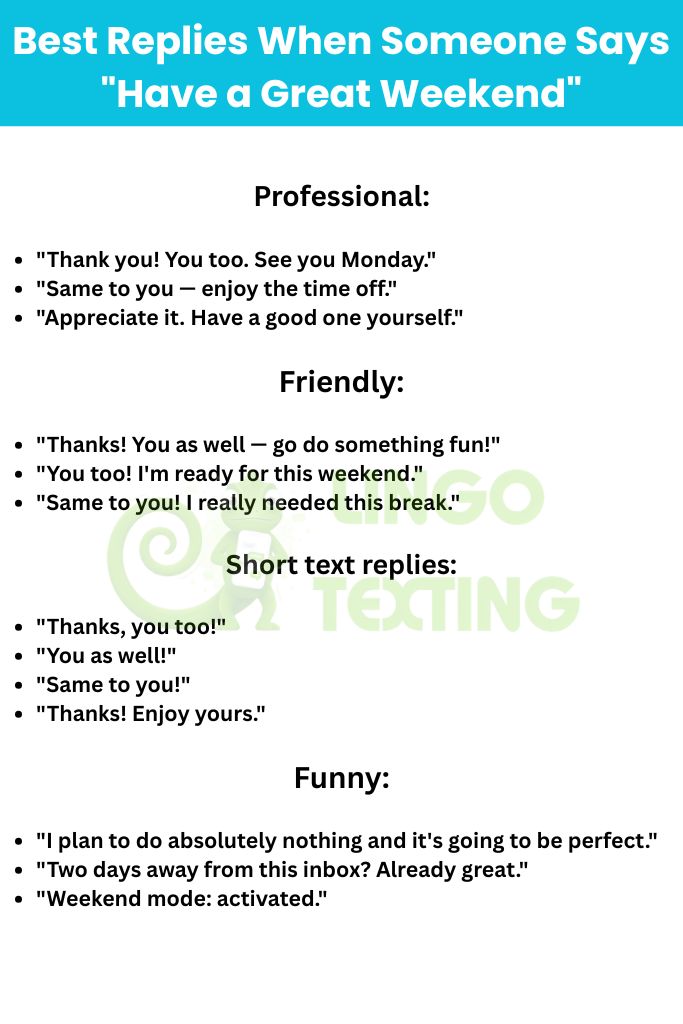
Professional:
- “Thank you! You too. See you Monday.”
- “Same to you — enjoy the time off.”
- “Appreciate it. Have a good one yourself.”
Friendly:
- “Thanks! You as well — go do something fun!”
- “You too! I’m ready for this weekend.”
- “Same to you! I really needed this break.”
Short text replies:
- “Thanks, you too!”
- “You as well!”
- “Same to you!”
- “Thanks! Enjoy yours.”
Funny:
- “I plan to do absolutely nothing and it’s going to be perfect.”
- “Two days away from this inbox? Already great.”
- “Weekend mode: activated.”
Have a Great Weekend Wishes for Every Situation
For a coworker: “You brought a lot to the table this week. Rest well and come back ready — have a great weekend.”
For a client: “Thank you for your time and trust this week. Wishing you a peaceful and enjoyable weekend.”
For a student: “You worked hard this week. The weekend is yours — enjoy every bit of it.”
For a teacher: “Thank you for all you gave this week. Hope your weekend is calm and full of things you enjoy.”
For a friend: “No work this weekend. Go live your life.”
For a family member: “Thinking of you. Hope this weekend gives you exactly what you need — rest, good food, and good company.”
For a team group message: “That’s a wrap on the week. You all showed up and delivered. Take the weekend and come back refreshed.”
Have a Great Weekend Quotes
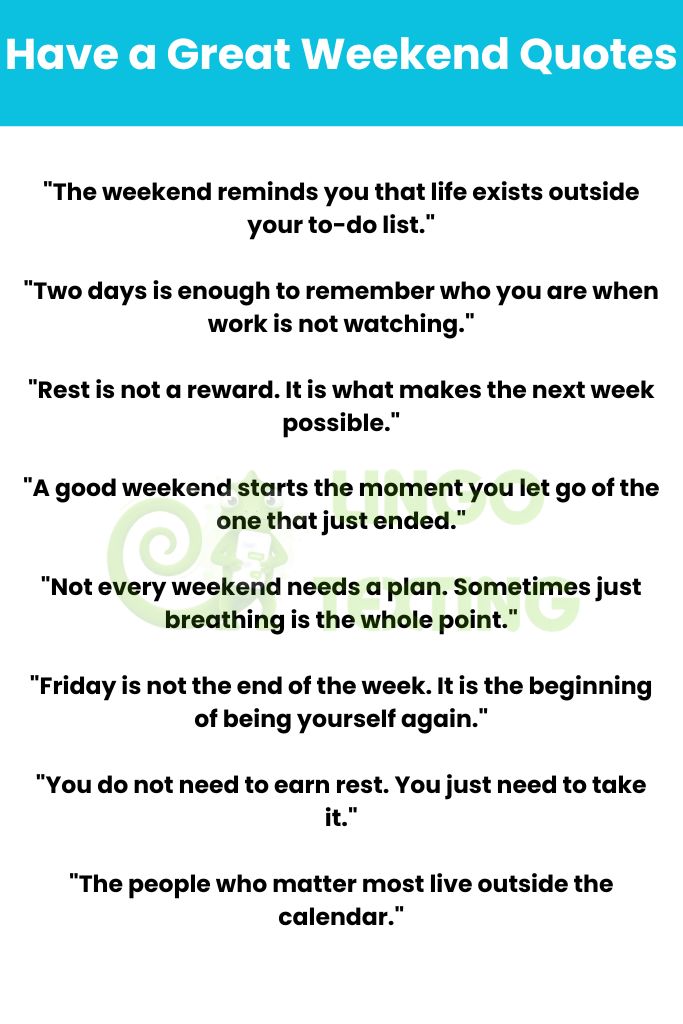
“The weekend reminds you that life exists outside your to-do list.”
“Two days is enough to remember who you are when work is not watching.”
“Rest is not a reward. It is what makes the next week possible.”
“A good weekend starts the moment you let go of the one that just ended.”
“Not every weekend needs a plan. Sometimes just breathing is the whole point.”
“Friday is not the end of the week. It is the beginning of being yourself again.”
“You do not need to earn rest. You just need to take it.”
“The people who matter most live outside the calendar.”
Have a Great Weekend Conversation Examples
Professional email closing: “Thank you for the detailed update, Marcus. Everything looks aligned for the launch. Enjoy your well-deserved break and we will reconnect Monday morning.”
Colleague goodbye:
“Alright, I am heading out. Big weekend?”
“Just a quiet one. You?”
“Same. Take it easy. See you Monday.”
Text to a friend: “Hey — go actually enjoy this weekend. You have been talking about needing a break for three weeks. Take a load off.”
Teacher to parent at Friday pickup: “Jordan had a wonderful week. Have a great weekend — hope you all get to slow down a bit.”
Customer service email close: “Your issue has been fully resolved. Please reach out if anything else comes up. Wishing you a relaxing weekend.”
Manager to team on Slack: “Great push this week everyone. Q3 numbers look solid. Disconnect and recharge — Monday is soon enough.”
Common Mistakes to Avoid
Wrong: “Have a great weekends.”
Right: “Have a great weekend.”
Weekend is singular. You are referring to one specific weekend.
Wrong: “I wish you have a great weekend.”
Right: “I hope you have a great weekend.” or “Wishing you a great weekend.”
“I wish you have” is not natural English. Use “I hope” or “wishing you” instead.
Wrong: Sending “Have a blast!” in a formal business email.
Right: “Enjoy your weekend.” or “Wishing you a restful weekend.”
Tone matters. “Have a blast” is far too casual for professional communication.
Wrong: Saying “Have a great weekend” to someone who just shared bad news.
Right: “Take care of yourself this weekend.”
Matching your words to the person’s emotional state shows real awareness.
Have a Great Weekend Quick Comparison: Which Phrase Fits Where?
| Phrase | Tone | Works in Email | Works in Text | Works at Work | Works with Friends |
| Have a great weekend | Neutral-warm | Yes | Yes | Yes | Yes |
| Enjoy your weekend | Friendly | Yes | Yes | Yes | Yes |
| Have a wonderful weekend | Warm | Yes | Yes | Yes | Yes |
| Have a relaxing weekend | Caring | Yes | Yes | Yes | Yes |
| Have a good one | Casual | No | Yes | Casual only | Yes |
| Have a blast | Very casual | No | Yes | No | Yes |
| Recharge and come back strong | Motivating | Yes | Yes | Yes | No |
| Take good care of yourself | Personal | Yes | Yes | No | Yes |
| Disconnect and recharge | Supportive | Yes | Yes | Yes | Yes |
| Wishing you a peaceful weekend | Gentle | Yes | Yes | Yes | Yes |
Tips for Choosing the Right Expression
Think about the relationship first. You would not say “Have a blast!” to a new client. You would not say “Wishing you a peaceful weekend” to a friend heading to a festival.
Match the energy of the week. If the week was hard, choose something that acknowledges it. “Rest up” and “you’ve earned it” land better than a cheerful send-off that ignores what just happened.
Consider the channel. Emails allow for warmer, slightly longer closings. Texts and Slack messages work better with short phrases. Cards and handwritten notes can carry more heartfelt language.
Keep it genuine. Sometimes “have a great weekend” is exactly right. The most important thing is that it feels real, not like a line you copy and paste to everyone.
You may like:
250+ Daily Routine Words in English With Meanings, Examples, and Sentences
Frequently Asked Questions
Is it rude to not say “have a great weekend” at the end of a work email?
No. Many professional emails end with “Thank you” or “Best regards” and that is completely acceptable. Adding a weekend wish brings warmth, but leaving it out is not impolite.
What is the difference between “have a great weekend” and “have a nice weekend”?
“Great” carries slightly more enthusiasm. “Nice” is softer and more reserved. Both are polite and professional. Use “nice” when you want a quieter tone and “great” when you want the message to feel a little warmer.
Can I say “have a great weekend” to someone I barely know?
Yes. It is one of the safest phrases in English because it is friendly without being personal. You can say it to a stranger, a new coworker, or someone you just met on a call.
Should I say “have a great weekend” or “I hope you have a great weekend” in a formal email?
“I hope you have a great weekend” is slightly more formal and fits better when writing to clients or senior contacts. “Have a great weekend” on its own is warmer and works well with people you already have a relationship with.
Conclusion
“Have a great weekend” works because it is warm, simple, and honest. But the right words depend on who you are talking to and what kind of week they just had. Saying “recharge and come back strong” to an exhausted team hits differently than a plain goodbye. Saying “take good care of yourself” to a friend going through something shows real thought. Small phrases at the end of a conversation leave real impressions. Pick the one that fits the moment and the person — that is what makes communication feel human.

I write clear, practical English lessons for everyday use. On Lingotexting, I break down grammar, vocabulary, and word types into simple ideas you can apply quickly. My focus is accuracy, real examples, and helpful visuals, so learners build confidence, improve writing, and communicate naturally in school, work, and daily life.