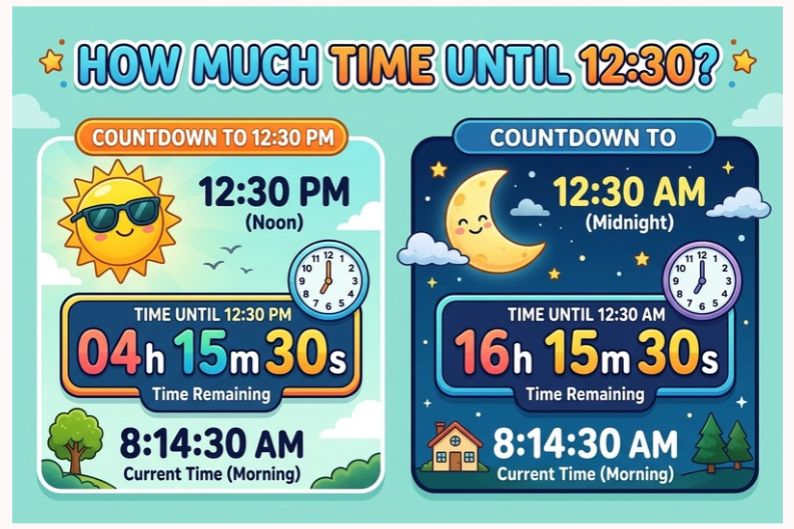
The countdown above uses the clock on your own device, so the answer is right wherever you are. If you’d rather work it out yourself, or the countdown isn’t loading, the method below takes about ten seconds.
The most useful thing to know first: 12:30 happens twice every day, once just after midnight and once just after noon. So whatever time it is now, the next 12:30 is never more than 12 hours away. The real question is which one you mean.
12:30 PM or 12:30 AM?
- 12:30 PM is half an hour after noon. It’s lunchtime, and on a 24-hour clock it is written 12:30.
- 12:30 AM is half an hour after midnight, in the middle of the night. On a 24-hour clock it is written 00:30.
If you saw “12:30” with no AM or PM in a work email, a school timetable or a lunch plan, it almost always means 12:30 PM. If it was written in 24-hour format, 12:30 always means midday.
The 12:30 AM trap
People often say “Friday night at 12:30.” On a clock and in a calendar app, that moment is 12:30 AM on Saturday, not Friday. If a deadline, ticket sale or submission portal closes at “12:30 AM Friday,” it closes in the first half hour of Friday. That is roughly 24 hours earlier than many people expect.
When a date is attached to 12:30 AM, ask yourself whether that date is the night that’s ending or the day that’s starting. The clock always uses the day that’s starting.
The 12 o’clock hour causes this confusion for a reason. The U.S. National Institute of Standards and Technology notes that 12 a.m. and 12 p.m. are ambiguous, since noon is neither before nor after noon. Clocks and phones handle this by convention: they show the hour after midnight as AM and the hour after noon as PM. The safest habit when you write a time yourself is to add “noon,” “midnight,” or the 24-hour form, for example “12:30 (midday)” or “00:30 Saturday.”
Work it out yourself in two steps
Counting backward across noon or midnight is where mental math goes wrong. It’s easier to count forward:
- Count the minutes up to the next half hour (the next :30 on the clock).
- Count the whole hours from there to 12:30.
- Add the two together.
Example 1: It’s 9:47 AM and you want 12:30 PM.
- 9:47 → 10:30 is 43 minutes.
- 10:30 → 12:30 is 2 hours.
- Answer: 2 hours 43 minutes, which is 163 minutes in total.
Example 2: It’s 4:34 PM and you want the next 12:30.
- 4:34 → 5:30 is 56 minutes.
- 5:30 PM → 12:30 AM is 7 hours, so 12:30 AM is 7 hours 56 minutes away.
- 5:30 PM → 12:30 PM tomorrow is 19 hours, so 12:30 PM is 19 hours 56 minutes away.
The second example shows why it matters which 12:30 you mean: the two answers are exactly 12 hours apart.
Two quick patterns:
- If the current time is exactly on the hour (9:00, 3:00), the answer always ends in 30 minutes.
- If it’s exactly half past (9:30, 3:30), the answer is a whole number of hours.
If your result doesn’t fit these patterns, recheck the minutes.
If it’s already past 12:30 PM, the next 12:30 PM is tomorrow. Add 24 hours to your negative result, or simply count forward from now. For example, at 12:45 PM the next 12:30 PM is 23 hours 45 minutes away, but 12:30 AM is only 11 hours 45 minutes away.
Quick reference
Time remaining from common starting points. Each answer is the next occurrence, which may be tomorrow.
| If it’s now… | Until 12:30 PM | Until 12:30 AM |
| 12:00 AM (midnight) | 12 h 30 min | 30 min |
| 6:00 AM | 6 h 30 min | 18 h 30 min |
| 8:00 AM | 4 h 30 min | 16 h 30 min |
| 9:00 AM | 3 h 30 min | 15 h 30 min |
| 10:00 AM | 2 h 30 min | 14 h 30 min |
| 11:00 AM | 1 h 30 min | 13 h 30 min |
| 11:45 AM | 45 min | 12 h 45 min |
| 12:00 PM (noon) | 30 min | 12 h 30 min |
| 1:00 PM | 23 h 30 min | 11 h 30 min |
| 3:00 PM | 21 h 30 min | 9 h 30 min |
| 6:00 PM | 18 h 30 min | 6 h 30 min |
| 9:00 PM | 15 h 30 min | 3 h 30 min |
| 11:00 PM | 13 h 30 min | 1 h 30 min |
| 11:45 PM | 12 h 45 min | 45 min |
Turning the answer into minutes or seconds
Some timers, apps and spreadsheets ask for one number instead of hours and minutes.
- Total minutes = hours × 60 + minutes. For example, 2 hours 43 minutes = 120 + 43 = 163 minutes.
- Total seconds = total minutes × 60. For example, 163 × 60 = 9,780 seconds.
You can also count minutes after midnight. 12:30 PM is minute 750 of the day and 12:30 AM is minute 30. Convert the current time the same way (hour on a 24-hour clock × 60 + minutes) and subtract. If the result is negative, add 1,440, the number of minutes in a day, to get the next occurrence.
When the 12:30 is in someone else’s time zone
A webinar at “12:30 PM Eastern” or a game release at “12:30 AM GMT” doesn’t happen at 12:30 on your clock. Convert the time to your own zone first, then count.
For example, 12:30 PM in New York in winter (EST, UTC−5) is 5:30 PM in London and 10:30 PM in Pakistan (PKT, UTC+5). For someone in Karachi, “time until 12:30 PM Eastern” really means “time until 10:30 PM local.”
Daylight saving time matters only on the night the clocks change, and only if your countdown runs through that change. On the night clocks go back, a stretch that looks like 13 hours on the clock is really 14 hours of elapsed time. On the night they go forward, it’s 12. A countdown that uses real dates, like the one at the top of this page, handles this automatically. Mental math using the clock face does not.
Read more about these:
- Thanks for Your Understanding vs Thank You for Understanding: Which Is Correct?
- Moving Forward vs Going Forward: What’s the Difference?
- Thanks for the Heads Up vs Thanks for a Heads Up: Which Is Correct?
- Willful vs Wilful: Which Spelling Is Correct?
- Congratulations vs Congradulations: Which Spelling Is Correct?

I write clear, practical English lessons for everyday use. On Lingotexting, I break down grammar, vocabulary, and word types into simple ideas you can apply quickly. My focus is accuracy, real examples, and helpful visuals, so learners build confidence, improve writing, and communicate naturally in school, work, and daily life.