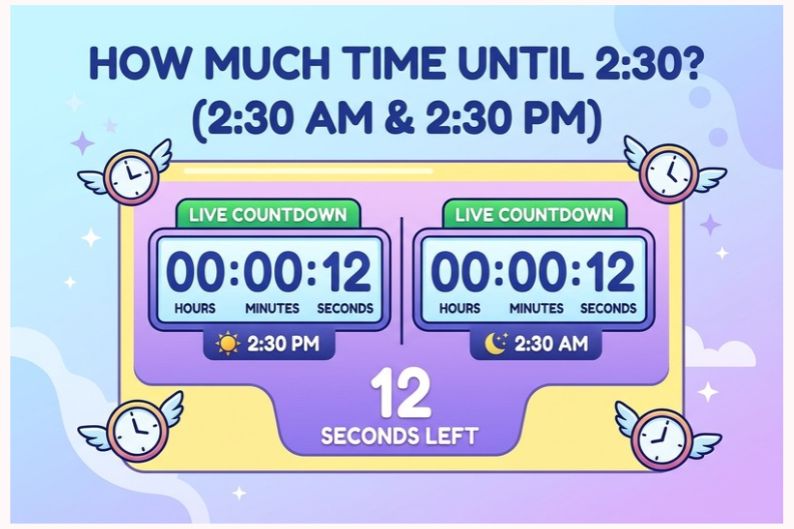
Countdown to 2:30 PM
Based on your local device time
The countdown above reads the clock on your device. It shows how long it is until the next 2:30 where you are, and it updates every second. No single fixed number can answer this question, because the answer changes every minute and depends on your local time.
If you can’t see the countdown, the chart and the quick method below give you the answer in a few seconds.
Which 2:30 do you mean?
A 12-hour clock shows 2:30 twice a day:
- 2:30 PM is in the afternoon. On a 24-hour clock it is 14:30.
- 2:30 AM is in the middle of the night. On a 24-hour clock it is 02:30.
If you didn’t specify, the countdown aims for whichever 2:30 comes next. That gives a useful rule: the next 2:30 is never more than 12 hours away.
- Between 2:30 AM and 2:30 PM, the next one is 2:30 PM.
- Between 2:30 PM and 2:30 AM, the next one is 2:30 AM.
If you specifically mean 2:30 PM and it’s already 4:00 PM, the next 2:30 PM is tomorrow afternoon, 22 hours and 30 minutes away. Use the AM or PM column in the chart below when you need a specific one.
Quick chart: time until 2:30 from common times
Find the time closest to now. Bold marks whichever 2:30 comes next.
| If it’s now… | Until 2:30 PM | Until 2:30 AM |
| 12:00 AM (midnight) | 14 h 30 min | 2 h 30 min |
| 3:00 AM | 11 h 30 min | 23 h 30 min |
| 6:00 AM | 8 h 30 min | 20 h 30 min |
| 8:00 AM | 6 h 30 min | 18 h 30 min |
| 9:15 AM | 5 h 15 min | 17 h 15 min |
| 11:45 AM | 2 h 45 min | 14 h 45 min |
| 12:00 PM (noon) | 2 h 30 min | 14 h 30 min |
| 1:00 PM | 1 h 30 min | 13 h 30 min |
| 2:00 PM | 30 min | 12 h 30 min |
| 2:45 PM | 23 h 45 min | 11 h 45 min |
| 5:00 PM | 21 h 30 min | 9 h 30 min |
| 9:00 PM | 17 h 30 min | 5 h 30 min |
| 11:00 PM | 15 h 30 min | 3 h 30 min |
Times in the PM column after 2:30 PM, and in the AM column after 2:30 AM, count to the next day.
How to work it out in your head
The quickest method is to count up to the next full hour, then count whole hours to 2:00, then add 30 minutes.
Example: it’s 10:40 AM.
- 10:40 to 11:00 is 20 minutes.
- 11:00 to 2:00 PM is 3 hours.
- 2:00 to 2:30 is 30 minutes.
The total is 3 hours 50 minutes.
Example: it’s 2:10 PM. 2:30 is only 20 minutes away, so count straight to it: 20 minutes.
Example: it’s 7:25 PM, and you mean 2:30 AM.
- 7:25 to 8:00 is 35 minutes.
- 8:00 PM to 2:00 AM is 6 hours.
- Add 30 minutes.
The total is 6 hours 65 minutes, which is 7 hours 5 minutes.
Watch for minutes adding up past 60, as in the last example. When they do, take away 60 and add 1 hour.
The exact method (useful for spreadsheets and code)
Convert both times into minutes after midnight, then subtract.
- 2:30 AM = 2 × 60 + 30 = 150
- 2:30 PM = 14 × 60 + 30 = 870
The formula is: minutes remaining = target − current time.
If the result is negative, the time has already passed today. Add 1,440 (the number of minutes in a day) to get the time until tomorrow’s 2:30.
Example: it’s 3:20 PM and you want 2:30 PM.
- 3:20 PM = 15 × 60 + 20 = 920
- 870 − 920 = −50
- −50 + 1,440 = 1,390 minutes, which is 23 hours 10 minutes
To convert minutes back to hours, divide by 60. The whole number is the hours, and the remainder is the minutes.
In total minutes or seconds
Some timers and apps ask for one number rather than hours and minutes:
| Time remaining | Total minutes | Total seconds |
| 30 min | 30 | 1,800 |
| 1 h 30 min | 90 | 5,400 |
| 2 h 30 min | 150 | 9,000 |
| 6 h 30 min | 390 | 23,400 |
| 12 h | 720 | 43,200 |
The conversions are: hours × 60 = minutes, and minutes × 60 = seconds.
Counting down to 2:30 on a specific date
If you need the time until 2:30 on a particular day, such as Friday afternoon or the 15th, the clock time alone isn’t enough. Count the full days first. Each day adds 24 hours. Then add the time from now to 2:30.
Example: it’s 4:00 PM Monday, and you want 2:30 PM Wednesday.
- 4:00 PM Monday to 4:00 PM Tuesday is 24 hours.
- 4:00 PM Tuesday to 2:30 PM Wednesday is 22 hours 30 minutes.
The total is 46 hours 30 minutes, or 1 day 22 hours 30 minutes.
Why 2:30 AM can be strange on daylight saving nights
In places that change their clocks, the change usually happens in the early morning hours, and 2:30 AM is often caught in it.
- United States and Canada, spring: clocks jump from 2:00 AM straight to 3:00 AM, so 2:30 AM doesn’t exist that night.
- Central Europe (for example Germany, France, Italy and Spain), spring: clocks also jump from 2:00 to 3:00 AM, so 2:30 AM is skipped there too.
- Central Europe, autumn: clocks go back from 3:00 AM to 2:00 AM, so 2:30 AM happens twice.
- United States, autumn: clocks go back from 2:00 AM to 1:00 AM. 2:30 AM happens once, but a countdown that starts the evening before includes one extra real hour. For example, from 11:00 PM it is 4 hours 30 minutes of real time until 2:30 AM, not 3 hours 30.
- UK: the change happens at 1:00 AM, so 2:30 AM always exists once.
Countries that don’t use daylight saving, such as Pakistan, India and Japan, never have this issue. On every other night of the year, 2:30 AM behaves normally. The live countdown above uses real elapsed time from your device, so it accounts for clock changes automatically.
2:30 on a 24-hour clock
If your phone, ticket or schedule uses the 24-hour format:
- 02:30 is 2:30 AM.
- 14:30 is 2:30 PM.
There’s no ambiguity in 24-hour time. If you see 14:30, you’re counting toward the afternoon.
Read more about these:
- Thanks for Your Understanding vs Thank You for Understanding: Which Is Correct?
- Moving Forward vs Going Forward: What’s the Difference?
- Well Said vs Very Well Said: What’s the Difference?

I write clear, practical English lessons for everyday use. On Lingotexting, I break down grammar, vocabulary, and word types into simple ideas you can apply quickly. My focus is accuracy, real examples, and helpful visuals, so learners build confidence, improve writing, and communicate naturally in school, work, and daily life.