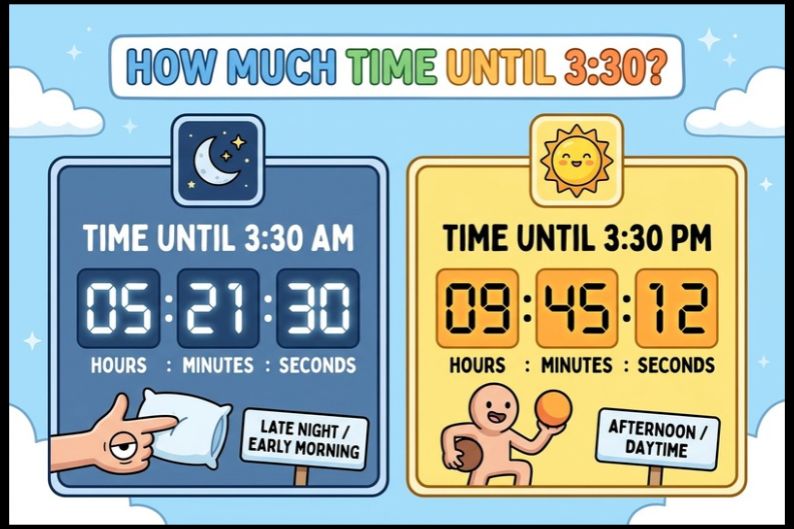
The countdown above uses your device’s own clock and time zone, so it is correct wherever you are. It updates every second.
If you just mean “the next time my clock says 3:30,” look at whichever countdown is smaller. That one is always less than 12 hours away.
Which 3:30 do you mean?
A 12-hour clock shows 3:30 twice a day:
- 3:30 AM (03:30 on a 24-hour clock) is in the early morning, three and a half hours after midnight.
- 3:30 PM (15:30 on a 24-hour clock) is in the afternoon, three and a half hours after noon.
The two answers are always exactly 12 hours apart. If 3:30 PM is 2 hours 15 minutes away, then 3:30 AM is 14 hours 15 minutes away. You can use this to check any answer you work out by hand.
Each countdown also always points to the next time that 3:30 happens. Suppose it’s 4:00 PM and you ask how long until 3:30 PM. Today’s 3:30 PM has already passed, so the answer is tomorrow’s 3:30 PM, 23 hours 30 minutes away. It isn’t “minus 30 minutes.”
Quick lookup: time until 3:30 from common times
If you can’t use the live countdown, find the time closest to yours:
| If it’s now… | Until 3:30 PM | Until 3:30 AM |
| 12:00 AM (midnight) | 15 h 30 min | 3 h 30 min |
| 1:15 AM | 14 h 15 min | 2 h 15 min |
| 3:45 AM | 11 h 45 min | 23 h 45 min (tomorrow) |
| 6:00 AM | 9 h 30 min | 21 h 30 min (tomorrow) |
| 9:20 AM | 6 h 10 min | 18 h 10 min (tomorrow) |
| 12:00 PM (noon) | 3 h 30 min | 15 h 30 min (tomorrow) |
| 1:45 PM | 1 h 45 min | 13 h 45 min (tomorrow) |
| 3:10 PM | 20 min | 12 h 20 min (tomorrow) |
| 4:39 PM | 22 h 51 min (tomorrow) | 10 h 51 min (tomorrow) |
| 8:00 PM | 19 h 30 min (tomorrow) | 7 h 30 min (tomorrow) |
| 11:50 PM | 15 h 40 min (tomorrow) | 3 h 40 min (tomorrow) |
“Tomorrow” means the next 3:30 falls on the next calendar day. Every row passes the 12-hour check above.
How to work it out yourself in under a minute
Step 1: Write both times on a 24-hour clock. 3:30 PM is 15:30, and 3:30 AM is 03:30. For PM times, add 12 to the hour, except 12 PM, which stays 12.
Step 2: Subtract the hours, then subtract the minutes.
- Hours: target hour minus current hour
- Minutes: 30 minus current minutes
Step 3: Fix any negative numbers.
- If the minutes come out negative, add 60 to the minutes and take 1 away from the hours.
- If the hours come out negative, the target has already passed today. Add 24 to the hours to get tomorrow’s 3:30.
Example 1: it’s 9:20 AM. How long until 3:30 PM?
- 15 − 9 = 6 hours
- 30 − 20 = 10 minutes
- Answer: 6 hours 10 minutes
Example 2: it’s 1:45 PM (13:45). How long until 3:30 PM?
- 15 − 13 = 2 hours
- 30 − 45 = −15 minutes, so add 60 to get 45 minutes, and take 1 hour away to get 1 hour
- Answer: 1 hour 45 minutes
Example 3: it’s 8:00 PM (20:00). How long until 3:30 AM?
- 3 − 20 = −17 hours, so add 24 to get 7 hours
- 30 − 0 = 30 minutes
- Answer: 7 hours 30 minutes
A shortcut for counting on your fingers: count the minutes up to the next full hour, then the whole hours up to 3:00, then add 30. From 9:20 AM that’s 40 minutes to 10:00, then 5 hours to 3:00, then 30 more. That gives 5 hours 70 minutes, which is 6 hours 10 minutes.
Converting to total minutes or seconds
Some timers and apps ask for one number instead of hours and minutes.
- Total minutes = hours × 60 + minutes. For example, 6 h 10 min = 360 + 10 = 370 minutes.
- Total seconds = total minutes × 60. For example, 370 minutes = 22,200 seconds.
Here are the conversions you’ll use most often for 3:30:
| Time left | Total minutes | Total seconds |
| 30 min | 30 | 1,800 |
| 1 h 30 min | 90 | 5,400 |
| 3 h 30 min (from noon or midnight) | 210 | 12,600 |
| 12 h (one 3:30 to the other) | 720 | 43,200 |
Counting down to 3:30 AM overnight: the clock-change trap
If you live somewhere that uses daylight saving time, be careful on the two nights a year when the clocks change. In most of these places, including the US, UK, EU and Australia, the change happens before 3:30 AM. So 3:30 AM still happens exactly once that night, but the night itself is a different length:
- When clocks go forward, the night is one hour shorter. From 11:00 PM to 3:30 AM is really 3 hours 30 minutes, not 4 hours 30 minutes.
- When clocks go back, the night is one hour longer. From 11:00 PM to 3:30 AM is really 5 hours 30 minutes.
The paper method above doesn’t know about clock changes, so add or subtract that hour yourself. The live countdown on this page uses your device’s calendar and already handles it.
Countries that don’t use daylight saving time, such as Pakistan and India, never have this problem.
When the 3:30 is in another time zone
If someone says “the call is at 3:30 PM London time,” convert it to your own time first, and then count down.
Example: London is on UTC+0 in winter, and Pakistan is on UTC+5. So 3:30 PM in London is 8:30 PM in Pakistan. If it’s 6:00 PM in Pakistan, you have 2 hours 30 minutes, not 9 hours 30 minutes.
If you skip the conversion, you count down to your own 3:30, which is a different moment entirely.
Read Check also more related:

I write clear, practical English lessons for everyday use. On Lingotexting, I break down grammar, vocabulary, and word types into simple ideas you can apply quickly. My focus is accuracy, real examples, and helpful visuals, so learners build confidence, improve writing, and communicate naturally in school, work, and daily life.