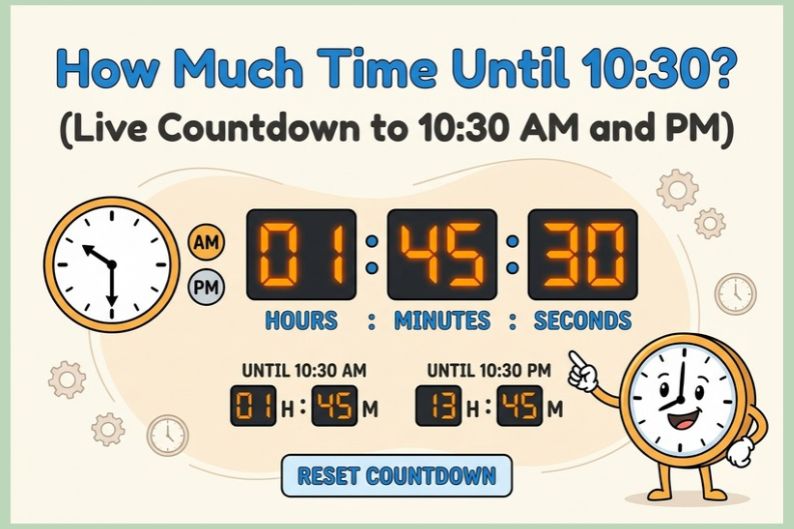
The answer depends on what time it is for you right now, and on which 10:30 you mean. A clock shows 10:30 twice a day: 10:30 AM in the morning and 10:30 PM (22:30) at night. So the next 10:30 is never more than 12 hours away. If you need one particular 10:30, such as 10:30 AM tomorrow, it can be almost 24 hours away.
How Long Until 10:30?
Countdown to Another Time or Date
The countdown is the quickest answer. If you’d rather check the numbers yourself, or you’re planning for a different day, use the methods below.
An example of how the answer reads. Say your clock shows 4:50 PM:
- The next 10:30 is 10:30 PM tonight, which is 5 hours 40 minutes away (340 minutes).
- 10:30 AM has already passed today, so the next one is tomorrow morning. That is 17 hours 40 minutes away (1,060 minutes).
These figures only apply at 4:50 PM. At any other time, the answer is different.
Work it out in your head
Because 10:30 is a half-hour mark, a simple two-step rule works. Use the same half of the day as your target: morning times for 10:30 AM, or afternoon and evening times for 10:30 PM.
If the minutes on your clock are 30 or less:
- Minutes left = 30 − your minutes
- Hours left = 10 − your hour
If the minutes on your clock are more than 30:
- Minutes left = 90 − your minutes
- Hours left = 9 − your hour
Example (to 10:30 AM): It’s 7:45 AM. The minutes are over 30, so the minutes left are 90 − 45 = 45 and the hours left are 9 − 7 = 2. The answer is 2 hours 45 minutes.
Example (to 10:30 PM): It’s 3:10 PM. The minutes are 30 or less, so the minutes left are 30 − 10 = 20 and the hours left are 10 − 3 = 7. The answer is 7 hours 20 minutes.
If you think in 24-hour time, use 22 instead of 10 for the evening target. For 3:10 PM, that is 15:10, and 22 − 15 = 7 hours.
When the count crosses midnight, split it into two parts: the time left until midnight, plus the time from midnight to 10:30.
Example: It’s 11:15 PM and you want 10:30 AM tomorrow. There are 45 minutes until midnight, then 10 hours 30 minutes until 10:30 AM. The total is 11 hours 15 minutes.
To get total minutes, multiply the hours by 60 and add the minutes. For example, 5 hours 40 minutes is 300 + 40 = 340 minutes. Multiply by 60 again for seconds: 20,400.
Time until 10:30 from common clock times
| Current time | Until 10:30 AM | Until 10:30 PM |
| 12:00 AM (midnight) | 10 h 30 min (630 min) | 22 h 30 min (1,350 min) |
| 6:00 AM | 4 h 30 min (270 min) | 16 h 30 min (990 min) |
| 7:00 AM | 3 h 30 min (210 min) | 15 h 30 min (930 min) |
| 8:00 AM | 2 h 30 min (150 min) | 14 h 30 min (870 min) |
| 9:00 AM | 1 h 30 min (90 min) | 13 h 30 min (810 min) |
| 10:00 AM | 30 min | 12 h 30 min (750 min) |
| 11:00 AM | 23 h 30 min, tomorrow (1,410 min) | 11 h 30 min (690 min) |
| 12:00 PM (noon) | 22 h 30 min, tomorrow (1,350 min) | 10 h 30 min (630 min) |
| 3:00 PM | 19 h 30 min, tomorrow (1,170 min) | 7 h 30 min (450 min) |
| 6:00 PM | 16 h 30 min, tomorrow (990 min) | 4 h 30 min (270 min) |
| 9:00 PM | 13 h 30 min, tomorrow (810 min) | 1 h 30 min (90 min) |
| 10:00 PM | 12 h 30 min, tomorrow (750 min) | 30 min |
| 11:00 PM | 11 h 30 min, tomorrow (690 min) | 23 h 30 min, tomorrow (1,410 min) |
In every row, the two answers are exactly 12 hours apart. Whichever is smaller is your “next 10:30.”
Which 10:30 do you mean?
- 10:30 AM is half past ten in the morning.
- 10:30 PM is half past ten at night. On a 24-hour clock it is written 22:30.
- In British English, “half ten” means 10:30.
- In German and Dutch, “half eleven” (halb elf or half elf) also means 10:30: half an hour before eleven, not after. If someone from those language backgrounds says “half eleven,” confirm which time they mean.
When a plan just says “10:30” with no AM or PM, context usually tells you which one: a class, shift or appointment is usually the morning, and a late show or bedtime is the evening. If anything depends on it, such as a booking or a flight, check rather than assume.
Situations that change the answer
It’s 10:30 right now, or it just passed. The 10:30 you were counting to is over, so the next one is about 12 hours away, or about 24 hours away if you need that same AM or PM time again.
You need 10:30 on a specific day. Count the full days first, then add the hours and minutes.
Example: From Monday at 4:50 PM to Friday at 10:30 AM:
- Monday 4:50 PM to Tuesday 10:30 AM is 17 h 40 min.
- Three more days take you to Friday 10:30 AM.
- The total is 3 days, 17 hours, 40 minutes, which is 89 h 40 min or 5,380 minutes.
The 10:30 is in another time zone. Convert the target into your own local time before counting.
Example: A 10:30 AM call in London is normally 5:30 AM in New York. For a few weeks each spring and autumn, the UK and US change their clocks on different dates, and the gap shrinks to 4 hours. Check a world clock for the actual date rather than relying on the usual difference.
The count runs through a daylight-saving change. Clocks usually change in the small hours of the morning, so a countdown that runs overnight can be off by an hour:
- On a “fall back” night, 10:30 PM Saturday to 10:30 AM Sunday is 13 hours of real time, not 12.
- On a “spring forward” night, the same span is 11 hours.
The live countdown above uses your device’s clock, so it accounts for this automatically. Manual clock arithmetic does not.
Read related also:

I write clear, practical English lessons for everyday use. On Lingotexting, I break down grammar, vocabulary, and word types into simple ideas you can apply quickly. My focus is accuracy, real examples, and helpful visuals, so learners build confidence, improve writing, and communicate naturally in school, work, and daily life.