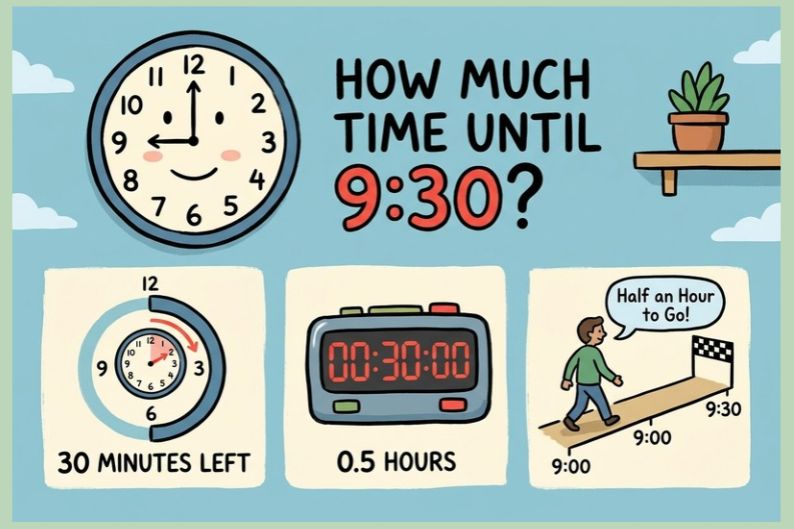
Countdown to 9:30 AM
Count Down to Another Time
The countdown above reads your device’s clock and shows two numbers: the time left until the next 9:30 AM and until the next 9:30 PM. Whichever is smaller is the next 9:30 you will see on a clock. It is never more than 12 hours away.
If the countdown isn’t loading, here’s how to get the answer in a few seconds.
Which 9:30 do you mean?
A 12-hour clock shows 9:30 twice a day:
| 12-hour clock | 24-hour clock | When |
| 9:30 AM | 09:30 | Morning |
| 9:30 PM | 21:30 | Evening |
If you’re thinking of “the next time the clock says 9:30,” the rule is simple:
- Before 9:30 AM (including after midnight), the next one is 9:30 AM today.
- Between 9:30 AM and 9:30 PM, the next one is 9:30 PM today.
- After 9:30 PM, the next one is 9:30 AM tomorrow.
If you need a specific one, such as a 9:30 AM appointment when it’s already evening, use the AM or PM line on the countdown. The other 9:30 is always exactly 12 hours further away than the nearest one.
Most people say “9:30” as an hour of the day. In 24-hour time, though, 9:30 written alone means morning (09:30), and the evening is 21:30.
Quick lookup: time until the next 9:30
This table works for both halves of the day. Find the hour you’re at, whether AM or PM.
| If it’s now… | Next 9:30 is in | Total minutes | That next 9:30 is… |
| 12:00 | 9 h 30 min | 570 | Same half of the day (12 AM → 9:30 AM, noon → 9:30 PM) |
| 1:00 | 8 h 30 min | 510 | Same half (AM → AM, PM → PM) |
| 2:00 | 7 h 30 min | 450 | Same half |
| 3:00 | 6 h 30 min | 390 | Same half |
| 4:00 | 5 h 30 min | 330 | Same half |
| 5:00 | 4 h 30 min | 270 | Same half |
| 6:00 | 3 h 30 min | 210 | Same half |
| 7:00 | 2 h 30 min | 150 | Same half |
| 8:00 | 1 h 30 min | 90 | Same half |
| 9:00 | 30 min | 30 | Same half |
| 10:00 | 11 h 30 min | 690 | Other half (10 AM → 9:30 PM, 10 PM → 9:30 AM tomorrow) |
| 11:00 | 10 h 30 min | 630 | Other half |
How to use it:
- Half past the hour (3:30, 7:30…): subtract 30 minutes from that row.
- Other times: use the method below.
- For the other 9:30 (the less immediate one): add 12 hours, or 720 minutes.
Work it out yourself in two steps
You don’t need to subtract times in your head. Count up instead.
- Count the minutes to the next half-hour.
- Count the whole hours from that half-hour to 9:30.
- Add them together.
Example at 4:49 PM:
- From 4:49 to 5:30 is 41 minutes.
- From 5:30 to 9:30 PM is 4 hours.
- Total: 4 hours 41 minutes until 9:30 PM.
Example at 4:12 PM:
- From 4:12 to 4:30 is 18 minutes.
- From 4:30 to 9:30 is 5 hours.
- Total: 5 hours 18 minutes.
Check with 24-hour time. Write both times in 24-hour form and subtract.
- 21:30 − 16:49 = 4:41 ✓
- If the result is negative, the next 9:30 is tomorrow, so add 24 hours.
For total minutes: multiply the hours by 60 and add the remaining minutes.
- 4 h 41 min = 240 + 41 = 281 minutes.
- 281 minutes × 60 = 16,860 seconds.
For the other 9:30: at 4:49 PM, the next 9:30 AM is 4 h 41 min + 12 h = 16 hours 41 minutes, which is 1,001 minutes.
If your 9:30 is in a different time zone
A 9:30 set somewhere else doesn’t arrive when your own clock reads 9:30. Convert the target to your local time first, then count.
The most common case is the US stock market. The NYSE and Nasdaq regular session opens at 9:30 a.m. Eastern Time, Monday to Friday, except market holidays.
Eastern Time switches between two offsets:
- EST (UTC−5): roughly November to March
- EDT (UTC−4): roughly March to November
| Your location | Market open (9:30 a.m. ET) during EST | During EDT |
| London | 2:30 PM GMT | 2:30 PM BST |
| Pakistan (PKT, UTC+5) | 7:30 PM | 6:30 PM |
| India (IST, UTC+5:30) | 8:00 PM | 7:00 PM |
| Dubai (UTC+4) | 6:30 PM | 5:30 PM |
For a stretch of a few weeks each year, the gap between New York and London is off by an hour. This happens in March and around late October to early November, because the US and the UK change their clocks on different dates. During those weeks, check a time-zone converter rather than relying on the usual difference.
The same applies to a webinar, a sports start, or a call “at 9:30” set by someone abroad. Find out whose 9:30 it is.
On nights the clocks change
In places that use daylight saving time, the clocks jump one night in spring and one night in autumn, usually around 2:00 AM. If that jump falls between now and 9:30, the actual wait differs from what simple clock arithmetic says.
- Clocks go back (autumn): you wait one hour longer. For example, at 11:00 PM before the change, 9:30 AM looks 10 h 30 min away on the clock. In reality it’s 11 h 30 min.
- Clocks go forward (spring): you wait one hour less. The same example gives 9 h 30 min of real time.
Pakistan, India and most of Asia don’t use daylight saving time, so this only matters there when the 9:30 is set in a country that does. The countdown above measures real elapsed time on your device, so it includes these changes automatically.
Read related also:

I write clear, practical English lessons for everyday use. On Lingotexting, I break down grammar, vocabulary, and word types into simple ideas you can apply quickly. My focus is accuracy, real examples, and helpful visuals, so learners build confidence, improve writing, and communicate naturally in school, work, and daily life.