If you’ve ever stopped mid-sentence thinking, “Wait… do I say ‘do she’ or ‘does she’?” — you’re in good company. This is one of the most common struggles for English learners at every level.
These three words — do, does, and did — are small but powerful. They help you ask questions, make negative sentences, and show strong feelings. The tricky part? They change depending on who you’re talking about and when the action happens.
Here’s the short version:
- Do → present tense with I, you, we, they
- Does → present tense with he, she, it
- Did → past tense with everyone
Just knowing the rule isn’t enough. You need to see these words in real sentences, understand why mistakes happen, and practice until it feels natural. That’s exactly what this guide does.
Why Do So Many Learners Get Confused?
Most learners make mistakes not because they’re careless — but because their first language works differently.
In many languages, the verb doesn’t change based on the subject. So saying “She do her homework” feels perfectly fine to someone whose brain is wired that way.
Here’s what else makes it tricky:
- “Do” and “does” look almost the same
- Both are used in the present tense
- The only difference is the subject — and that’s easy to miss in fast speech
Then “did” adds another layer — people forget that after “did,” the main verb must return to its base form. More on that soon.
Do, Does, Did Rules at a Glance
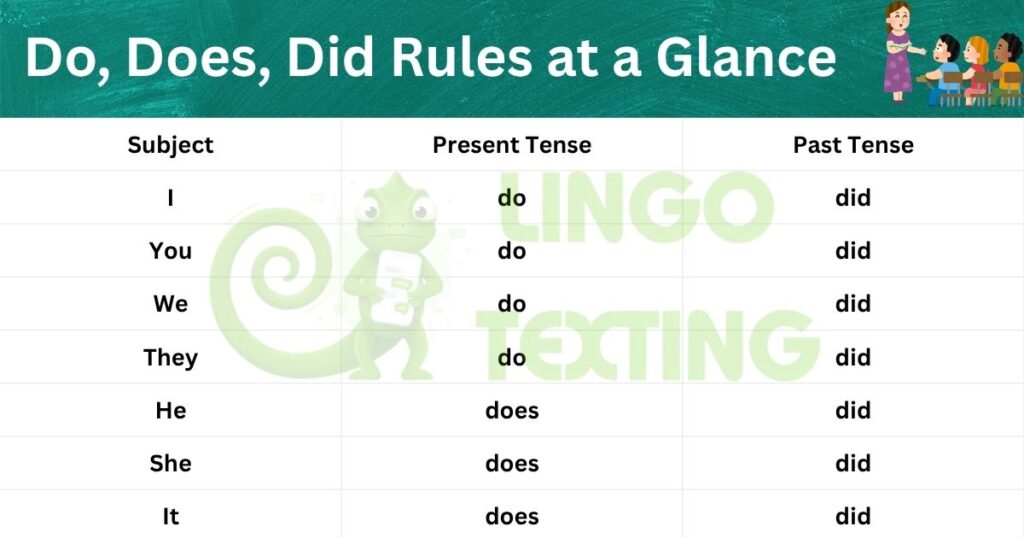
| Subject | Present Tense | Past Tense |
| I | do | did |
| You | do | did |
| We | do | did |
| They | do | did |
| He | does | did |
| She | does | did |
| It | does | did |
Key point: “Did” is the same for every subject — no exceptions. That’s the one part that’s actually simple.
Use of “DO”
Daily Habits and Routines
When you want to describe something that happens regularly, “do” fits naturally:
- I do my homework after dinner every night.
- We do exercise together every morning.
- They do their shopping on Saturdays.
- You do a great job keeping your notes organized.
Asking Questions With “Do”
Most present-tense questions with I, you, we, and they need “do” at the front:
- Do you understand what I’m saying?
- Do they live near the school?
- Do we have class tomorrow?
- Do I need to bring my book?
Worth noticing: “Do” jumps to the front of the sentence in questions. In statements, the subject comes first. That flip is how English signals a question — and this same logic applies to “does” and “did” too.
Making Negative Sentences
To say something is not true in the present tense, use do not or its short form don’t:
- I don’t understand this part.
- We don’t watch TV every night.
- They do not agree with the plan.
When to use which form: Don’t is natural in everyday conversation. Do not sounds more formal or serious — use it in writing or when making a firm point. This same rule applies to doesn’t and didn’t throughout the article.
Emphasis — The Use Most Learners Don’t Know
You can use “do” in a statement — not to ask or negate — but simply to stress that something is true:
- I do want to help you.
- We do care about your progress.
This usually happens when correcting a misunderstanding or expressing strong feeling. If someone says, “You never clean up!” and you fire back, “I do clean up!” — that “do” is carrying real emotional weight. You’ll hear this constantly in movies and real conversations once you start listening for it.
Use of “DOES”
The Rule That Trips Everyone Up
When the subject is he, she, or it, you must use does — not “do”:
- ❌ She do her work every evening.
- ✅ She does her work every evening.
- ❌ He do know the answer.
- ✅ He does know the answer.
This happens because English adds “-s” to verbs when the subject is he, she, or it. So “do” becomes “does” — just like “go” becomes “goes.”
Daily Routines With “Does”
- She does yoga every morning before breakfast.
- He does his assignments right after school.
- My brother does all the cooking at home.
Questions With “Does”
“Does” moves to the front for questions — same flip as “do”:
- Does he play cricket on weekends?
- Does she understand the lesson?
- Does your sister work nearby?
Critical rule here: After “does,” the main verb goes back to its base form. Do NOT add “-s” to the verb again — “does” already handles that:
- ❌ Does she plays the piano?
- ✅ Does she play the piano?
This double “-s” error is one of the most common do, does, did mistakes. Once you know it exists, you’ll stop making it.
Negatives With “Does”
- He doesn’t like spicy food.
- She doesn’t want to go alone.
- It doesn’t matter right now.
Use of “DID”
Here’s the good news: “did” works the same for every subject — no variation needed.
- I did finish the assignment before the deadline.
- She did call you — check your missed calls.
- We did visit that place last summer.
- They did understand the instructions.
The Biggest Mistake Learners Make With “Did”
- ❌ Did you went there?
- ✅ Did you go there?
- ❌ Did she called him?
- ✅ Did she call him?
The rule: After “did,” always use the base form of the verb. Not past tense. Not “-ing.” Just the simple base.
Why do so many people get this wrong? Because the brain says “I’m talking about the past, so I need a past verb.” That makes sense — but “did” already carries the past meaning. The main verb doesn’t need to repeat it.
Questions in the Past
- Did you call me this morning?
- Did they finish the project?
- Did she understand the lesson?
Past Negatives
- I didn’t see that coming.
- He didn’t finish his food.
- We didn’t know about the change.
“Did” for Emphasis
Just like “do” and “does,” “did” can stress that something actually happened:
- I did send that email — check your inbox.
- She did try her best, even if the result wasn’t great.
This is especially useful when someone doubts you. The stress lands on “did” and makes the confirmation feel solid.
Side-by-Side Comparison about Uses of Do Does and Did
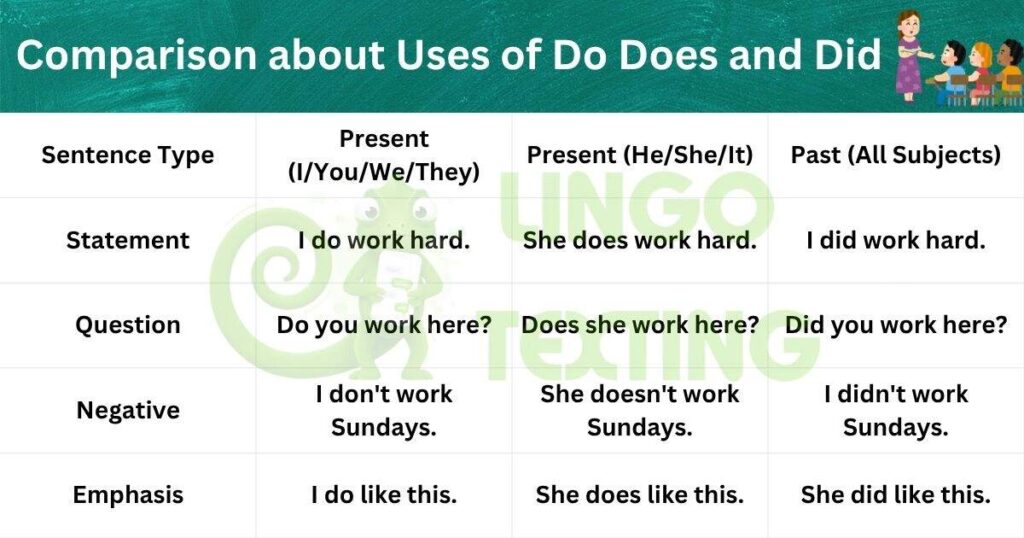
| Sentence Type | Present (I/You/We/They) | Present (He/She/It) | Past (All Subjects) |
| Statement | I do work hard. | She does work hard. | I did work hard. |
| Question | Do you work here? | Does she work here? | Did you work here? |
| Negative | I don’t work Sundays. | She doesn’t work Sundays. | I didn’t work Sundays. |
| Emphasis | I do like this. | She does like this. | She did like this. |
Common Mistakes about Do, Does, Did Rules — and Why They Happen
Mistake 1: Using “do” with he/she/it
- ❌ He do his homework late.
- ✅ He does his homework late.
- Why: Forgetting that he/she/it needs its own form.
Mistake 2: Using a past verb after “did”
- ❌ Did you finished the work?
- ✅ Did you finish the work?
- Why: The brain adds past tense twice — once in “did,” once in the main verb.
Mistake 3: Skipping “do” in questions
- ❌ You like coffee?
- ✅ Do you like coffee?
- Why: In some languages, tone alone forms a question. English needs the helping verb in writing and formal speech.
Mistake 4: Adding “-s” to the verb after “does”
- ❌ Does she walks to school?
- ✅ Does she walk to school?
- Why: Learners remember the “-s” rule but apply it to the wrong word.
Mistake 5: Using “does” with “I” or “you”
- ❌ Does I need to sign?
- ✅ Do I need to sign?
- Why: Over-correction — using “does” everywhere to feel safe.
Mistake 6: Mixing up “don’t” and “doesn’t”
- ❌ She don’t want help.
- ✅ She doesn’t want help.
- Why: Guessing the contraction instead of applying the subject rule.
Do, Does, Did in Question Tags
Question tags are the short questions added at the end of a sentence. Do, does, and did appear here too:
- You like pizza, don’t you?
- She studies hard, doesn’t she?
- They came early, didn’t they?
- He finished the test, didn’t he?
The rule: Use the helping verb that matches the subject and tense of the main sentence — then flip it. Positive becomes negative. Negative becomes positive.
Do, Does, Did Rules Mini Practice — Fill in the Blanks
Try these before checking the answers:
- ___ she like cold drinks?
- I ___ not understand this word.
- Did you ___ your homework last night?
- He ___ not play video games during school days.
- ___ they arrive on time yesterday?
- We ___ exercise every morning.
Answers:
- Does
- do
- do
- does
- Did
- do
Practical Tips for Real-Life Use
- In spoken English, “do” sometimes disappears. You might hear “You want some tea?” instead of “Do you want some tea?” — but in writing or formal speech, always keep it.
- Stress “do/does/did” when correcting someone. Saying “I DID send that email” or “She DOES try hard” puts the weight exactly where you need it.
- Match formality to the situation. Use do not / does not / did not in essays, professional emails, or formal writing. Use don’t / doesn’t / didn’t in everyday conversation.
- Listen for emphasis in movies and shows. Every time a character says “I do care” or “She does know,” they’re using this pattern intentionally. Training your ear this way speeds up learning faster than any textbook.
Read more:
Use of Is, Am, Are Sentences — Guide for Every Beginner Needs
Simple English Sentences for Class 1: (Examples, Practice & Worksheets)
FAQs
Q: What is the difference between “do” and “does”?
“Do” is used with I, you, we, and they. “Does” is used with he, she, and it. The subject alone decides which one to use — nothing else.
Q: Can “do/does/did” be used for emphasis in statements?
Yes. “I do want to come,” “She does understand,” and “He did finish it” are all emphasis forms. They confirm or correct — and the stress is always on the helping verb.
Q: Is “did not” stronger than “didn’t”?
Yes, in tone. “Didn’t” is casual and neutral. “Did not” feels firmer — like you’re making a very deliberate point.
Q: How do question tags work with do/does/did?
The tag must mirror the subject and tense of the main sentence, then flip positive to negative or vice versa. “She works here, doesn’t she?” — “does” matches she + present, flipped to negative.
Q: Can I use “did” and “does” together?
No. “Does” is present, “did” is past. Choose based on when the action happens.
Final Thought
Mastering do, does, and did isn’t about memorizing a chart — it’s about building a feel for the language.
Once you know that “does” belongs to he/she/it, that “did” always takes a base verb, and that all three can add emphasis — you stop second-guessing yourself mid-sentence.
The fastest way forward? Use them. Make sentences out loud. Ask questions. Correct yourself when something sounds off. Every conversation you have in English is practice — and these three small words will show up in almost all of them.

I write clear, practical English lessons for everyday use. On Lingotexting, I break down grammar, vocabulary, and word types into simple ideas you can apply quickly. My focus is accuracy, real examples, and helpful visuals, so learners build confidence, improve writing, and communicate naturally in school, work, and daily life.