
Picture this: you want to say something simple in English, but your brain freezes. Should I say “he are” or “he is”? Is it “I is” or “I am”?
This happens to almost every English learner. The rule is short and easy once you see it clearly.
Quick answer: Use am with I, is with one person or thing, and are with more than one — or with you.
By the end of this guide, you will:
- Know exactly when to use is, am, and are
- See real-life examples that make sense
- Spot and fix your own mistakes
- Feel more confident while speaking
Quick Rule Table
| Subject | Correct Word |
| I | am |
| He / She / It | is |
| You | are |
| We | are |
| They | are |
| One person or thing | is |
| More than one | are |
One-line reminder: Am = only I. Is = one. Are = many or you.
What Do Is, Am, and Are Actually Do?
These three words describe a state, identity, feeling, or what is happening right now. Think of them as a bridge between the subject and the description.
- Who someone is → She is a doctor.
- How someone feels → I am tired.
- What is happening → They are playing outside.
- What something is → The sky is blue.
Use of “Is” — For One Person or Thing
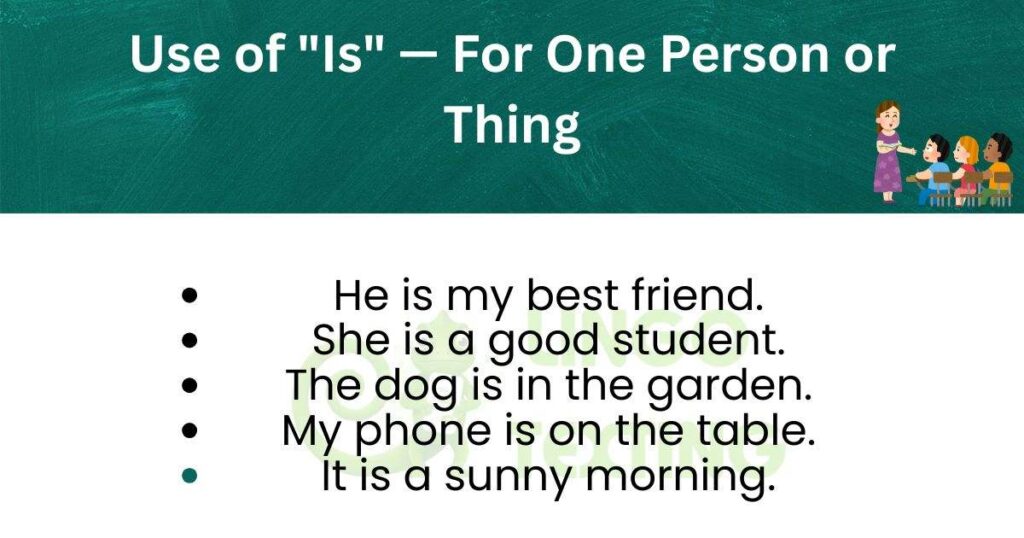
Rule: Use is for one person, animal, or thing — and with he, she, it.
Examples:
- He is my best friend.
- She is a good student.
- The dog is in the garden.
- My phone is on the table.
- It is a sunny morning.
Questions:
- Is she ready?
- Is the door open?
Negatives:
- He is not coming today.
- The shop is not open right now.
Tip: If you can replace the subject with he, she, or it — use is.
Use of “Am” — Only for “I”
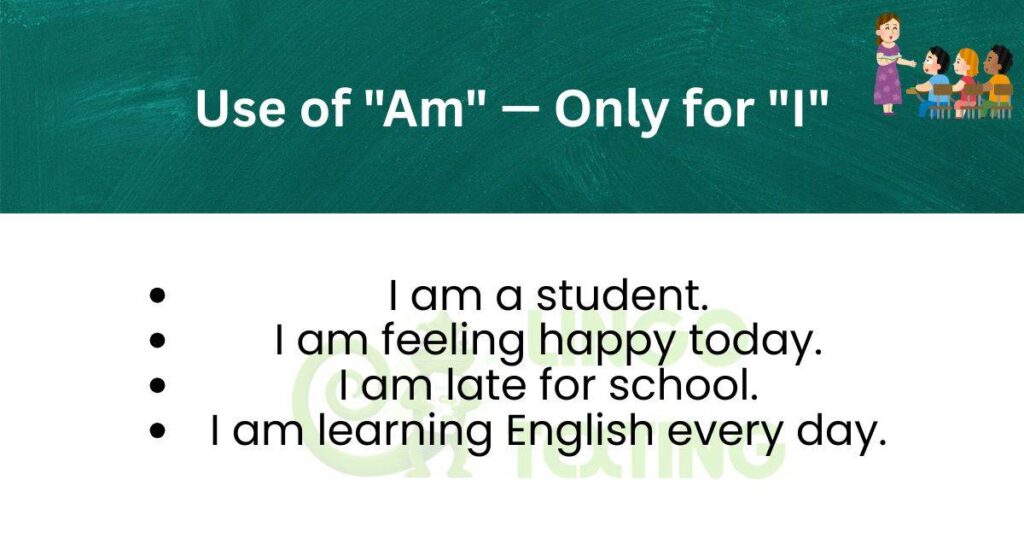
Rule: Am is used only with I. No other subject ever uses am.
Examples:
- I am a student.
- I am feeling happy today.
- I am late for school.
- I am learning English every day.
Questions:
- Am I late?
- Am I doing this correctly?
Negatives:
- I am not angry.
- I am not done yet.
Tip: See I at the start? Always write am — zero exceptions.
Use of “Are” — For More Than One, or “You”
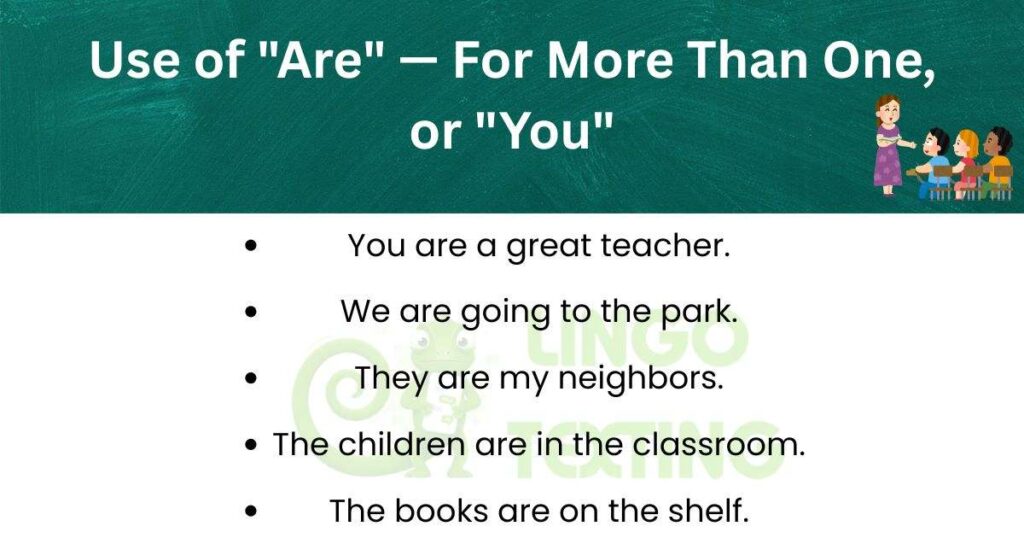
Rule: Use are with you, we, they, and any plural noun.
One thing that trips many learners: even when speaking to one person, you still say “you are” — never “you is.”
Examples:
- You are a great teacher.
- We are going to the park.
- They are my neighbors.
- The children are in the classroom.
- The books are on the shelf.
Questions:
- Are you okay?
- Are we late?
Negatives:
- They are not ready yet.
- We are not going today.
Tip: “You are” is always correct — even talking to just one person.
How These Words Sound in Real Conversations
Forget the textbook for a moment. Here is a short conversation that shows all three words in action:
Riya: Are you free this evening? Sam: No, I am busy. My sister is visiting today. Riya: Oh, that is nice!
More everyday examples:
- “Dinner is ready.”
- “I am really hungry right now.”
- “Are you done with your homework?”
- “We are watching a movie.”
- “She is so funny.”
Once you notice this pattern in daily talk, you stop overthinking it.
Common Mistakes on Use of Is, Am, Are in Sentences — And How to Fix Them
| ❌ Wrong | ✅ Correct | Why |
| She are happy. | She is happy. | “She” is singular → is |
| I is a student. | I am a student. | “I” always → am |
| They is playing. | They are playing. | “They” is plural → are |
| You is my friend. | You are my friend. | “You” always → are |
| He are tall. | He is tall. | “He” is singular → is |
| We is going home. | We are going home. | “We” is plural → are |
| The dogs is barking. | The dogs are barking. | “Dogs” is plural → are |
| I are not sure. | I am not sure. | “I” always → am |
Practice Exercises about Use of Is, Am, Are Sentences
Part 1: Fill in the Blank
(Try without looking at the rules first.)
- I ___ a student.
- She ___ very kind.
- They ___ my friends.
- We ___ going to school.
- He ___ the captain of the team.
- You ___ so smart.
- It ___ a cold night.
- The flowers ___ beautiful.
- I ___ not feeling well today.
- My cat ___ sleeping on the sofa.
Part 2: Correct the Sentence
- She are my sister.
- I is happy today.
- They is playing in the park.
- He are a good boy.
- We is at home.
- You is very tall.
- The bird are singing.
- I are going to the market.
Answers
Part 1:
- am 2. is 3. are 4. are 5. is 6. are 7. is 8. are 9. am 10. is
Part 2:
- She is my sister.
- I am happy today.
- They are playing in the park.
- He is a good boy.
- We are at home.
- You are very tall.
- The bird is singing.
- I am going to the market.
How to Teach This to a Beginner (Step-by-Step)
For parents, teachers, or older siblings — here is the simplest way to explain this:
- Step 1 — Start with “I am” only. Ask: “Who are you?” → “I am Ali.” Repeat with different names.
- Step 2 — Introduce “is” with objects and people. Point and ask: “What is this?” → “It is a pencil.”
- Step 3 — Bring in “are” with groups. Ask: “Who are they?” → “They are my friends.”
- Step 4 — Quick-fire mixing. Say a subject, learner fills in: “I ___.” / “She ___.” / “We ___.”
- Step 5 — Practice through speaking, not just writing. Conversation makes the rule stick faster than exercises alone.
Key point: Teach one word at a time. Don’t introduce all three together on day one.
Read also these related:
250+ Simple Sentences for Nursery Class (Daily Use)
Simple English Sentences for Class 1: (Examples, Practice & Worksheets)
FAQs on Use of Is, Am, Are Sentences
Can I use “am” with “he” or “she”?
No. Am is only for I. For he, she, or it — use is.
Why do we say “you are” even for one person?
In English, you always takes are — whether one person or a group.
Is “they is” ever correct?
Never. They is always followed by are.
What about “it”?
It is singular, so use is. → “It is a nice day.”
What is the difference between “I am going” and “I go”?
“I am going” = happening right now. “I go” = a habit or regular routine.
Can is, am, are be used in questions?
Yes — just move them to the front: “Is she ready?” / “Am I correct?” / “Are they home?”
Conclusion
The rule for is, am, are sentences is one of the shortest in English — and one of the most useful. Lock in am = I, is = one, are = many or you, and the confusion disappears.
Reading rules helps, but using them is what builds real confidence. Speak small sentences out loud, notice how people talk around you, and check your writing. With steady daily practice, these three words will come naturally — without a second thought.

I write clear, practical English lessons for everyday use. On Lingotexting, I break down grammar, vocabulary, and word types into simple ideas you can apply quickly. My focus is accuracy, real examples, and helpful visuals, so learners build confidence, improve writing, and communicate naturally in school, work, and daily life.