
Learning English becomes much easier when you start with sentences instead of grammar rules. Many learners know individual words but struggle to use them in real conversations. Practicing Basic English Sentences helps you understand sentence structure, improve speaking confidence, and express your ideas clearly in everyday situations.
This collection is designed for students, children, beginners, parents, and teachers who want practical examples they can use right away. From school and family topics to daily conversations, these sentences provide a simple way to build strong English skills step by step.
Very Short Basic English sentences
These are the easiest sentences in English. Start here.
- I am happy.
- She is kind.
- He is tall.
- We are friends.
- It is cold.
- Birds fly.
- Dogs bark.
- Run fast.
- I feel sleepy.
- The sun is bright.
- She is quiet.
- He is brave.
- I am ready.
- We are late.
- It is dark outside.
- She cried softly.
- He smiled warmly.
- I feel tired.
- The baby is sleeping.
- The door is open.
Daily Use Basic English sentences — Morning Routine
- I wake up at six in the morning.
- My mother makes breakfast for the family.
- I brush my teeth before eating.
- My father reads the newspaper every morning.
- I pack my school bag after getting dressed.
- The alarm rings at five-thirty on school days.
- We eat breakfast together as a family.
- I wash my face with cold water every morning.
- My sister gets ready before me every day.
- We leave the house by seven-thirty.
Daily Use English Sentences — At School
- I go to school by bus.
- My school starts at eight o’clock.
- I sit in the third row in my class.
- My teacher writes on the whiteboard.
- We have five classes every day.
- I eat lunch with my classmates.
- My favorite subject is science.
- We play cricket in the school ground during lunch.
- The school bell rings at two o’clock.
- I walk to the school gate with my friends.
Daily Use English Sentences — Evening and Night
- I come home at two in the afternoon.
- I do my homework after drinking milk.
- We watch television together in the evening.
- My father waters the plants before dinner.
- I read a storybook before sleeping.
- My family sits together for dinner every night.
- I sleep at ten o’clock on school nights.
- My mother checks my homework every evening.
- I keep my school bag ready before sleeping.
- We turn off all the lights before bed.
Basic Classroom English sentences
Some children feel shy speaking English in class. That shyness usually comes from not knowing what to say. Practice these until they feel natural.
Students say these in class:
- May I come in, please?
- Can I borrow your pencil?
- I do not understand this question.
- Please repeat that, ma’am.
- Can you explain this again, sir?
- I finished my homework.
- I forgot my notebook at home.
- May I go to the washroom?
- I have a question about this lesson.
- I am sorry, I was late today.
- Can I sit here, please?
- I lost my eraser.
- My pen is not working.
- Can I sharpen my pencil?
- I did not hear the question clearly.
Teachers say these in class:
- Open your books to page twelve.
- Write this sentence in your notebook.
- Who wants to answer this question?
- Please be quiet and listen carefully.
- Your homework is due tomorrow.
- Well done! That is a great answer.
- Try again, you are almost correct.
- Today we will learn something new.
- Raise your hand if you know the answer.
- Line up quietly, please.
Basic English sentences About Family
- My mother is a kind woman.
- My father goes to work every day.
- My sister loves to draw pictures.
- My brother is younger than me.
- My grandmother tells me stories at night.
- My grandfather takes a walk every morning.
- We all eat dinner together.
- My mother cooks delicious food.
- My father helps me with math homework.
- My uncle lives in another city.
- My aunt visits us every summer.
- My cousin and I play together on weekends.
- My grandmother makes the best dessert.
- My brother and I share a bedroom.
- My parents work very hard for our family.
Basic English sentences About Animals
- A dog is a loyal animal.
- Cats sleep a lot during the day.
- Elephants have a very long trunk.
- A parrot can repeat words we say.
- Fish live inside water.
- Lions are called the king of the jungle.
- Rabbits have soft white fur.
- Cows give us milk every day.
- Birds build nests on trees.
- A butterfly comes out of a cocoon.
- Monkeys love to eat bananas.
- Horses run very fast.
- Camels can go without water for many days.
- Penguins live in cold places.
- Frogs jump from place to place.
Five Sentences in English — Topic-Wise Examples
This section is very helpful for school homework. Students are often asked to write five sentences on a topic.
Five Sentences About My Mother
- My mother wakes up before everyone else in the family.
- She cooks food with love and care every day.
- My mother helps me when I feel sad or confused.
- She works very hard without complaining.
- I love my mother more than anyone in the world.
Five Sentences About My School
- My school is a big and beautiful building.
- There are many classrooms, a library, and a playground.
- My teachers are kind and always ready to help.
- I have many good friends in my school.
- I enjoy going to school every morning.
Five Sentences About Myself
- My name is Ali and I am ten years old.
- I study in Class Five at my local school.
- My favorite subject is English.
- I like to play football with my friends after school.
- I want to become a doctor when I grow up.
Five Sentences About My Best Friend
- My best friend’s name is Hana.
- We have been friends since Class Two.
- She is funny, honest, and very helpful.
- We sit together in class and share our lunch.
- I am very lucky to have a friend like her.
Five Sentences About My Favorite Animal
- My favorite animal is the dolphin.
- Dolphins live in the ocean and are very intelligent.
- They swim in groups and play together.
- Dolphins can understand signals and learn tricks.
- I hope to see a real dolphin one day.
Five Sentences About My Teacher
- My class teacher’s name is Miss Sara.
- She teaches us English and helps us speak clearly.
- She is patient and never gets angry when we make mistakes.
- She gives us interesting activities to do in class.
- I respect my teacher a lot.
Present Tense Basic English sentences
Present tense sentences describe what happens regularly or what is happening right now.
Simple Present Tense
- She drinks water every morning.
- He goes to the market on Saturdays.
- The train leaves at nine o’clock.
- My dog sleeps near the door.
- Children love to play in the rain.
- I study for one hour every evening.
- The baker opens his shop at seven.
- My uncle lives in another city.
- She teaches English at a primary school.
- The sun rises in the east every morning.
- We play cricket every Sunday.
- The cook prepares lunch at noon.
- My cat drinks milk from a small bowl.
- He reads a newspaper after dinner.
- Birds sing early in the morning.
Present Continuous Tense
- She is reading a book right now.
- The children are playing in the garden.
- My mother is cooking biryani today.
- It is raining outside at the moment.
- He is writing a letter to his friend.
- I am learning new English sentences today.
- The birds are singing on the tree.
- We are watching an interesting documentary.
- My brother is doing his homework now.
- The teacher is explaining the lesson.
Past Tense Basic English sentences
Past tense tells us what already happened.
Simple Past Tense
- I visited my grandmother last Sunday.
- She cooked a delicious meal for us.
- We played football in the park yesterday.
- He forgot his pencil box at school.
- The teacher explained the lesson clearly.
- It rained heavily last night.
- My father bought me a new bag.
- We watched a funny movie on Friday.
- I wrote a letter to my friend last week.
- She sang a beautiful song at the school event.
- The children ran to the playground after class.
- He came home early yesterday.
- My mother made my favorite food last night.
- We visited the zoo last month.
- The cat drank all the milk in the bowl.
Past Continuous Tense
- I was reading when the phone rang.
- She was cooking when we arrived.
- They were playing when it started raining.
- He was sleeping when I called him.
- We were studying when the light went off.
Future Tense Basic English sentences
- I will study hard for my exam.
- We are going to visit our relatives next week.
- She will cook dinner tonight.
- He is going to join a new school next year.
- It will rain tomorrow, I think.
- My brother will turn twelve on his next birthday.
- We shall begin our trip on Sunday morning.
- I am going to read ten pages tonight.
- She will finish her project by Friday.
- They are going to plant trees in the school garden.
- I will call you when I reach home.
- He will bring his book tomorrow.
- We will celebrate her birthday on Saturday.
- My father will come home early today.
- The team will practice again next week.
Spoken English Practice Sentences
Greetings
- Good morning! How are you today?
- Hi, my name is Zara. What is yours?
- It is nice to meet you.
- How was your day?
- I am doing well, thank you.
- Good afternoon! Where are you going?
- Good night! Sleep well.
- Have a nice day!
- Welcome to our class.
- See you tomorrow!
Asking for Help
- Can you help me with this?
- Could you please show me the way?
- I am lost. Which road goes to the market?
- Please say that again. I did not hear you.
- Can you write it down for me?
- I need help with this question.
- Can someone explain this to me?
Expressing Feelings
- I am really excited about the trip.
- She feels sad because she missed her friend.
- We were very happy to hear that news.
- I feel nervous before exams.
- He was surprised by the birthday party.
- I feel proud of myself today.
- She was angry when she lost her book.
- We were bored during the long wait.
Polite Requests
- Could you please close the window?
- Would you mind passing the salt?
- Thank you very much for your help.
- No problem at all, glad to help.
- Please sit down and make yourself comfortable.
- Excuse me, can I ask something?
- Sorry to bother you, but I need a moment.
- May I please use your pen?
Sentences for Class 5 — Word-to-Sentence Practice
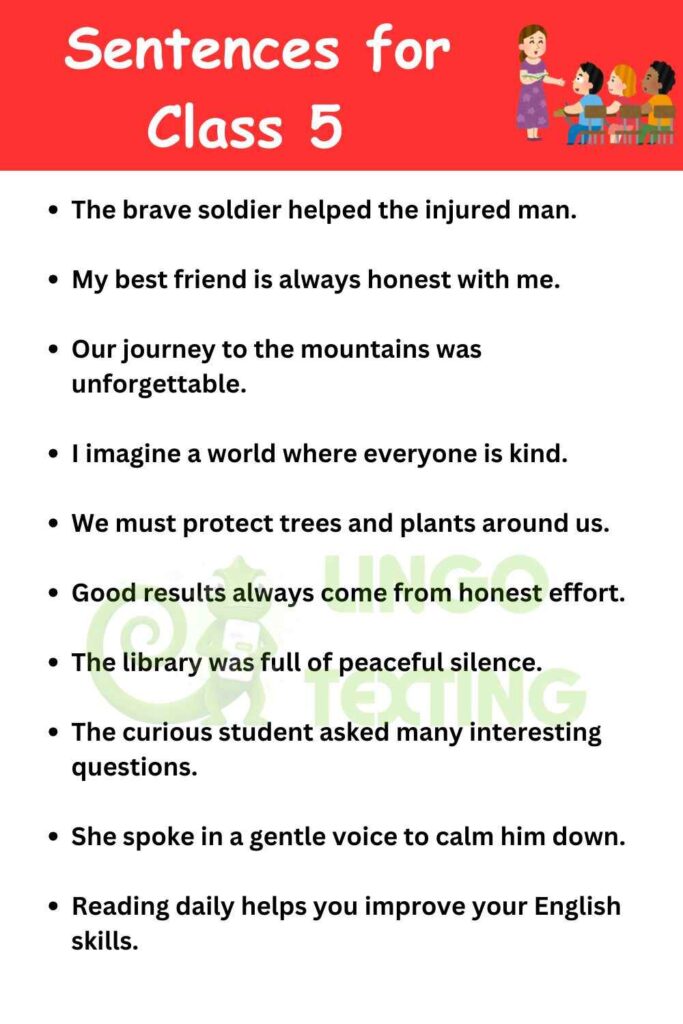
- The brave soldier helped the injured man.
- My best friend is always honest with me.
- Our journey to the mountains was unforgettable.
- I imagine a world where everyone is kind.
- We must protect trees and plants around us.
- Good results always come from honest effort.
- The library was full of peaceful silence.
- The curious student asked many interesting questions.
- She spoke in a gentle voice to calm him down.
- Reading daily helps you improve your English skills.
- The kind man shared his food with the poor.
- My grandfather has great wisdom and experience.
- We should respect everyone around us.
- The garden was full of beautiful flowers.
- She completed the task with full attention.
Sentence Correction Practice
These are common mistakes beginners make. Study both columns carefully.
| Wrong | Correct |
| He go to school every day. | He goes to school every day. |
| She don’t like vegetables. | She doesn’t like vegetables. |
| I am went to the market. | I went to the market. |
| They was playing outside. | They were playing outside. |
| He have two brothers. | He has two brothers. |
| I did not ate anything. | I did not eat anything. |
| She is more taller than me. | She is taller than me. |
| We are go now. | We are going now. |
| He can sings well. | He can sing well. |
| I have seen him yesterday. | I saw him yesterday. |
| She do not know the answer. | She does not know the answer. |
| They plays in the evening. | They play in the evening. |
Fill in the Blank — Practice Exercise
Complete these sentences on your own. Think before you write.
- My mother always _________ breakfast before school.
- I love to _________ with my friends on weekends.
- The teacher asked us to _________ our notebooks.
- Yesterday, I _________ a very interesting book.
- Tomorrow, we will _________ to our uncle’s house.
- The little cat _________ on the warm mat.
- My favorite food is _________ because it tastes amazing.
- She _________ her homework before dinner every night.
- In summer, the weather becomes very _________.
- I want to be a _________ when I grow up.
Rearrange the Words — Sentence Practice
Put these words in the correct order to make a sentence.
- school / every / goes / she / day / to
- book / interesting / reading / an / I / am
- loves / my / playing / sister / football
- last / visited / we / week / grandparents / our
- tomorrow / test / a / there / is / English
- morning / the / sing / birds / in
- lunch / after / playground / the / to / go / we
- homework / night / every / finishes / he / his
Nature and Weather Basic English sentences
- The sky is clear and blue today.
- It is very hot in the summer months.
- Leaves fall from the trees in autumn.
- Snow covers the mountains in winter.
- The river flows slowly through the valley.
- Flowers bloom beautifully in the spring.
- A rainbow appears after the rain.
- The wind is blowing strongly today.
- Clouds are gathering in the sky.
- The moon looks very bright tonight.
Food and Eating Basic English sentences
- I love to eat mangoes in summer.
- My mother makes rice and lentils every day.
- We always wash our hands before eating.
- I drink a glass of milk every morning.
- Fruits and vegetables keep us healthy.
- My favorite snack is a grilled sandwich.
- We had chicken and rice for dinner last night.
- I always feel hungry after playing outside.
- The food at my grandmother’s house is the best.
- I do not like eating too much sugar.
Health and Body Sentences
- I brush my teeth two times every day.
- Exercise keeps our body strong and healthy.
- Drinking enough water is very important.
- I sleep for eight hours every night.
- Washing hands prevents many illnesses.
- We should eat fresh food, not junk food.
- Going outside and playing keeps us fit.
- I visited the doctor when I had a fever.
- My mother gives me medicine when I feel sick.
- A healthy body and a healthy mind go together.
Basic English sentences About Places
- The park near my house is very peaceful.
- Our school library has hundreds of books.
- The market is crowded on Fridays.
- We went to the beach during the holidays.
- The hospital is at the end of this street.
- Our mosque is a beautiful and quiet place.
- The bookshop has many books for children.
- We visited a historical fort on our school trip.
- The post office is next to the bakery.
- Our neighborhood is clean and friendly.
Bonus Sentences — Inspirational and Thinking Sentences
- Mistakes help us learn and grow.
- Every day is a chance to do better.
- Reading opens doors to new worlds.
- Kindness costs nothing but means everything.
- Small steps every day lead to big changes.
- A good friend stands by you always.
- Learning never stops, no matter how old you are.
- Hard work always pays off in the end.
- Be honest even when it is difficult.
- Help others and you will feel good inside.
Common Mistakes Children Make
Beyond grammar, there are some habits that hold beginners back.
Translating word by word from their first language. English has its own word order. Translating directly from Urdu, Arabic, or Hindi often produces wrong sentences. Instead, try to think in small English chunks.
Starting every sentence with “I.” It makes writing feel flat. Try starting with time words like “Yesterday…” or “Every morning…” to add variety.
Forgetting the verb. In English, every sentence needs a verb. “She my sister” is incomplete. It must be “She is my sister.”
Forgetting -s for he/she/it. “He play” is wrong. “He plays” is correct. This one small -s makes a big difference.
Tips to Improve English Sentence Writing
Read out loud every day. Even five minutes helps your brain connect written words with spoken sounds.
Copy sentences by hand. Pick five sentences from this article and write them in a notebook. Writing builds memory differently than just reading.
Speak to yourself in English. Describe what you are doing while getting ready, eating, or walking. It sounds strange but it works.
Keep a small sentence diary. Every evening, write three sentences about your day. “I played cricket today. The weather was nice. My team won.” That is enough to build a habit.
Do not wait until you are perfect. Many learners wait until they fully know grammar before they speak. That waiting is the real problem. Speak from day one.
Read more:
350+ List of Nouns for Kids: A to Z Vocabulary List with Examples
Completing Sentence Rules: Easy Guide for Students
FAQs
1. What is the best way to learn basic English sentences?
Start with short, common sentences that you can use every day. Read them aloud, write them in a notebook, and try changing a few words to create your own sentences. Daily practice is more effective than long study sessions once in a while.
2. How many English sentences should a beginner practice each day?
A good goal is 10 to 15 sentences daily. Focus on understanding and using them correctly rather than memorizing large lists. Consistent practice helps build confidence and natural speaking habits.
3. Why can I understand English words but not make sentences?
This is a common challenge for beginners. Knowing vocabulary and building sentences are different skills. The solution is to practice complete sentences regularly so your brain learns how English words fit together naturally.
4. Should children memorize sentences or create their own?
Memorizing useful sentences can help at the beginning, but children should gradually create their own versions. Changing names, places, actions, or time words encourages real language development and better communication skills.
5. Can I improve my spoken English without taking classes?
Yes. Reading sentences aloud, speaking to yourself, listening to English conversations, and using simple sentences in daily life can significantly improve fluency. Many learners build strong speaking skills through regular self-practice.
Conclusion
Building confidence in English does not happen overnight. It grows through small, consistent steps. The more you read, speak, write, and practice Basic English Sentences, the more natural English will feel in everyday life. Focus on progress rather than perfection, use English whenever you can, and keep learning one sentence at a time. Over time, those small efforts turn into real communication skills that last a lifetime.

I write clear, practical English lessons for everyday use. On Lingotexting, I break down grammar, vocabulary, and word types into simple ideas you can apply quickly. My focus is accuracy, real examples, and helpful visuals, so learners build confidence, improve writing, and communicate naturally in school, work, and daily life.