You Read the Sentence. Two Options Look Right. Now What?
Here’s what happens during an exam. You look at four options. Two of them feel correct. You pick one. You get it wrong — not because you don’t know English, but because no one taught you how to decide.
That’s the real problem. Sentence completion isn’t just a grammar test. It’s a decision test. This guide gives you the rules, a thinking method, a chart, and practice questions with real explanations — so you stop guessing and start knowing.
What Are Completing Sentence Rules?
Completing sentence rules are the grammar and meaning checks that help you pick the right word for a blank in a sentence.
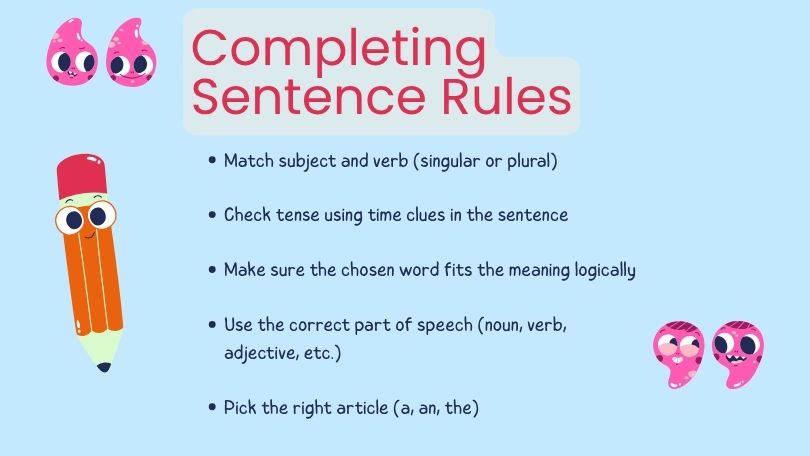
Core rules:
- Match subject and verb (singular or plural)
- Check tense using time clues in the sentence
- Make sure the chosen word fits the meaning logically
- Use the correct part of speech (noun, verb, adjective, etc.)
- Pick the right article (a, an, the)
Why Students Get Confused about Completing Sentence Rules
Most students lose marks because of how they think during the question — not just what they know.
They rush past time clues. Words like “yesterday” or “every day” tell you exactly which tense to use. Most students read right past them.
They go by sound. “This sounds right” is a feeling, not a rule. Examiners know this — they write options that all sound natural.
Two options look identical. “Is” vs “are.” “Go” vs “goes.” These tiny differences are planted deliberately. This is the trap most students fall into.
They pick the wrong word type. The sentence needs a verb, but they pick a noun. Or it needs an adverb, but they choose an adjective. The word looks right but plays the wrong role.
Core Completing Sentence Rules with Examples
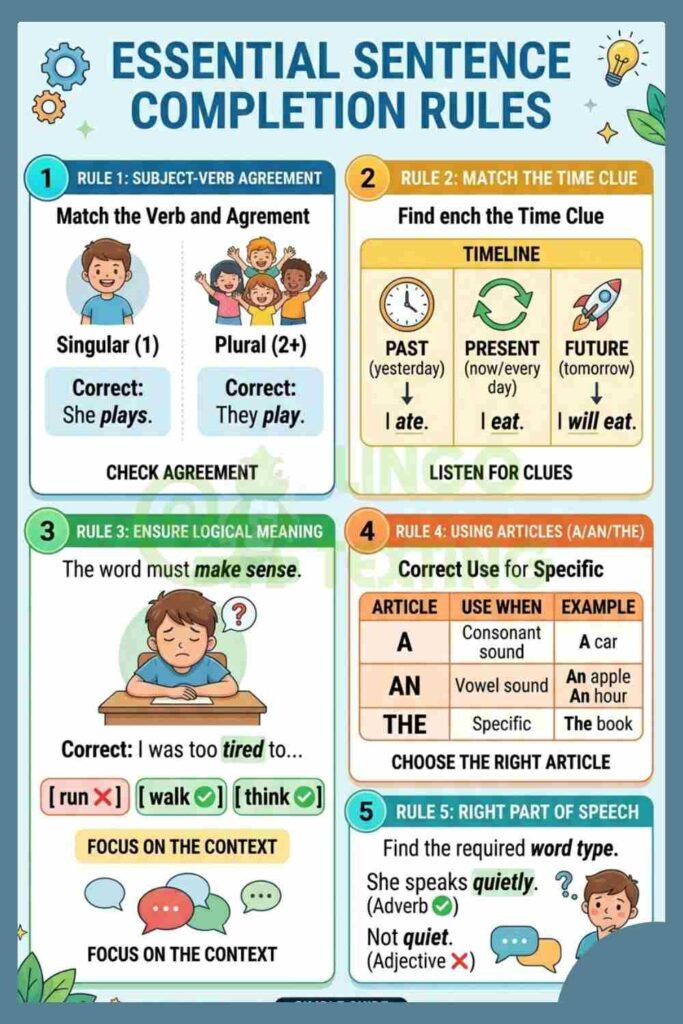
Rule 1: Subject–Verb Agreement
The verb must match the subject in number. One person or thing → singular verb. More than one → plural verb.
Mistake: ❌ She go to school every day. Correct: ✅ She plays football daily.
Quick trick: If the subject is he, she, or it — add s/es to the verb in simple present.
Rule 2: Tense Matches the Time Clue
Every sentence gives you a hidden time signal. Find it. Use it.
| Time Clue | Tense to Use |
| Yesterday, last week, ago | Past tense |
| Every day, always, usually | Present tense |
| Tomorrow, next week, soon | Future tense |
Example: “She ___ her homework yesterday.” → finished The word “yesterday” locks in the past tense. No other option is acceptable.
Rule 3: Meaning Comes Before Grammar
Sometimes every option is grammatically possible — but only one makes sense.
Example: “He was so tired that he could barely ___.” Options: sing / walk / calculate
All three are grammatically correct. But “tired” points to physical exhaustion → walk is the natural fit.
Ask yourself: What is this sentence actually saying?
Rule 4: Articles — A, An, The
- Use a before consonant sounds: a book, a car
- Use an before vowel sounds: an apple, an hour
- Use the for something specific or already known
Tricky case: “He is ___ honest man.” → an — because “honest” starts with a vowel sound, not a vowel letter.
Rule 5: Use the Right Part of Speech
The blank needs a specific type of word. Look at what surrounds it.
Example: “She spoke very ___.” The word “very” tells you an adverb is needed — not an adjective.
❌ She spoke very quiet. ✅ She spoke very quietly.
Step-by-Step Thinking Method on Completing Sentence Rules
This is the method that separates students who guess from students who know.
Step 1 — Read the entire sentence. Don’t stop at the blank. The clue is usually at the end.
Step 2 — Find the subject. Who or what is the sentence about?
Step 3 — Spot the time clue. Is there a word that tells you when?
Step 4 — Think about meaning. What is the sentence actually trying to say?
Step 5 — Eliminate wrong options. Cross out anything that fails grammar or meaning.
Step 6 — Choose the best fit. Not just correct — naturally correct.
Worked Example:
“The children ___ playing in the park when it started to rain.” Options: (a) was (b) were (c) are (d) is
- Subject: The children → plural
- Time clue: when it started → past action in progress
- Rule: Plural subject + past continuous = were
- ✅ Answer: were
Parts of Speech in Completing Sentence Rules
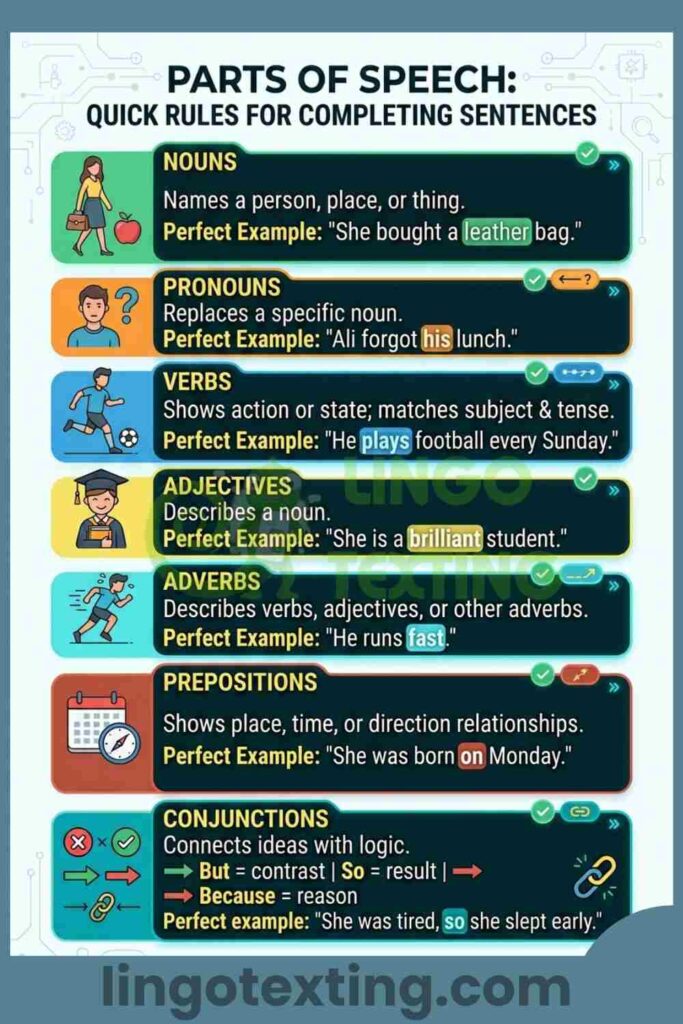
Nouns
A noun names a person, place, or thing. When the blank follows an article (a, an, the) or an adjective, it likely needs a noun.
“She bought a ___ bag.” → needs a noun: leather, new, small won’t work alone — you need the thing itself.
Common mistake: Placing an adjective where a noun belongs.
Pronouns
Match the pronoun to what it refers to — in number and gender.
“Ali forgot ___ lunch.” → his (singular male reference)
Common mistake: Using “their” when the subject is clearly one specific person.
Verbs
Verbs show action or state. They must match subject and tense — both at once.
“He ___ football every Sunday.” → plays (singular subject, present habit)
Common mistake: Forgetting to adjust for he/she/it in simple present.
Adjectives
Adjectives describe nouns. Don’t put them where an adverb belongs.
“She is a ___ student.” → brilliant, hardworking — adjective describing the noun “student”
Adverbs
Adverbs describe verbs, adjectives, or other adverbs.
“He runs ___.” → fast, quickly, slowly — not quick or slow
Common mistake: Dropping the -ly ending and using the adjective form instead.
Prepositions
Prepositions show relationships — place, time, direction. Many are fixed phrases — learn them as units.
“She was born ___ Monday.” → on (days of the week always take “on”) “He is good ___ maths.” → at
Common mistake: Translating directly from your first language. English prepositions often don’t follow logic — they follow habit.
Conjunctions
Conjunctions connect ideas. The right one depends on the logical relationship.
- But = contrast → “He studied hard, but he failed.”
- So = result → “She was tired, so she slept early.”
- Because = reason → “He was late because the bus broke down.”
Common mistake: Using “but” and “so” interchangeably when the logic is different.
Tense-Based Completing Sentence Rules
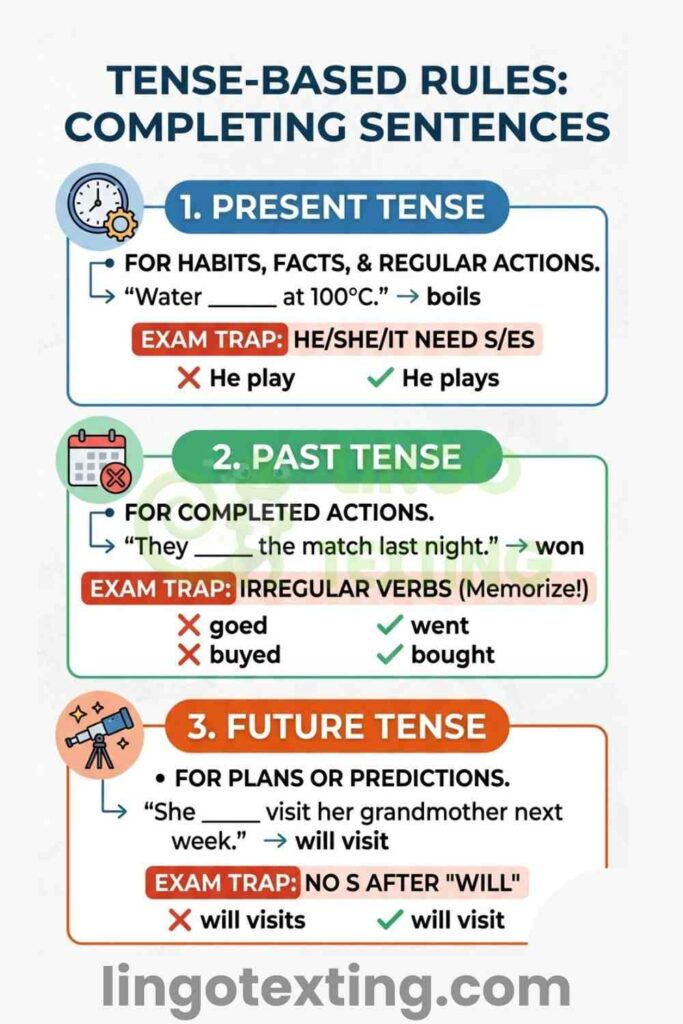
Present Tense
Used for habits, facts, and regular actions.
“Water ___ at 100°C.” → boils
Exam trap: Forgetting s/es for he/she/it. Students write “He play” — the correct form is “He plays.”
Past Tense
Used for completed actions.
“They ___ the match last night.” → won
Exam trap: Irregular verbs. “Go” becomes “went,” not “goed.” “Buy” becomes “bought,” not “buyed.” These must be memorized — they don’t follow the standard pattern.
Future Tense
Used for plans or predictions.
“She ___ visit her grandmother next week.” → will visit
Exam trap: Adding s after “will.” Never write “She will visits.” The verb after will always stays in base form.
Completing Sentence Rules Chart
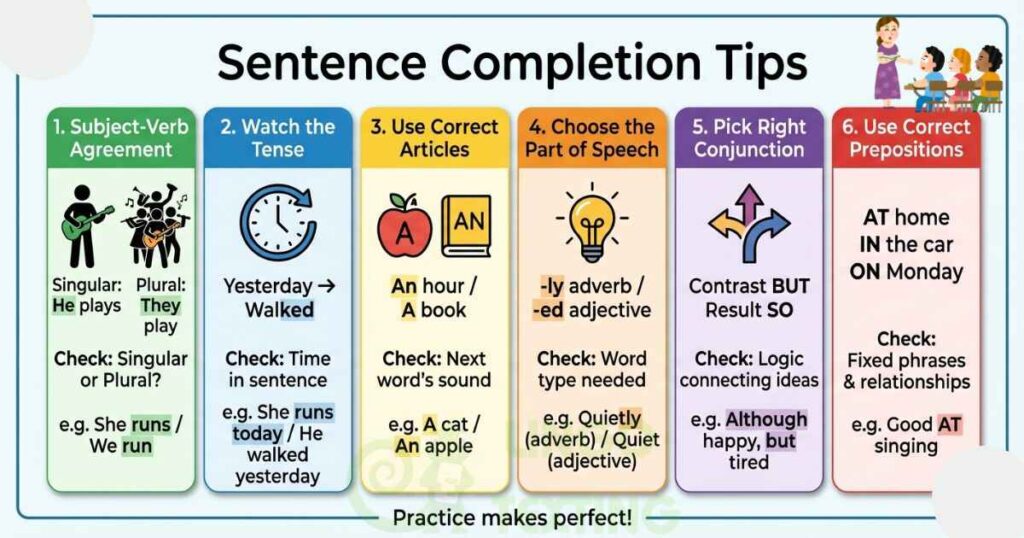
| Rule | What to Check | Example |
| Subject–Verb Agreement | Singular or plural subject | She plays / They play |
| Tense | Time clue in the sentence | Yesterday → past tense |
| Meaning | Does the word logically fit? | Tired → could barely walk |
| Articles | Sound of the next word | An hour / A book |
| Part of Speech | Which type is needed? | Quietly (adverb) not quiet |
| Conjunctions | What logic connects the ideas? | But (contrast) / So (result) |
| Prepositions | Fixed phrase or relationship | Good at / Born on Monday |
Practice: Completing Sentence Rules with Answers
Try these first. Then check the explanations below.
- She ___ (go/goes) to school every morning.
- They ___ (was/were) playing cricket yesterday.
- He is ___ (a/an) honest person.
- The dog ran ___ (quick/quickly).
- I ___ (will finish/will finishes) the work tomorrow.
- She felt tired, ___ she went to bed early. (so/but)
- The students ___ (is/are) ready for the exam.
- He ___ (buyed/bought) a new bag last week.
- We go to the park ___ (in/on) Sundays.
- The baby ___ (sleep/sleeps) for two hours every afternoon.
Answers and Explanations:
- goes — “She” is singular. Present habit takes s/es.
- were — “They” is plural. “Yesterday” = past tense.
- an — “Honest” starts with a vowel sound, not a vowel letter.
- quickly — The verb “ran” needs an adverb, not an adjective.
- will finish — After will, the verb stays in base form. Never add s.
- so — She was tired → result = went to bed. “So” shows a result.
- are — “The students” is plural.
- bought — “Buy” is irregular. Past tense = bought, not buyed.
- on — Days of the week always use on.
- sleeps — “The baby” is singular. Present habit → s/es.
Completing Sentence Rules for Class 10 Exams
Class 10 board exams test sentence completion through fill-in-the-blank questions and MCQs. The options are designed to confuse — not to help.
What examiners do to trick you:
They put the time clue at the end of the sentence. Students who stop reading at the blank miss it completely.
They make two options look almost identical — “was” and “were,” or “a” and “an.” The difference is one letter. The rule decides.
They mix up word types — putting an adverb and an adjective together as options when both “sound” correct in the blank.
What to do in the exam:
Circle the time clue before touching the options. Identify the subject. Check the word type the blank needs. Then eliminate — don’t just pick.
Common Mistakes Students Make
Picking by sound, not structure. “It sounds right” is the most expensive mistake in sentence completion. Always check against at least one rule.
Ignoring irregular verbs. Go → went. Buy → bought. Take → took. These don’t follow standard rules and must be learned separately.
Mixing adjectives and adverbs. “He drove careful” is wrong. The verb needs carefully. If you’re describing how something is done — use an adverb.
Using wrong prepositions. Prepositions are fixed. “Interested in,” “good at,” “afraid of” — these don’t change. Learn them as phrases, not individual words.
Read also more:
Simple English Sentences for Class 1: (Examples, Practice & Worksheets)
1000+ English Sentences Used in Daily Life: Practical Guide
FAQs about Completing Sentence Rules
What are completing sentence rules?
Grammar and meaning checks — like subject-verb agreement, tense matching, and part of speech selection — that help you pick the correct word for a blank.
Why do two options often feel equally correct?
Examiners design it that way. Both options may be grammatically possible — but only one fits the meaning and the structure. Using the step-by-step method resolves this every time.
How do I improve at sentence completion quickly?
Do daily practice. After every question, ask why the answer is correct — not just what it is. Understanding the reason builds pattern recognition faster than repetition alone.
What is a completing sentence rules chart used for?
It’s a quick checklist. Before finalizing your answer, run through each row: subject-verb, tense, meaning, article, word type. Each check takes a few seconds and catches most errors.
One Last Thing Before Your Next Exam
The students who do well at sentence completion aren’t the ones who know the most grammar. They’re the ones who slow down, use a method, and check their answer against meaning and structure — not just instinct.
Use the 6-step method every time. Keep the rules chart in your head. Understand the why behind each practice answer. The moment you stop guessing and start checking, sentence completion stops feeling hard.

I write clear, practical English lessons for everyday use. On Lingotexting, I break down grammar, vocabulary, and word types into simple ideas you can apply quickly. My focus is accuracy, real examples, and helpful visuals, so learners build confidence, improve writing, and communicate naturally in school, work, and daily life.