Most bad habits start small. A few extra minutes on your phone, putting off a task, or skipping a healthy routine may not seem important at first. Over time, though, these actions can become automatic and affect your health, work, relationships, and confidence. This guide explores practical Bad Habit Examples, why they stick, and simple ways to replace them with healthier choices that support long-term growth.
What Are Bad Habits?
A bad habit is any repeated behavior that causes harm — to your health, relationships, work, or future self.
The key word is repeated. Doing something unhealthy once isn’t a habit. A habit is when a behavior becomes automatic. You don’t decide to do it — you just do it.
Psychologically, habits live in the basal ganglia — the part of the brain that stores patterns so you don’t have to think about them every time. The habit loop — trigger → behavior → reward — explains why habits stick. Every habit starts with a cue, leads to a behavior, and ends with some kind of reward (even a tiny one, like a moment of relief). Repeat that cycle enough and it becomes nearly automatic.
What Makes a Habit “Bad”?
A habit earns the “bad” label when it creates real consequences:
- Health consequences — poor sleep, weight gain, fatigue, illness
- Productivity consequences — missed deadlines, wasted time, low output
- Relationship consequences — arguments, trust issues, emotional distance
- Financial consequences — debt, impulse spending, missed savings
- Emotional consequences — guilt, anxiety, low self-worth
Some bad habits are mild inconveniences. Others — addiction, chronic lying, financial recklessness — can genuinely damage a life over time.
Why Do People Develop Bad Habits?
Stress is the most common driver. When stressed, people reach for whatever gives fast relief — food, scrolling, cigarettes. The brain learns the pattern and repeats it.
Boredom is underrated as a trigger. Many people don’t realize they’re snacking, scrolling, or procrastinating because they’re under-stimulated.
Anxiety pushes people toward avoidance. Avoiding a hard task feels safe for a moment but makes the anxiety worse — and the avoidance becomes the habit.
Environment shapes behavior more than people admit. A messy apartment keeps you disorganized. Coworkers who gossip make it easy to join in.
Dopamine and reward seal the deal. Every habit that sticks offers some kind of dopamine hit — pleasure, relief, or comfort. Even a bad habit feels good short-term. That’s the trap.
Health Bad Habit Examples
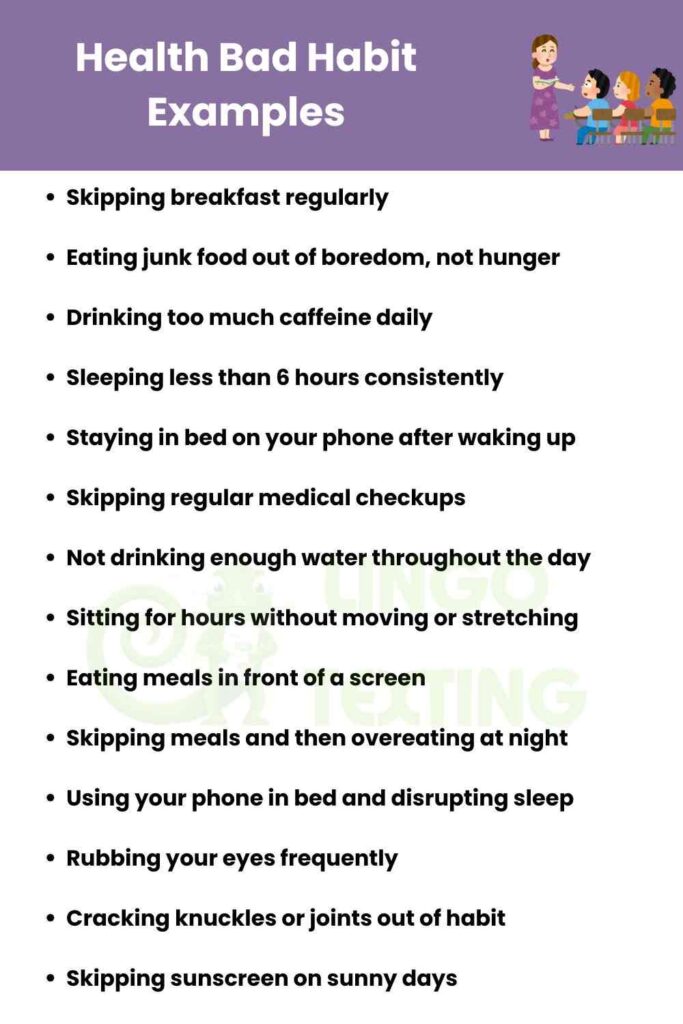
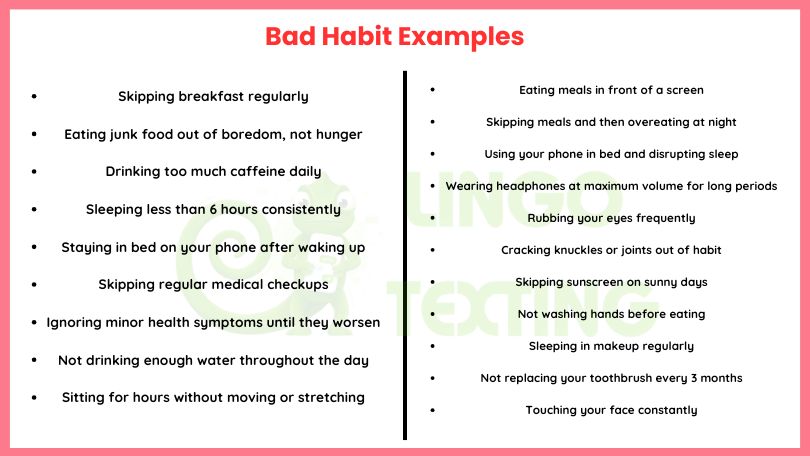
- Skipping breakfast regularly
- Eating junk food out of boredom, not hunger
- Drinking too much caffeine daily
- Sleeping less than 6 hours consistently
- Staying in bed on your phone after waking up
- Skipping regular medical checkups
- Ignoring minor health symptoms until they worsen
- Not drinking enough water throughout the day
- Sitting for hours without moving or stretching
- Eating meals in front of a screen
- Skipping meals and then overeating at night
- Using your phone in bed and disrupting sleep
- Wearing headphones at maximum volume for long periods
- Rubbing your eyes frequently
- Cracking knuckles or joints out of habit
- Skipping sunscreen on sunny days
- Not washing hands before eating
- Sleeping in makeup regularly
- Not replacing your toothbrush every 3 months
- Touching your face constantly
Study and School Bad Habit Examples
- Leaving assignments until the night before they’re due
- Studying with social media or TV playing in the background
- Highlighting everything in a textbook without actually reading
- Re-reading notes without testing yourself on them
- Skipping class and telling yourself you’ll catch up later
- Pulling all-nighters before exams
- Cramming instead of using spaced repetition
- Copying homework from friends
- Not asking questions when you don’t understand
- Multitasking during lectures or online classes
- Checking your phone every few minutes while studying
Work Bad Habit Examples
- Checking email constantly instead of doing focused work
- Agreeing to every request and then missing deadlines
- Gossiping about coworkers
- Arriving late consistently without communicating
- Avoiding difficult conversations until they explode
- Taking credit for team efforts
- Complaining about your job on social media
- Procrastinating on tasks you don’t enjoy
- Being on your phone during meetings
- Not writing things down and relying on memory
- Over-promising and under-delivering
- Skipping lunch breaks and burning out by midday
- Saying yes publicly and disagreeing privately
- Not documenting your work or processes
Financial Bad Habit Examples
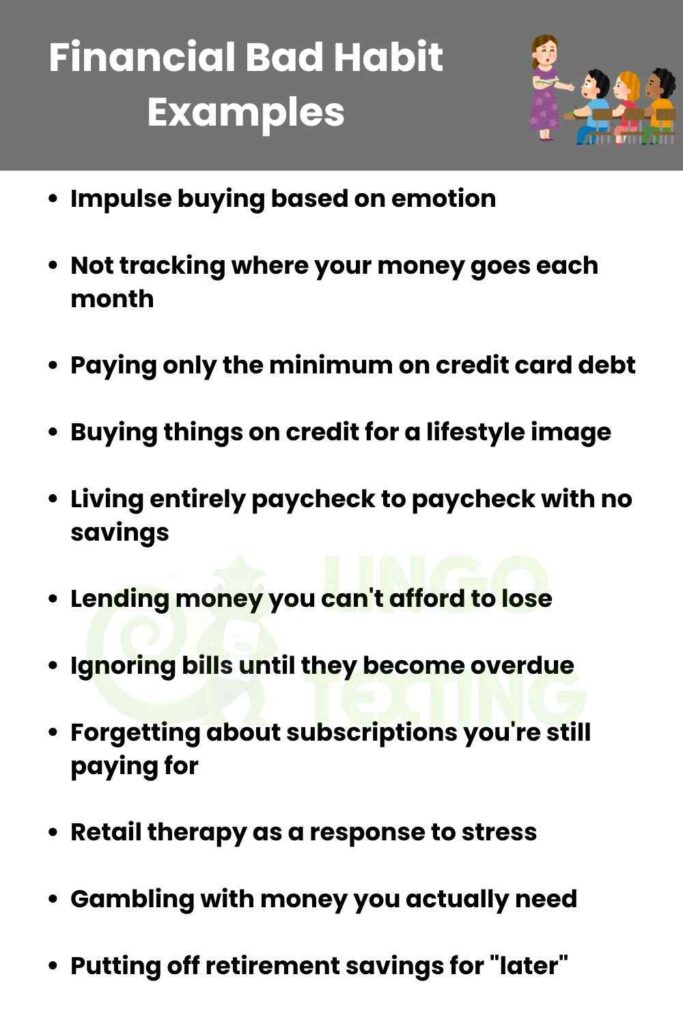
- Impulse buying based on emotion
- Not tracking where your money goes each month
- Paying only the minimum on credit card debt
- Buying things on credit for a lifestyle image
- Living entirely paycheck to paycheck with no savings
- Lending money you can’t afford to lose
- Ignoring bills until they become overdue
- Forgetting about subscriptions you’re still paying for
- Retail therapy as a response to stress
- Gambling with money you actually need
- Putting off retirement savings for “later”
Relationship Bad Habit Examples
- Checking your partner’s phone without permission
- Bringing up past arguments during a current one
- Saying “fine” or “whatever” instead of expressing real feelings
- Stonewalling — going completely silent during conflict
- Criticizing small things constantly
- Making jokes at your partner’s expense in front of others
- Expecting your partner to read your mind
- Apologizing without changing the behavior
- Using “you always” or “you never” in arguments
- Being physically present but mentally on your phone
Social Bad Habit Examples
- Interrupting people before they finish speaking
- Giving unsolicited advice in every conversation
- One-upping every story someone shares
- Canceling plans at the last minute regularly
- Passive-aggressive comments dressed as honesty
- Talking about people behind their backs
- Not making eye contact during conversations
- Being chronically late and treating it as a personality trait
- Dominating conversations without asking others questions
- Complaining constantly without working toward any solution
Technology and Social Media Bad Habit Examples
- Doomscrolling — endlessly consuming negative news
- Comparing your real life to other people’s highlight reels
- Posting on social media while emotionally reactive
- Using social media to avoid dealing with real problems
- Checking your phone first thing every morning
- Getting into arguments in comment sections
- Oversharing personal problems publicly
- Using screens to avoid silence or boredom
- Playing videos at full volume in public spaces
- Responding to messages without actually reading them fully
Personal Development Bad Habit Examples
- Quitting something new the moment it gets difficult
- Comparing your progress to others instead of your past self
- Waiting for motivation before starting anything
- Setting vague goals with no actual plan attached
- Starting many things and finishing none
- Surrounding yourself only with people who agree with you
- Refusing to accept feedback or constructive criticism
- Telling yourself “I’m just not that kind of person”
- Researching and planning endlessly instead of doing
- Rewarding yourself before you’ve done the work
Emotional and Mental Bad Habit Examples
- Catastrophizing — automatically assuming the worst outcome
- People-pleasing at the expense of your own needs
- Suppressing emotions instead of processing them
- Guilt-tripping others when you don’t get what you want
- Holding grudges long after an issue could be resolved
- Using self-deprecating humor to mask real insecurity
- Seeking constant external validation
- Overthinking decisions until the opportunity passes
- Dismissing your own feelings as “not a big deal”
- Ruminating on past mistakes instead of learning and moving on
The 20 Most Damaging Bad Habits
| Bad Habit | Why It’s So Damaging |
| Chronic procrastination | Causes compounding anxiety, missed opportunities, lost time |
| Regular sleep deprivation | Damages memory, mood, immune system, and decision-making |
| Constant phone use | Destroys focus, disrupts sleep, reduces real-world connection |
| Smoking | Major risk for cancer, heart disease, and lung damage |
| Excessive alcohol | Affects liver, brain, judgment, and relationships |
| Avoiding hard conversations | Problems fester; relationships slowly deteriorate |
| Impulse spending | Erodes financial stability and creates lasting debt |
| Negative self-talk | Slowly reshapes how you see yourself |
| Chronic lying | Destroys trust and creates constant internal stress |
| People-pleasing | Leads to burnout, resentment, and loss of self-identity |
| Doomscrolling daily | Increases anxiety and distorts your view of reality |
| Skipping preventive healthcare | Small issues go undetected until serious |
| Emotional overeating | Affects physical health and reinforces avoidance |
| Isolating during stress | Cuts off the support that actually helps recovery |
| Holding grudges | Keeps you emotionally trapped in the past |
| Overcommitting | Leads to burnout and consistently letting others down |
| Not saving money | Any emergency becomes a financial crisis |
| Quitting when things get hard | Prevents growth and confirms false beliefs about yourself |
| Comparing yourself to others | Creates chronic dissatisfaction regardless of real progress |
| Avoiding accountability | Blocks growth and damages trust in every relationship |
Bad Habits by Ageing
Students
- Procrastinating on assignments until the last night
- Passive studying — re-reading without self-testing
- All-nighters before exams (sleep consolidates memory; skipping it backfires)
- Skipping class and assuming you’ll catch up
- Never asking for help when confused
Adults
- No monthly budget or spending awareness
- Skipping routine health checkups
- Working through every break and calling it discipline
- Defaulting to silence or sarcasm instead of honest conversation
- Delaying retirement savings indefinitely
Kids
- Lying about small things to avoid consequences
- Screen time before homework is done
- Not saying please, thank you, or sorry
- Blaming others when things go wrong
- Forgetting basic hygiene unless reminded every time
Bad Habits in Different Situations
At School
- Sitting in the back to avoid participation
- Not reviewing notes after class
- Studying only the night before a test
At Home
- Leaving dirty dishes for days
- Scrolling instead of sleeping
- Ignoring small maintenance tasks until they become big problems
At Work
- Sending vague, unclear messages
- Copying everyone on every email
- Avoiding feedback from managers
In Relationships
- Not listening — just waiting to speak
- Keeping score of who did what
- Withholding appreciation because “they should already know”
On Social Media
- Posting emotional reactions before thinking
- Engaging with accounts that make you feel worse
- Measuring your worth by engagement numbers
Good Habits vs. Bad Habits
| Area | Bad Habit | Better Alternative |
| Morning | Phone in bed first thing | 10 minutes of quiet, stretch, or walk |
| Sleep | Irregular sleep times | Consistent sleep and wake schedule |
| Eating | Mindless snacking while scrolling | Eating at a table without screens |
| Work | Checking email constantly | Scheduled email time blocks |
| Studying | Passive re-reading | Active recall and practice tests |
| Money | Impulse buying | 24-hour pause before non-essential purchases |
| Relationships | Avoiding conflict | Addressing issues calmly while they’re still small |
| Social media | Doomscrolling | Time-limited, intentional browsing |
| Emotions | Suppressing feelings | Journaling or talking to someone trusted |
| Goals | Vague intentions | Specific, written, time-bound plans |
Bad Habits for Fictional Characters (Useful for Writers)
Believable characters need real human-scale weaknesses — not cartoon villainy, but habits that create natural conflict:
- Arrogance — dismisses advice, alienates allies, assumes they know best
- Impulsiveness — acts before thinking, good intentions create real problems
- Jealousy — misreads situations, damages relationships from fear of loss
- Perfectionism — avoids completing things because nothing is ever good enough
- Dishonesty — small lies create a web that becomes impossible to manage
- Manipulation — gets short-term results but destroys long-term trust
- Avoidance — runs from problems until they become crises
- Excessive loyalty — defends people who don’t deserve it, ignores warning signs
- Savior complex — helps others to avoid dealing with their own life
- Stubbornness — holds positions even after the evidence has changed
The most compelling character flaws were once survival strategies. Arrogance might come from having to be the most capable person to survive a difficult environment. Dishonesty might have started as self-protection. That origin is what makes characters feel real, not just broken.
How to Break a Bad Habit
Step 1 — Name the exact habit. Not “I eat badly” but “I eat chips on the couch every night after 10 PM.” Specificity makes it workable.
Step 2 — Find the real trigger. Is it boredom? Stress? A specific time, place, or person? You can’t change what you haven’t identified.
Step 3 — Replace, don’t just remove. The brain craves the pattern. Give it a better option. If you stress-eat, replace it with a short walk or a glass of water first. Removal without replacement rarely sticks.
Step 4 — Change your environment. If your phone is in the bedroom, you’ll use it in bed. If chips are on the counter, you’ll eat them. Make the bad habit harder and the good habit easier. This works better than willpower alone.
Step 5 — Track without judging. A simple log helps you see patterns. Awareness alone changes behavior — you can’t unsee what you’ve noticed.
Step 6 — Expect setbacks and keep going. One bad day is not failure. The mistake most people make is treating a single slip as proof that change is impossible. Consistency over weeks matters more than perfection day to day.
Common Myths About Bad Habits
Myth: It takes 21 days to break a habit. This figure comes from a misread 1960s observation, not research. Studies show habit formation takes anywhere from 18 to 254 days depending on the person and the behavior.
Myth: Willpower is all you need. Willpower depletes throughout the day. Environment design, habit replacement, and identity shifts work far better than trying to out-will a deeply wired pattern.
Myth: Bad habits mean you’re weak. The most disciplined people alive have bad habits. Habits form through repetition and reward — not through character weakness. They’re patterns, not personality.
Myth: You have to quit cold turkey. Gradual reduction works for many habits — sometimes better than abrupt stopping, which can trigger a rebound. Neither approach is universally correct.
Signs a Bad Habit Is Affecting Your Life More Than You Realize
- You’re more tired than your schedule explains
- People who care about you have mentioned the behavior more than once
- You feel mild guilt after doing it but keep doing it anyway
- You’ve tried to stop before and couldn’t
- It’s costing you time, money, health, or closeness in relationships
- You need more of it now to feel the same effect as before
That last point — needing more for the same result — describes escalation. That’s how mild habits become serious ones.
Read also –
45+ Cooking Verbs: Essential Words Every Home Cook Needs to Know
150+ Compound Sentence Examples: Guide for Real English Learners
Frequently Asked Questions
How do I know if a habit is actually hurting my life?
A habit may be causing problems if it repeatedly costs you time, energy, money, health, or trust. If you often feel regret after doing it or others have raised concerns, it’s worth taking a closer look.
Which bad habit should I work on first?
Start with the habit creating the biggest impact on your daily life. For many people, that could be poor sleep, constant phone use, procrastination, or unhealthy spending. Improving one key habit often makes other changes easier.
Why do bad habits keep coming back even after I stop?
Many habits are linked to triggers such as stress, boredom, loneliness, or routine. If the trigger remains unchanged, the habit can return. Replacing the behavior with a healthier alternative usually works better than relying on willpower alone.
Can small habit changes really make a difference?
Yes. Small actions repeated consistently often create bigger results than dramatic short-term efforts. A few minutes of daily improvement can lead to meaningful changes over months and years.
Final Takeaway
Bad habits aren’t signs of failure. Every person has them — different ones, in different areas, at different levels of severity.
What matters isn’t having zero bad habits. What matters is direction: Are you becoming slightly more aware of your patterns? Are you slowly replacing the ones doing the most damage?
Change doesn’t happen all at once. It happens in small moments — when you pause, notice the pattern, and choose differently. Even once. Even imperfectly. That pause is where everything starts.

I write clear, practical English lessons for everyday use. On Lingotexting, I break down grammar, vocabulary, and word types into simple ideas you can apply quickly. My focus is accuracy, real examples, and helpful visuals, so learners build confidence, improve writing, and communicate naturally in school, work, and daily life.