
“Attention to detail” means noticing small things carefully and making sure nothing is missed. Common alternatives include thoroughness, meticulousness, precision, accuracy, and carefulness. These phrases work in resumes, emails, performance reviews, and daily conversations. The right choice depends on your tone, audience, and how formal the situation is.
What Does “Attention to Detail” Mean?
It means you catch small errors. You check your work. You don’t rush past the small stuff.
In real life, this phrase shows up on resumes, in job interviews, in performance reviews, and in professional emails. Managers use it to praise employees. Teachers use it to describe students who submit clean, careful work.
The phrase itself is neutral. It’s not too formal or too casual. It fits most professional settings comfortably.
But it’s also overused. Hiring managers see it on almost every resume. That’s why finding a smarter, fresher way to say the same thing actually makes you stand out.
When Does This Phrase Show Up?
- Job applications and resumes
- Performance appraisals
- Professional references and recommendation letters
- Self-evaluations at work
- Cover letters
- Business emails
- Team feedback sessions
- School reports and grading comments
It rarely appears in casual conversation. You wouldn’t text a friend, “I really appreciate your attention to detail.” You’d say something like “you’re so careful” or “you never miss anything.”
Is “Attention to Detail” Professional?
Yes, absolutely. It’s one of the most accepted professional phrases in workplace English.
The only issue is frequency. It’s used so often that it has lost some of its power. If your resume, cover letter, and self-review all say “attention to detail,” it starts to feel like a copy-paste habit rather than a real strength.
That’s where the alternatives in this article become genuinely useful.
27 Another Way to Say Attention to Detail
Each option below comes with its meaning, tone, best use, and example sentences. No two alternatives are the same. Choose based on your situation.
1. Thoroughness
Meaning: Doing something completely, without skipping steps.
Tone: Professional and calm.
Best for: Resumes, performance reviews, formal emails.
- “Her thoroughness during the audit saved the company thousands.”
- “The report was praised for its thoroughness.”
- “He approaches every task with real thoroughness.”
Tip: Use this when you want to emphasize completeness, not just carefulness.
2. Meticulousness
Meaning: Paying extremely careful attention to every small part.
Tone: Formal and impressive.
Best for: Academic writing, legal documents, high-level professional settings.
- “His meticulousness in data entry reduced errors by 40%.”
- “She is known for her meticulousness when reviewing contracts.”
- “The design team appreciated her meticulousness.”
Tip: This word carries strong weight. Use it when you want to make a lasting impression.
3. Precision
Meaning: Being exact. No guesswork. No approximations.
Tone: Sharp and confident.
Best for: Technical roles, science, engineering, finance, medicine.
- “The surgeon performed the procedure with great precision.”
- “Precision is non-negotiable in financial reporting.”
- “His precision with measurements kept the project on track.”
Tip: Use “precision” when the context involves numbers, measurements, or technical accuracy.
4. Accuracy
Meaning: Getting things right. No mistakes in facts or figures.
Tone: Neutral and professional.
Best for: Data work, research, accounting, journalism, customer service.
- “She double-checked every figure for accuracy.”
- “Accuracy in this role is more important than speed.”
- “The team was recognized for the accuracy of their reports.”
Tip: “Accuracy” focuses on the result being correct. “Precision” focuses on the method being exact. They’re close but not identical.
5. Carefulness
Meaning: Moving slowly and deliberately to avoid mistakes.
Tone: Warm and approachable.
Best for: Everyday professional contexts, feedback to junior employees, school settings.
- “I admire your carefulness when handling client data.”
- “His carefulness during the setup prevented any damage.”
- “She showed great carefulness in her response.”
Tip: This is gentler than “meticulousness.” Use it with people newer to a role.
6. Diligence
Meaning: Consistent, steady effort put into work.
Tone: Professional and respectful.
Best for: Performance reviews, recommendation letters, LinkedIn profiles.
- “Her diligence in every project made her a trusted team member.”
- “Years of diligence brought him to this leadership role.”
- “We value your diligence and care with every task.”
Tip: Diligence suggests sustained effort over time, not just careful work in one moment.
7. Exactness
Meaning: Matching a standard perfectly, with no room for error.
Tone: Formal and technical.
Best for: Legal, engineering, scientific, or data-heavy environments.
- “The exactness of her work helped the team pass the inspection.”
- “This role demands exactness in every measurement.”
- “He is valued for his exactness in written communication.”
Tip: Use “exactness” when perfection to a specific standard is the goal.
8. Conscientiousness
Meaning: Taking your responsibilities seriously and completing them carefully.
Tone: Mature and professional.
Best for: Character descriptions, HR reports, leadership evaluations.
- “Her conscientiousness sets the standard for the whole department.”
- “Conscientiousness is one of the most valued traits in this field.”
- “He completes every task with genuine conscientiousness.”
Tip: This word covers both effort and ethics. It signals that someone cares about doing the right thing, not just the correct thing.
9. Fastidiousness
Meaning: Being very particular and hard to satisfy unless things are exactly right.
Tone: Formal, slightly strong.
Best for: High-standard creative fields, publishing, architecture, luxury services.
- “Her fastidiousness in layout design makes every page look perfect.”
- “His fastidiousness with grammar is well known in the editing team.”
- “Clients appreciated her fastidiousness about product quality.”
Tip: This word can sometimes suggest someone is too particular. Use it in contexts where high standards are clearly a strength.
10. Scrupulousness
Meaning: Following rules and standards with great care, leaving no detail unchecked.
Tone: Formal and ethical.
Best for: Legal, compliance, medical, and financial fields.
- “Her scrupulousness during compliance checks protected the firm.”
- “The accountant’s scrupulousness ensured a clean audit.”
- “He is known for his scrupulousness in documentation.”
Tip: Use this when the detail work involves integrity, not just skill.
11. Painstaking Effort
Meaning: Putting great care and energy into work, even when it’s hard or slow.
Tone: Descriptive and sincere.
Best for: Performance reviews, recommendations, project summaries.
- “She put painstaking effort into every part of the proposal.”
- “The restoration required painstaking effort over three years.”
- “His painstaking effort on this report is clear to everyone.”
Tip: This phrase highlights difficulty overcome, not just quality. It shows someone worked hard and carefully.
12. Rigorous Review
Meaning: Checking something very carefully, multiple times, using a strict process.
Tone: Professional and process-focused.
Best for: Academic peer review, audits, quality control, legal review.
- “Every submission goes through a rigorous review before approval.”
- “Her rigorous review of the contract prevented a major issue.”
- “The team conducted a rigorous review of all safety procedures.”
Tip: This phrase works best when describing a system or process, not a personality trait.
13. Close Observation
Meaning: Watching or checking something carefully, not missing anything.
Tone: Descriptive and neutral.
Best for: Research, medical, teaching, quality assurance.
- “Close observation of the data revealed a pattern no one expected.”
- “Her close observation of the students helped her adapt quickly.”
- “Through close observation, the technician found the source of the issue.”
Tip: This is less about output and more about the act of watching carefully.
14. Sharp Eye
Meaning: The ability to notice small errors, changes, or problems others miss.
Tone: Casual to semi-professional.
Best for: Team feedback, informal emails, creative fields.
- “She has a sharp eye for inconsistencies in design.”
- “His sharp eye caught the typo before the brochure went to print.”
- “If you need someone with a sharp eye, she’s your first call.”
Tip: This is more conversational. Avoid it in formal documents but it’s great in verbal feedback or casual written praise.
15. Eagle-Eyed
Meaning: Noticing even the tiniest detail that others overlook.
Tone: Friendly and slightly playful.
Best for: Team meetings, casual email appreciation, social media posts.
- “Our eagle-eyed proofreader saved us from a big embarrassment.”
- “She’s eagle-eyed — nothing slips past her.”
- “Having one eagle-eyed person on the team makes everything better.”
Tip: This is informal. It works well in team culture but not in formal reviews or applications.
16. Zero-Error Mindset
Meaning: An approach to work where mistakes are simply not acceptable.
Tone: Confident and modern.
Best for: Resumes, cover letters, interviews, startup environments.
- “She brings a zero-error mindset to every deliverable.”
- “His zero-error mindset raised the quality bar for the entire team.”
- “In this role, a zero-error mindset is not optional.”
Tip: This phrase is newer and punchy. It works well in industries that value results over process descriptions.
17. Methodical Approach
Meaning: Working through tasks in an organized, step-by-step way.
Tone: Professional and structured.
Best for: Engineering, project management, operations, IT.
- “Her methodical approach to problem-solving earns trust from clients.”
- “A methodical approach ensured nothing was left out.”
- “He walks through every task with a methodical approach.”
Tip: This phrase emphasizes how someone works, not just how carefully. It suggests order and reliability.
18. Thoroughgoing Analysis
Meaning: An examination that leaves no part unchecked.
Tone: Formal and academic.
Best for: Research summaries, audit reports, legal briefs.
- “The consultant delivered a thoroughgoing analysis of the market.”
- “Her thoroughgoing analysis of the proposal identified three risks.”
- “The committee asked for a thoroughgoing analysis before approval.”
Tip: Use this phrase to describe a completed output, not a personality trait.
19. High Standards
Meaning: Expecting quality and not settling for work that’s merely acceptable.
Tone: Professional and motivating.
Best for: Performance conversations, leadership descriptions, team goals.
- “She holds high standards for herself and the people around her.”
- “His high standards pushed the project to a better result.”
- “Clients return because they know we maintain high standards.”
Tip: This phrase is broader than attention to detail. Use it when quality shows up across multiple areas.
20. Nothing-Slips-Through Attitude
Meaning: A mindset where every step is checked and no detail is ignored.
Tone: Confident and strong.
Best for: Interviews, personal statements, team culture descriptions.
- “What makes her exceptional is her nothing-slips-through attitude.”
- “That nothing-slips-through attitude saved the launch from a major delay.”
- “In compliance, a nothing-slips-through attitude is what we hire for.”
Tip: This is expressive and memorable. It works well in interviews or storytelling formats.
21. Minute-Level Accuracy
Meaning: Accuracy that reaches even the smallest, most fine-grained level.
Tone: Technical and precise.
Best for: Science, data analysis, manufacturing, healthcare.
- “Minute-level accuracy is required in pharmaceutical dosing.”
- “The system tracks every action with minute-level accuracy.”
- “Her minute-level accuracy in transcription is unmatched.”
Tip: This phrase signals that you’re talking about accuracy at a very fine level, not just general carefulness.
22. Careful Review
Meaning: Going through something slowly and attentively to catch issues.
Tone: Neutral and professional.
Best for: Emails, work memos, project communication.
- “Please allow time for a careful review before submitting.”
- “Her careful review of the contract caught three errors.”
- “A careful review of the timeline showed we needed two extra days.”
Tip: Simple and clean. This phrase works in almost any professional setting without feeling overly formal.
23. Exacting Standards
Meaning: Holding work to a very strict, specific level of quality.
Tone: Formal and demanding.
Best for: Leadership roles, quality assurance descriptions, client-facing industries.
- “The chef is known for his exacting standards in every dish.”
- “She applies exacting standards to every report before it leaves her desk.”
- “Their exacting standards are why the brand is trusted worldwide.”
Tip: This phrase says quality is demanded, not just desired. It implies consistency under pressure.
24. Attentiveness
Meaning: Being alert and present, noticing what’s happening around you carefully.
Tone: Calm and professional.
Best for: Healthcare, education, customer service, administrative roles.
- “Her attentiveness during client calls builds genuine trust.”
- “Attentiveness to patient needs is the mark of great nursing.”
- “He earns respect for his attentiveness in every meeting.”
Tip: “Attentiveness” is slightly softer than “attention to detail.” It works better when describing interpersonal skill.
25. Careful Execution
Meaning: Carrying out a task slowly, attentively, and without rushing.
Tone: Professional and results-focused.
Best for: Project management, construction, creative production.
- “The careful execution of the plan kept everything on schedule.”
- “Careful execution during testing saved two weeks of rework.”
- “She is recognized for her careful execution in high-pressure situations.”
Tip: This phrase focuses on the action, not the trait. Use it when describing a completed task.
26. Fine-Tuned Focus
Meaning: A sharp mental focus directed at the smallest parts of something.
Tone: Modern and vivid.
Best for: Creative writing, team recognition, marketing roles.
- “His fine-tuned focus on typography made the brand look premium.”
- “She brings fine-tuned focus to everything she touches.”
- “That fine-tuned focus is what separates good from excellent.”
Tip: This phrase is more descriptive than technical. It works well in creative and storytelling contexts.
27. Systematic Checking
Meaning: Going through a process step by step to make sure everything is correct.
Tone: Process-oriented and professional.
Best for: Operations, compliance, finance, IT, healthcare.
- “Systematic checking of all entries reduced errors to almost zero.”
- “Her systematic checking before each submission is a model for the team.”
- “The process requires systematic checking at every stage.”
Tip: This phrase signals structure and repeatability. Use it when describing a working method, not just a result.
Which Way to Say Attention to Detail Should You Use?
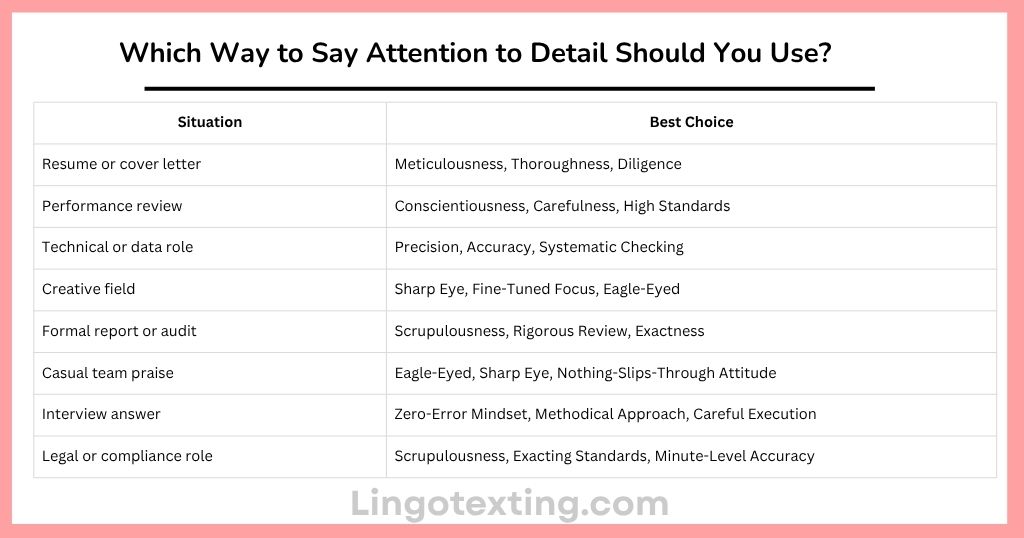
| Situation | Best Choice |
| Resume or cover letter | Meticulousness, Thoroughness, Diligence |
| Performance review | Conscientiousness, Carefulness, High Standards |
| Technical or data role | Precision, Accuracy, Systematic Checking |
| Creative field | Sharp Eye, Fine-Tuned Focus, Eagle-Eyed |
| Formal report or audit | Scrupulousness, Rigorous Review, Exactness |
| Casual team praise | Eagle-Eyed, Sharp Eye, Nothing-Slips-Through Attitude |
| Interview answer | Zero-Error Mindset, Methodical Approach, Careful Execution |
| Legal or compliance role | Scrupulousness, Exacting Standards, Minute-Level Accuracy |
Common Mistakes to Avoid
Mistake 1: Using “attention to detail” on every section of a resume
Repeating this phrase in your objective, skills section, and work experience makes it look like filler. Pick one strong alternative and let your examples do the rest.
Mistake 2: Choosing a word that doesn’t match the field
“Eagle-eyed” works in a creative team email. It does not belong in a medical report or a legal brief. Match the word to the setting.
Mistake 3: Using formal words in casual settings
Telling a colleague “I appreciate your scrupulousness” in a chat message sounds stiff. Say “You never miss a thing” instead.
Mistake 4: Using these phrases without proof
Saying you have “meticulous attention to detail” means nothing without an example. Always follow the phrase with evidence.
Way to Say Attention to Detail in Real-World Examples
Resume bullet point: “Brought a zero-error mindset to monthly financial reporting, cutting discrepancies by 30% over six months.”
Performance review comment: “Her conscientiousness in client communication has directly improved our satisfaction scores.”
Cover letter line: “I approach every deliverable with careful execution, which is why my work rarely needs major revision.”
Team email: “Just wanted to say — your eagle-eyed review of the deck saved us from a pretty embarrassing slide error. Thank you.”
Self-evaluation: “This year I worked on developing a more methodical approach to quality checking, which helped reduce rework significantly.”
Manager feedback: “The team’s systematic checking during the product rollout is what kept us on schedule.”
Read more:
26 Other Ways to Say “Looking Forward to Meeting You”
26 Other Ways to Say “Mark Your Calendars”
Final Thoughts
“Attention to detail” is a fine phrase. It does the job. But doing the job is not always enough.
When you replace it with a more specific, more vivid, or more context-fitting phrase, your writing gets stronger. Your resume stands out. Your review feels more genuine. Your email sounds more human.
Start with the situation. Then pick the phrase that fits the tone, audience, and purpose. That’s what good communication actually looks like — not finding a fancier word, but finding the right one.

I write clear, practical English lessons for everyday use. On Lingotexting, I break down grammar, vocabulary, and word types into simple ideas you can apply quickly. My focus is accuracy, real examples, and helpful visuals, so learners build confidence, improve writing, and communicate naturally in school, work, and daily life.