

“Keep up the good work” means: your work is good, and I want you to continue. It fits professional and casual settings equally. When it starts to feel overused or too generic, alternatives like “You’ve exceeded my expectations,” “Your effort is really showing,” or “You nailed it” feel more personal and land harder.
What Does “Keep Up the Good Work” Mean?
The phrase does two things at once. It approves what someone did. And it encourages them to continue at the same level.
It does not say what was good. It is intentionally broad. That is its strength in casual moments and its weakness in serious feedback situations.
People use it in:
- Emails and text messages
- Performance reviews
- Parent-teacher conversations
- Coaching and mentoring sessions
- Everyday workplace conversations
It works best when it is timely and sincere. It loses impact when it becomes a reflex — something typed at the end of every email without thought.
Grammar Notes
“Keep up the good work” vs “Keep up with the good work”
The correct phrase has no “with.” Adding “with” changes the meaning entirely. “Keep up with” means to stay current or not fall behind — that is different.
Comma before a name
- Wrong: “Keep up the good work Maria.”
- Correct: “Keep up the good work, Maria.”
In a sentence
- “I hope you keep up the good work this month.” — no capital K here.
33 Alternatives to “Keep Up the Good Work”
1. You’re on the Right Track
Meaning: You are moving in the correct direction. Keep going.
Tone: Encouraging, neutral, professional
Best for: Midway feedback, students, employees still in progress
- “You’re on the right track — just keep pushing forward.”
- “The first draft is solid. You’re on the right track.”
- “I can see the improvement. You’re on the right track.”
Use this when someone is still working toward a goal, not after they have already finished.
2. This Is Exactly What I Was Looking For
Meaning: The work matched expectations completely.
Tone: Warm, specific, professional
Best for: Client feedback, project deliverables, academic submissions
- “This is exactly what I was looking for. Well done.”
- “You nailed the brief. This is exactly what I was looking for.”
- “No changes needed — this is exactly what I was looking for.”
This feels more personal than a generic compliment because it shows the person hit a specific target.
3. Your Effort Is Really Showing
Meaning: I can see how hard you worked, not just the result.
Tone: Warm, personal, sincere
Best for: Students, creative workers, early-career employees
- “Your effort is really showing in this report.”
- “The detail in here tells me your effort is really showing.”
- “I noticed how much time you put in — your effort is really showing.”
Use this when you want to recognize the process, not just the output.
4. You’re Doing a Fantastic Job
Meaning: Your overall performance is excellent.
Tone: Friendly, enthusiastic, semi-informal
Best for: Casual workplaces, team chats, encouraging texts
- “You’re doing a fantastic job this quarter.”
- “Honestly, you’re doing a fantastic job with this client.”
- “Everyone on the team thinks you’re doing a fantastic job.”
In very formal settings, “Your performance has been outstanding” fits better.
5. I’m Really Impressed
Meaning: This went beyond what I expected.
Tone: Genuine, warm, slightly personal
Best for: Standout work, first-time achievements, surprise moments
- “I’m really impressed with how you handled that meeting.”
- “I’m really impressed — this is better than I expected.”
- “You put a lot into this. I’m really impressed.”
Do not overuse this phrase or it loses its weight quickly.
6. Keep It Up
Meaning: Continue exactly what you are doing.
Tone: Short, casual, punchy
Best for: Texts, quick verbal feedback, informal emails
- “Great session today. Keep it up!”
- “You’ve been consistent all month. Keep it up.”
- “That presentation was strong. Keep it up.”
This is the most condensed version of “keep up the good work.” Best when you want to sound quick and direct.
7. You’re Really Growing
Meaning: I can see real development in you over time.
Tone: Personal, supportive, thoughtful
Best for: Mentors, coaches, parents, teachers
- “You’re really growing as a writer.”
- “Each month I see something new in your work. You’re really growing.”
- “You’re really growing in how you handle pressure.”
This focuses on the person, not just the task. It feels deeper than surface-level praise.
8. This Work Speaks for Itself
Meaning: The quality is clear without needing explanation.
Tone: Confident, respectful, professional
Best for: Creative work, client deliverables, portfolio submissions
- “This work speaks for itself — outstanding.”
- “I was going to leave notes, but this work speaks for itself.”
- “Send this to the client. This work speaks for itself.”
9. I Couldn’t Have Done This Better Myself
Meaning: The quality is at or above my own standard.
Tone: High praise, personal, warm
Best for: Trusted team members, skilled professionals, mentees who have visibly grown
- “This report is excellent. I couldn’t have done this better myself.”
- “You really took ownership here. I couldn’t have done this better myself.”
- “The research depth alone — I couldn’t have done this better myself.”
Save this for genuinely impressive moments. It carries real weight.
10. You Outdid Yourself
Meaning: This is better than your usual standard.
Tone: Enthusiastic, warm, friendly
Best for: Someone who consistently performs well but just delivered something exceptional
- “This design is incredible. You outdid yourself.”
- “The whole event ran perfectly. You outdid yourself.”
- “I knew you were good, but this time you outdid yourself.”
11. I Appreciate Your Dedication
Meaning: I notice and value the commitment you bring to your work.
Tone: Professional, respectful, sincere
Best for: Work emails, performance appraisals, formal recognition
- “I appreciate your dedication to this project.”
- “Over the past month, I really appreciate your dedication.”
- “I appreciate your dedication — it does not go unnoticed.”
This sounds more mature and considered than “good job.”
12. You’re Setting a Great Example
Meaning: Others can learn from how you are working.
Tone: Leadership-focused, motivating, professional
Best for: Experienced employees, team leads, role models within a group
- “You’re setting a great example for the rest of the team.”
- “The way you handled that complaint — you’re setting a great example.”
- “New people are watching how you work. You’re setting a great example.”
13. This Is Top-Quality Work
Meaning: The work meets the highest standard.
Tone: Formal, direct, professional
Best for: Client communication, formal emails, written appraisals
- “I reviewed everything. This is top-quality work.”
- “We can send this straight to the client — this is top-quality work.”
- “Every section is well-done. This is top-quality work.”
14. You’ve Exceeded My Expectations
Meaning: The result went beyond what I thought you would deliver.
Tone: Formal, high praise, professional
Best for: Performance reviews, completed project feedback, formal recognition
- “You’ve exceeded my expectations on this one.”
- “I gave you a tough brief and you’ve exceeded my expectations.”
- “The final result clearly shows you’ve exceeded my expectations.”
One of the strongest professional compliments. Use it when you genuinely mean it.
15. I’m Proud of What You’ve Accomplished
Meaning: Your achievement carries personal meaning to me.
Tone: Warm, emotional, personal
Best for: Parents, mentors, close colleagues, friends
- “I’m proud of what you’ve accomplished this year.”
- “Watching your growth — I’m proud of what you’ve accomplished.”
- “You came so far from where you started. I’m proud of what you’ve accomplished.”
In strictly professional settings, gauge your relationship before using this. It can occasionally feel too personal with someone you do not know well.
16. You’re Killing It
Meaning: You are performing exceptionally well.
Tone: Very casual, modern, enthusiastic
Best for: Friends, informal teams, group chats
- “New job, new city — and you’re killing it.”
- “Three sales in one day? You’re killing it.”
- “Whatever you’re doing right now, keep doing it — you’re killing it.”
Not appropriate in formal emails, client communication, or performance documents.
17. The Results Speak for Themselves
Meaning: The numbers or outcomes show clearly how well you performed.
Tone: Data-focused, confident, professional
Best for: Business reviews, sales teams, outcome-based evaluations
- “You hit every target this quarter. The results speak for themselves.”
- “No long discussion needed — the results speak for themselves.”
- “Look at the numbers. The results speak for themselves.”
18. You’re Making Real Progress
Meaning: I can see clear, measurable improvement.
Tone: Encouraging, neutral, supportive
Best for: Long-term projects, skill development, ongoing learning
- “Week by week, you’re making real progress.”
- “You’re making real progress with your writing.”
- “The difference from month one to now — you’re making real progress.”
19. Your Consistency Is Commendable
Meaning: You do not just perform well once — you do it repeatedly, and that matters.
Tone: Formal, respectful, professional
Best for: Performance reviews, long-term employees, formal recognition letters
- “Your consistency is commendable — you deliver every time.”
- “Among the whole team, your consistency is commendable.”
- “This is not about one good project — your consistency is commendable.”
This stands out in formal reviews because it recognizes reliability over time, not just a single win.
20. You Nailed It
Meaning: You did this perfectly.
Tone: Casual, upbeat, direct
Best for: Quick praise, team messages, texts
- “That presentation? You nailed it.”
- “I wasn’t sure how it would go, but you nailed it.”
- “Every point landed exactly right. You nailed it.”
21. You’re a Natural at This
Meaning: You seem like you were made for this kind of work.
Tone: Warm, personal, complimentary
Best for: Someone discovering a new skill, a new hire who adapts quickly
- “You’re a natural at this — it doesn’t even look hard for you.”
- “Three weeks in and you’re a natural at this.”
- “Most people struggle here. You’re a natural at this.”
22. I Knew You Could Do It
Meaning: I believed in you before the result, and you proved it.
Tone: Personal, motivating, warm
Best for: Someone who doubted themselves before achieving something
- “You were nervous, but I knew you could do it.”
- “All that doubt — look at this now. I knew you could do it.”
- “Nobody else was sure, but I knew you could do it.”
23. You’re Crushing It
Meaning: You are performing at an exceptional level, often beyond expectations.
Tone: Very casual, modern, high energy
Best for: Friends, young teams, social media comments
- “New role, new team — and you’re crushing it.”
- “Every target this month — you’re crushing it.”
- “Whatever shift you made recently, it’s working. You’re crushing it.”
Same rules as “you’re killing it” — keep it out of formal contexts.
24. That Was Impressive Work
Meaning: A direct compliment focused on a specific task or deliverable.
Tone: Professional, clear, respectful
Best for: Post-meeting messages, written feedback, follow-up emails
- “That was impressive work on the client pitch.”
- “I want to say — that was impressive work from everyone in the room.”
- “Looking back at this project, that was impressive work throughout.”
25. You’re Proving Yourself Every Day
Meaning: Each day you demonstrate what you are capable of.
Tone: Motivating, personal, long-term focused
Best for: New hires, people returning after a difficult period, ongoing mentorship
- “You came in quietly, but you’re proving yourself every day.”
- “The team sees it — you’re proving yourself every day.”
- “You don’t need to say anything. You’re proving yourself every day.”
26. This Shows What You’re Capable Of
Meaning: This work reveals your real potential.
Tone: Encouraging, forward-looking, sincere
Best for: Someone who has not consistently shown their best yet
- “This shows what you’re capable of when you focus.”
- “I hope this reminds you what you’re capable of.”
- “One project like this shows what you’re capable of long-term.”
27. Beautifully Done
Meaning: The work was executed with care, skill, and real quality.
Tone: Warm, slightly expressive, professional
Best for: Creative work, writing, design, teaching
- “Beautifully done — this is the standard we’re aiming for.”
- “The structure, the detail, the clarity — beautifully done.”
- “I read through this twice. Beautifully done.”
28. I’m Glad You’re on the Team
Meaning: Your presence and contribution make a real difference.
Tone: Personal, inclusive, warm
Best for: Team settings, colleague appreciation, informal team emails
- “Weeks like this remind me — I’m glad you’re on the team.”
- “You handled everything calmly and skillfully. I’m glad you’re on the team.”
- “We needed someone like you here. I’m glad you’re on the team.”
29. Well Done, Seriously
Meaning: A sincere, slightly emphasized version of “well done.”
Tone: Direct, genuine, unpretentious
Best for: Moments when you want to sound real, not scripted
- “Well done, seriously — that could not have gone better.”
- “Well done, seriously. You put a lot into this and it shows.”
- “No notes. Well done, seriously.”
The word “seriously” makes this sound human and unscripted. That one word changes the whole feel.
30. You’re Getting Better and Better
Meaning: Each attempt is an improvement over the last.
Tone: Encouraging, positive, growth-focused
Best for: Learners, students, people developing a new skill
- “Every week you bring something new. You’re getting better and better.”
- “Your writing — you’re getting better and better with each draft.”
- “I compare this to three months ago and you’re getting better and better.”
31. This Is the Standard I Wanted
Meaning: The work matches exactly what I was aiming for.
Tone: Professional, clear, direct
Best for: Managers giving feedback, clients reviewing deliverables
- “This is the standard I wanted. Use this as your benchmark.”
- “Finally — this is the standard I wanted from day one.”
- “No revisions. This is the standard I wanted.”
32. You Should Be Proud of This
Meaning: Your work deserves personal pride, not just external praise.
Tone: Warm, personal, sincere
Best for: Students, creative professionals, personal milestones
- “Look at what you built. You should be proud of this.”
- “You put months into this. You should be proud of this.”
- “Not everyone could have done this. You should be proud of this.”
This shifts recognition inward. Instead of you praising them, you are reminding them to value themselves.
33. This Is Just the Beginning
Meaning: What you have done is great — and even better things are ahead.
Tone: Motivating, forward-looking, inspiring
Best for: After a major milestone, first big success, or a personal breakthrough
- “You finished your first big project. This is just the beginning.”
- “The team noticed what you did. This is just the beginning.”
- “You proved you can do it. Now this is just the beginning.”
Read also: 30 Ways to Say “Have a Safe Trip” (With Examples)
Keep Up the Good Work Quick Comparison: Tone at a Glance
| Phrase | Tone | Professional | Casual |
| You’ve exceeded my expectations | Formal | ✓ | — |
| Your consistency is commendable | Formal | ✓ | — |
| I appreciate your dedication | Warm + formal | ✓ | — |
| This is top-quality work | Direct | ✓ | — |
| You outdid yourself | Enthusiastic | ✓ | ✓ |
| You nailed it | Upbeat | — | ✓ |
| You’re killing it | Very casual | — | ✓ |
| You’re crushing it | Very casual | — | ✓ |
| Keep it up | Quick | ✓ | ✓ |
| Well done, seriously | Genuine | ✓ | ✓ |
How to Reply When Someone Says Keep Up the Good Work
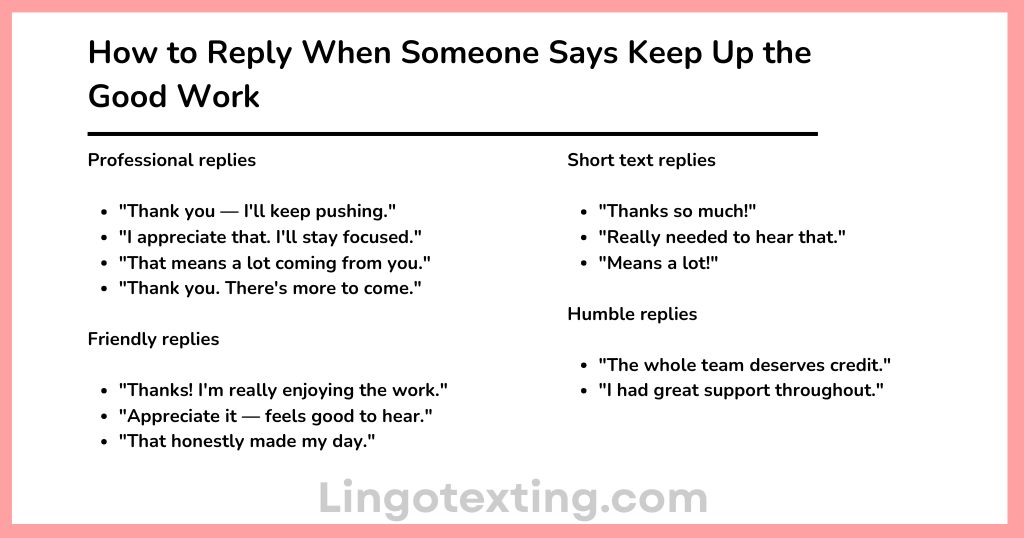
Professional replies
- “Thank you — I’ll keep pushing.”
- “I appreciate that. I’ll stay focused.”
- “That means a lot coming from you.”
- “Thank you. There’s more to come.”
Friendly replies
- “Thanks! I’m really enjoying the work.”
- “Appreciate it — feels good to hear.”
- “That honestly made my day.”
Short text replies
- “Thanks so much!”
- “Really needed to hear that.”
- “Means a lot!”
Humble replies
- “The whole team deserves credit.”
- “I had great support throughout.”
Keep Up the Good Work in Real-Life Examples
Manager to employee — email
“I reviewed the Q2 report. This is top-quality work — thorough, organized, and clearly written. You’ve exceeded my expectations. I appreciate your dedication.”
Teacher to student — written feedback
“Your essay shows strong thinking and good structure. You’re making real progress as a writer. You should be proud of this.”
Friend — text message
“You’ve been training every single day. You’re killing it. Seriously.”
Parent to child
“I watched your recital today and I’m proud of what you’ve accomplished. All that practice really showed. You outdid yourself.”
Colleague in a team meeting
“Before we move on — the way you handled the client call yesterday was impressive. You nailed it.”
Common Mistakes to Avoid about Keep Up the Good Work
Using it after every email
When every message ends with “keep up the good work,” people stop reading it as meaningful. It becomes background noise.
- Weak: “Thanks for sending the file. Keep up the good work.”
- Better: “Thanks for getting this over so quickly — that kind of reliability really helps the team.”
Praising without knowing what was good
Generic praise with no backing sounds hollow. If you cannot say what was good specifically, do not say it was great.
- Weak: “Great job on everything.”
- Better: “The way you handled the client’s objections in that call was really skilled.”
Using casual praise in formal documents
- Wrong in a formal review: “You’re crushing it this year.”
- Right: “Your performance this year has consistently exceeded targets.”
Forgetting the comma before a name
- Wrong: “Keep up the good work Maria.”
- Correct: “Keep up the good work, Maria.”
Tips for Choosing the Right Phrase
Think about your relationship first. A message to a close colleague can be warmer and less formal than one to a client or senior leader.
Match the phrase to what actually happened. If the work was genuinely exceptional, say something that matches that. If it was steady and reliable, “your consistency is commendable” fits better than “you’re crushing it.”
Think about the channel. Texts can be short and casual. Emails should match the formality of the relationship. Verbal comments can be brief and direct.
Think about timing. Right after a big win, enthusiasm fits. In a quarterly review, specificity matters more than energy.
Read also:
38 Ways to Say “Hope You Are Doing Well”
31 Different Ways to Say Bro (With Meanings & Examples)
FAQs about Keep Up the Good Work
Is it okay to use “keep up the good work” in a formal email?
Yes. It is polite and professional in most email contexts. But in senior or high-stakes communication, pairing it with specific feedback sounds more thoughtful — for example: “Your dedication to this project has been evident throughout. Keep it up.”
What is the difference between “keep it up” and “keep up the good work”?
“Keep it up” is shorter and more casual — something said in passing or in a quick text. “Keep up the good work” is slightly more deliberate and works better in written communication. Both carry the same meaning, but the longer version has a bit more weight on paper.
Can I use these phrases when someone is still struggling?
Only if they are genuinely making progress. “You’re on the right track” and “you’re making real progress” work well for someone improving but not yet there. Saying “you outdid yourself” or “you’ve exceeded my expectations” to someone who is struggling reads as sarcastic or hollow. Match the praise to what is actually true.
Which phrase fits best in a performance review?
In a formal review, use phrases like “your performance has consistently exceeded targets,” “your consistency is commendable,” or “you have exceeded my expectations.” These feel measured, specific, and appropriate for a formal document.
Conclusion
“Keep up the good work” is not a bad phrase. It is just an easy one. The best encouragement shows someone that you noticed what they did and why it mattered.
The 33 alternatives in this article give you more precise, more personal, and more fitting options for almost any situation. Pick the one that matches your relationship, your tone, and the moment. Specific praise stays with people. The right words at the right time — that is what actually motivates someone to keep going.

I write clear, practical English lessons for everyday use. On Lingotexting, I break down grammar, vocabulary, and word types into simple ideas you can apply quickly. My focus is accuracy, real examples, and helpful visuals, so learners build confidence, improve writing, and communicate naturally in school, work, and daily life.